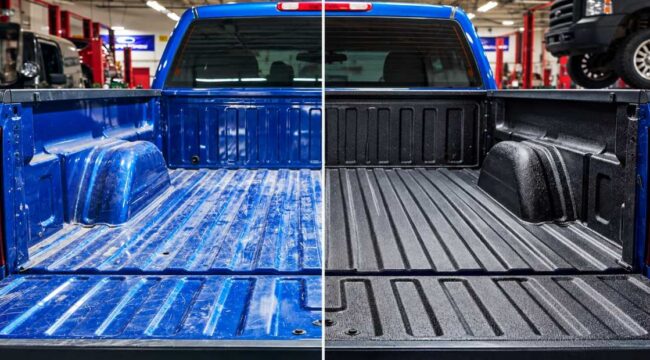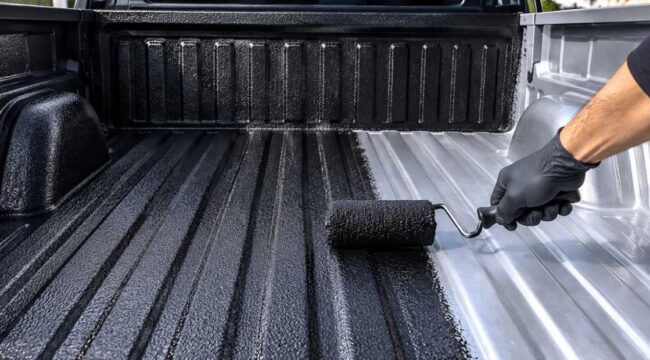
A roll-on truck bed liner is one of the simplest ways to add a permanent protective coating without taking the truck to a professional spray-in shop. Instead of using a spray gun, you apply the coating with a roller and brush after cleaning, scuffing, and masking the bed. That makes roll-on liners attractive to DIY truck owners who want to control the project and keep equipment requirements low.
The challenge is that roll-on bed liners are not all the same. Some use solvent-based polyurethane, some are water-based rubberized polyurethane coatings, and others use more specialized one- or two-component chemistry. Coverage can also vary dramatically, as can texture, curing time, surface preparation, and the amount of equipment included in the package.
For this guide, we focused specifically on roll-on truck-bed liner products and kits rather than treating every type of bed protection as interchangeable. We compared current product information, application methods, coverage, materials, preparation requirements, texture, and practical DIY considerations. We did not personally test these products, so recommendations are based on published manufacturer information and verified product listings rather than hands-on testing.
If you are comparing roll-on coating with a professional spray-in liner, the two approaches have different strengths. A roll-on system can be much easier to tackle at home, while a professionally sprayed liner can offer a more controlled finish and application process. For a broader look at spray-applied DIY options, see our guide to best spray-in bed liners.
Before buying any coating, check the exact product instructions and the condition of your truck bed. Existing rust, loose paint, previous bedliner material, aluminum surfaces, and other substrates can change the required preparation.
For a straightforward full-bed DIY project, the HERCULINER HCL1B8 Roll-on Bed Liner Kit is one of the most established choices because the one-gallon kit includes rollers and a brush and is specifically designed around roll-on application. The RAPTOR Roll-On Bed Liner Kit is another dedicated roll-on system and covers about 65 square feet in two coats according to current product information.
For a water-based option, Dupli-Color BAQ2010 Bed Armor is a quart-size coating that can make sense for smaller areas or owners who prefer water-based cleanup. POR-15 OEM Bed Liner is another water-based, rubberized coating that can be rolled on and is available in quart and gallon sizes.
For a lower-commitment quart-sized project, Rust-Oleum 342668 Truck Bed Coating is designed for application by brush, roller, or spray on properly prepared metal surfaces.
- Our Top Picks
- Roll-On vs. Spray-In Bed Liners
- Types of Roll-On Bed Liners
- How We Chose
- Detailed Reviews
- Roll-On Bed Liner Comparison
- How to Prepare a Truck Bed for a Roll-On Liner
- How to Apply a Roll-On Truck Bed Liner
- What to Consider Before Buying
- Coverage and Number of Coats
- Maintenance, Repairs, and Touch-Ups
- Common Roll-On Bed Liner Mistakes
- FAQs
Our Top Picks
These five products represent different approaches to roll-on truck bed protection. They are not identical formulas, so the best choice depends on the size of the project, the surface you are coating, the texture you want, and how much preparation and curing time you are willing to manage.
RAPTOR Roll-On Bed Liner KitDedicated one-gallon roll-on system
POR-15 OEM Bed LinerFlexible water-based coating
Dupli-Color BAQ2010 Bed ArmorWater-based quart option
Rust-Oleum 342668Quart-size brush or roller coating
Roll-On vs. Spray-In Bed Liners
The basic difference is how the coating reaches the truck bed. A roll-on liner is spread across the prepared surface with a roller, with a brush used for corners, seams, wheel wells, and other areas that are difficult to reach cleanly. A spray-in liner uses a spray gun or aerosol system to atomize the coating.
Why choose a roll-on liner?
The biggest advantage is equipment. A dedicated roll-on product does not require a compressor, spray gun, spray booth, or the same type of spray setup required by many spray-applied systems. You still need proper ventilation, protective equipment, masking materials, and preparation supplies, but the application itself is familiar to anyone who has painted a large surface with a roller.
Roll-on products can also be easier to control on a small project. If you are coating a tailgate, trailer floor, toolbox, rocker panel, or a section of a truck bed, you can buy a smaller quantity and work at your own pace. The downside is that the finish can depend more heavily on roller technique. Lap marks, uneven texture, trapped debris, and inconsistent thickness are possible if the coating is applied carelessly.
What does spray-in do better?
Spray application can produce a more uniform texture when the equipment, pressure, material, and technique are properly controlled. It can also make it easier to cover complex contours and large areas quickly. Professional spray-in installations are particularly different because the installer controls the surface preparation and application environment.
A roll-on product should therefore not be sold as automatically equivalent to a professional spray-in installation. The real benefit is value and accessibility: you can apply a protective coating yourself without specialized spraying equipment.
When roll-on is the better fit
- You want to complete the project yourself.
- You do not own a compressor or spray gun.
- You are comfortable spending time on surface preparation.
- You need to coat a small or medium-size area.
- You want a textured, functional finish rather than a perfectly uniform cosmetic finish.
Types of Roll-On Bed Liners
Looking only at the word “bedliner” can hide meaningful differences in chemistry. The following categories are more useful when deciding what to buy.
Solvent-based polyurethane and rubber-granule coatings
Products such as the original Herculiner use a solvent-based protective coating with polyurethane and rubber granules. The resulting surface is designed to be textured and skid-resistant. Herculiner specifically describes its formula as bonding to multiple substrates and curing stronger than a water-based product. The trade-off is that solvent-based coatings require careful ventilation and appropriate protective equipment during application.
One-part roll-on coatings
One-part products are attractive because there is no separate activator to mix. That can simplify the project and remove one common source of application error. The RAPTOR Roll-On Bed Liner Kit is a dedicated one-part roll-on system, with the coating supplied with roller accessories for the application process.
Water-based rubberized polyurethane coatings
Water-based formulas can be appealing when lower odor and easier cleanup are important. Dupli-Color Bed Armor and POR-15 OEM Bed Liner are examples of coatings in this broad category. Water-based does not mean the finished product is simply paint, but it does change the application and cleanup experience compared with solvent-heavy systems.
Quart-size coatings for smaller projects
A full gallon is not always the sensible purchase. If you are repairing a small damaged section, coating a tailgate, refreshing a toolbox, or protecting a smaller project, a quart can reduce waste. The important calculation is coverage per coat and the number of coats recommended by the manufacturer. Buying by container size alone can be misleading.
How We Chose
We focused on products that genuinely belong in a roll-on truck bed liner comparison rather than adding spray-only kits simply because they are popular in the broader bedliner category.
Our comparison considered:
- Application method: the product must be suitable for roller application and relevant to a DIY roll-on project.
- Formula: whether the coating is solvent-based, water-based, one-part, or otherwise differentiated.
- Coverage: published coverage information and whether the product is intended for a full bed or smaller project.
- Included equipment: whether rollers, brushes, trays, or other application items are supplied.
- Surface compatibility: the materials the manufacturer says the coating can be used on.
- Texture and finish: whether the result is intended to be textured, non-skid, flexible, or rubberized.
- Preparation: cleaning, sanding, scuffing, priming, and other steps that can affect adhesion.
- DIY practicality: how much equipment, mixing, and project management the product requires.
We did not use personal test results, invented durability scores, or unsupported claims about how long a product will last on a particular truck. Bed condition, preparation, climate, cargo use, and application quality can all affect the finished result.
Detailed Reviews
1. HERCULINER HCL1B8 Roll-on Bed Liner Kit, Black, 1 Gal. — Established DIY Choice
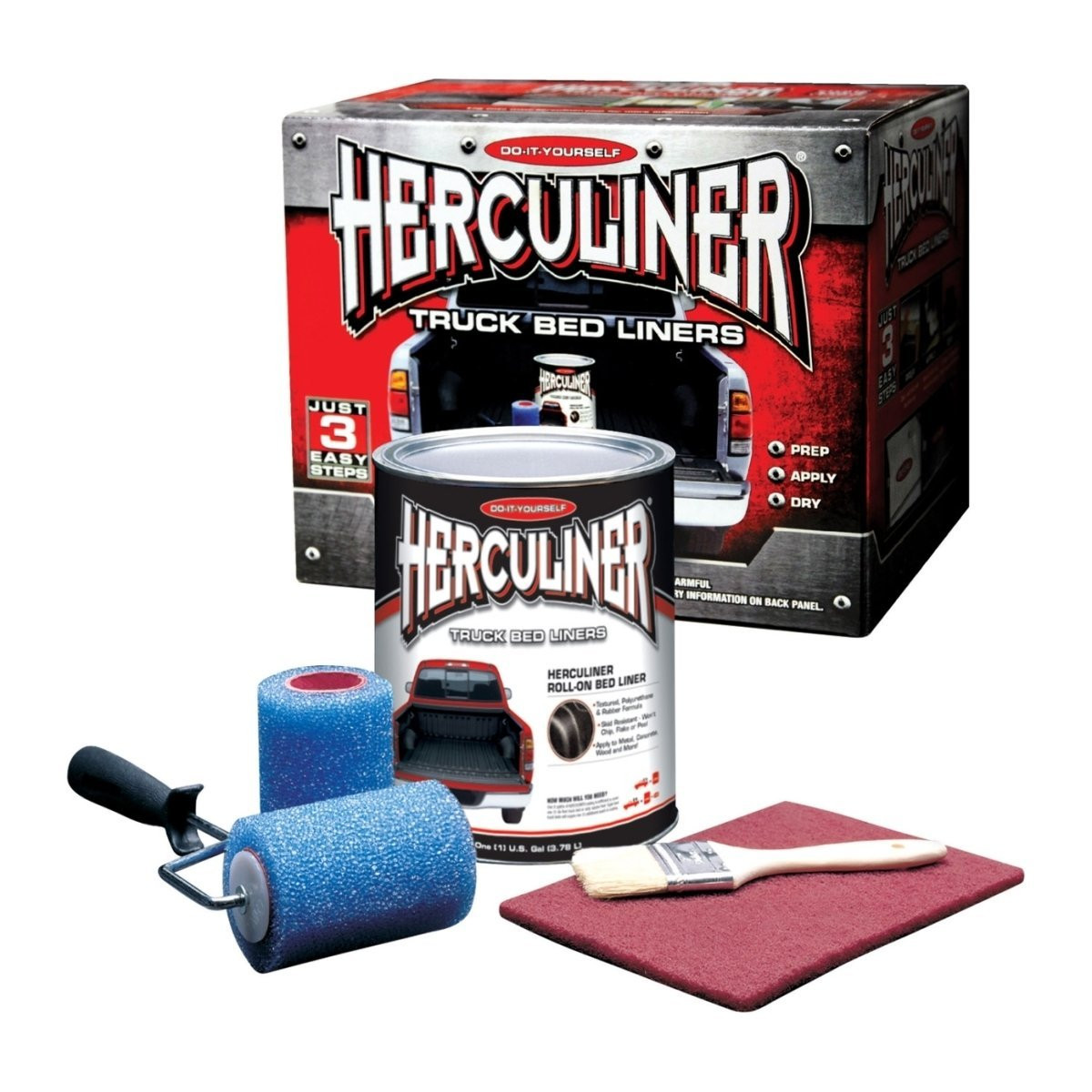
Herculiner is one of the most recognizable names in DIY roll-on bed liners, and the HCL1B8 kit is built specifically around a roller-and-brush application. The current manufacturer information identifies HCL1B8 as a one-gallon black kit containing the ready-to-use protective coating, an application brush, two rollers, and a roller handle. Herculiner says the kit covers one six-foot truck bed and notes that an additional quart is needed for an eight-foot bed.
The coating uses polyurethane and rubber granules to create a textured surface. Herculiner describes the cured finish as skid-resistant and says the coating can bond to surfaces including metal, aluminum, wood, fiberglass, rubber, and certain plastics. That broad substrate range makes the product useful beyond a conventional steel pickup bed, although the surface must still be prepared according to the instructions.
The application is relatively straightforward in concept: prepare the surface, apply the coating, and allow it to cure. The difficult part is not the roller itself. It is the preparation. A truck bed with old loose coating, grease, rust scale, or glossy paint is not a good candidate for simply rolling material over the top. The bed needs to be clean, sound, dry, and properly scuffed so the coating can bond.
Herculiner also lists a functional cure in roughly 10 to 12 hours and full cure in 24 hours. That does not mean the truck should automatically be loaded heavily as soon as the surface feels dry. Follow the current product instructions for the actual temperature and curing conditions of your project.
Who should consider it?
- First-time DIYers who want a dedicated roll-on kit.
- Owners coating a standard-size pickup bed.
- Buyers who want the rollers and brush included.
- Owners who prefer a pronounced textured, skid-resistant surface.
Who may want another option?
If lower odor and water cleanup are more important to you, a water-based product may be easier to live with during application. If you need a very large coverage area, compare the published coverage of the other gallon-size options before buying.
Pros
- Purpose-built roll-on kit
- One gallon supplied with rollers and brush
- Textured, skid-resistant finish
- Broad range of supported substrates
- Well-established DIY bedliner format
Cons
- One gallon is not the stated amount for an eight-foot bed
- Requires thorough preparation
- Solvent-based application requires careful ventilation
- Texture may be more aggressive than some owners prefer
2. RAPTOR Roll-On Bed Liner Kit, Black, 1 Gallon — Dedicated Roll-On System
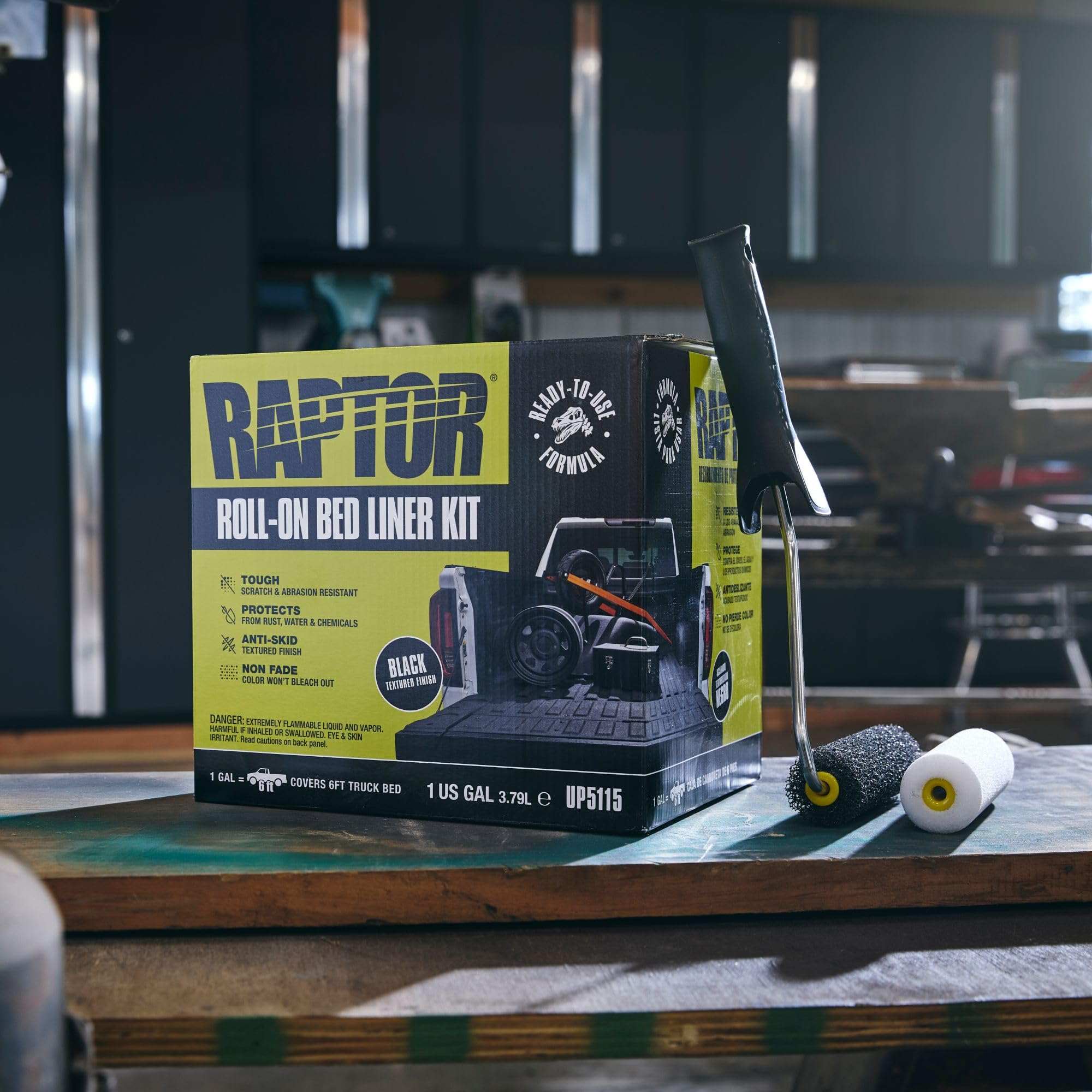
The RAPTOR Roll-On Bed Liner Kit is different from the better-known Raptor spray-applied kits. This specific product is a one-part roll-on system intended to be applied with rollers rather than a spray gun. That distinction matters because searching for Raptor bedliner products can otherwise lead to the wrong type of product for this article.
The current manufacturer listing identifies the kit as UP5115 and includes one U.S. gallon of black roll-on bed liner, a fine roller, a coarse roller, a roller handle, and an application brush. Raptor states that the coating is designed to resist impact, abrasion, scratches, rust, water damage, fuel, and chemical spillages. It also describes the finish as textured and anti-skid.
Coverage is one of the more useful reasons to consider this kit. Raptor lists coverage of about 65 square feet in two coats, which it relates to a six-foot truck bed. That number should still be treated as a planning figure rather than a guarantee. Rough surfaces, heavy texture, waste around edges, and application technique can all affect actual consumption.
The included fine and coarse rollers give the product a useful distinction from basic paint-style kits. The choice of roller can influence the final texture, so it is worth following the current instructions rather than assuming that either roller can be used interchangeably for every stage of the job.
Because it is a one-part coating, there is no separate hardener ratio to calculate. That simplifies the mixing side of the project. You still need to prepare the surface carefully and follow the manufacturer’s conditions for application and curing.
Who should consider it?
This is a good fit for a DIY owner who specifically wants a dedicated roll-on Raptor product, wants a gallon-size system, and likes the idea of having different roller textures supplied with the kit.
Who may want another option?
If you want the lowest-odor or easiest water cleanup experience, compare this with the water-based products in this guide. If your main project is only a small repair, a quart-size coating can be more practical.
Pros
- Dedicated roll-on Raptor product
- One-part application simplifies mixing
- Includes fine and coarse rollers
- About 65 sq. ft. in two coats according to the manufacturer
- Textured anti-skid finish
Cons
- Still requires substantial surface preparation
- Gallon size may be excessive for small repairs
- Final texture depends partly on application technique
- Exact curing conditions should be checked before use
3. POR-15 Bed Liner, 32 Fluid Ounces, Black — Flexible Water-Based Option
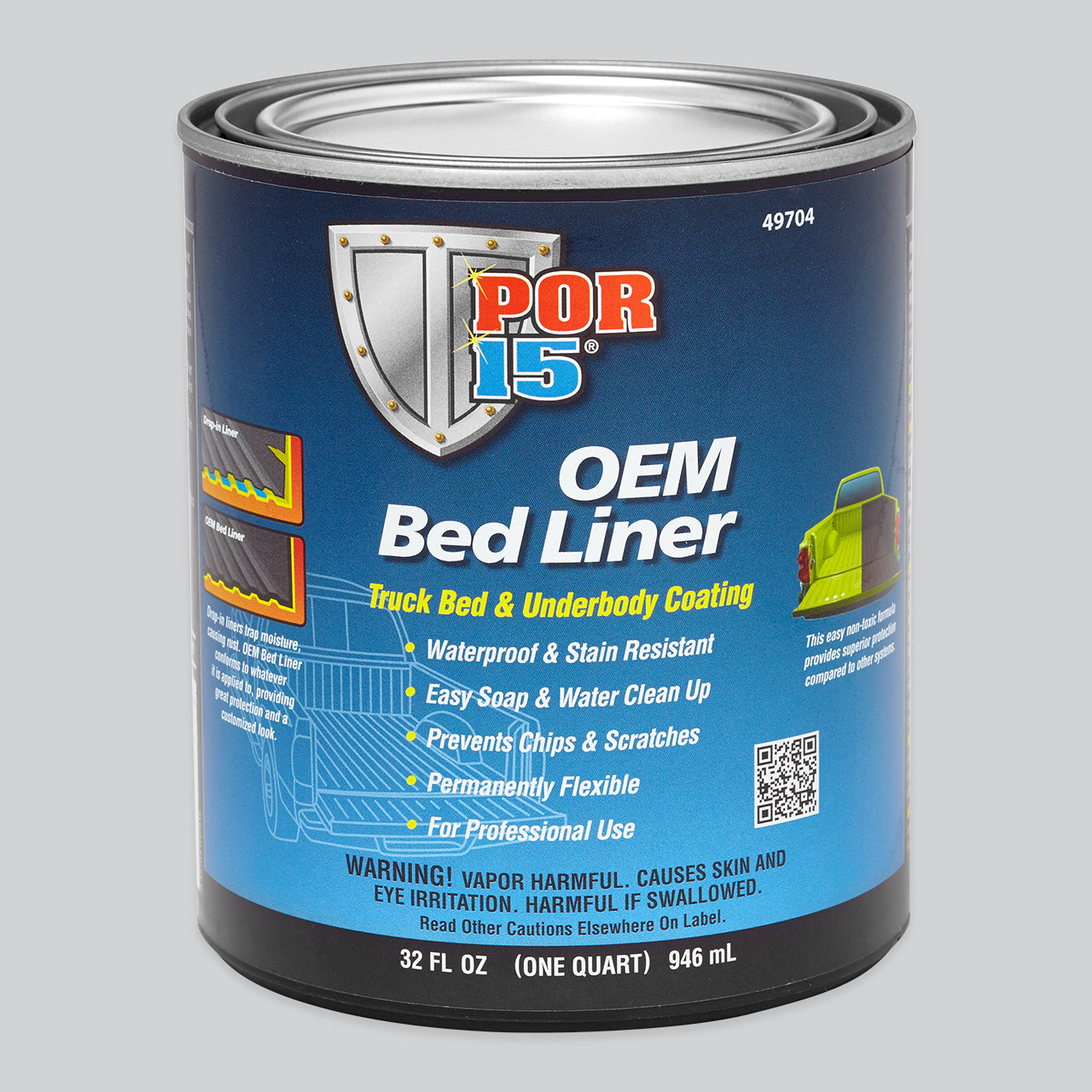
POR-15 OEM Bed Liner takes a different approach from a traditional solvent-heavy roll-on product. POR-15 describes it as a water-based, rubberized coating designed for truck beds and other surfaces exposed to impacts and scuffs. It can be brushed, rolled, or sprayed, which gives DIY users flexibility in how they apply it.
The manufacturer lists superior adhesion, impact resistance, flexibility, UV stability, and a textured gloss-black finish. It also describes the coating as low odor and says cleanup can be performed with soap and water. Those characteristics can make it attractive when the application environment is a bigger concern than simply maximizing the thickness of the coating.
The quart product is particularly interesting for smaller projects. POR-15 states that one gallon covers approximately 100 to 120 square feet and is enough for the recommended two coats on a standard six-foot truck bed. A quart therefore should be treated as a smaller-project quantity rather than assuming one quart will cover an entire pickup bed to the same standard.
POR-15 also lists uses beyond truck beds, including rocker panels, bumpers, trailers, bulkheads, fiberglass, aluminum, toolboxes, running boards, and work-van floors. For a truck owner who is restoring several surfaces at once, that versatility can be useful.
Surface preparation still matters. The manufacturer recommends appropriate cleaning and preparation before coating, and metal surfaces may require additional treatment depending on the system being used underneath. Do not interpret “water-based” as “no preparation required.” Adhesion is still determined by the condition and cleanliness of the substrate.
Who should consider it?
POR-15 is a sensible option for owners who value a flexible rubberized coating, want water-based cleanup, and may be coating several metal or composite surfaces rather than only the truck bed.
Who may want another option?
If you want a complete one-gallon roller kit with the application tools included, compare it with Herculiner or RAPTOR. If you need only a small section, the quart format can be an advantage rather than a drawback.
Pros
- Water-based rubberized coating
- Can be rolled, brushed, or sprayed
- Flexible textured finish
- UV-stable formula according to the manufacturer
- Soap-and-water cleanup
Cons
- Quart size is not intended to replace a gallon for a full two-coat bed
- Preparation is still important for adhesion
- Application tools are not the main focus of the quart package
- Glossy texture may not suit every truck owner
4. Dupli-Color BAQ2010 Bed Armor DIY Truck Bed Liner — Black, Quart
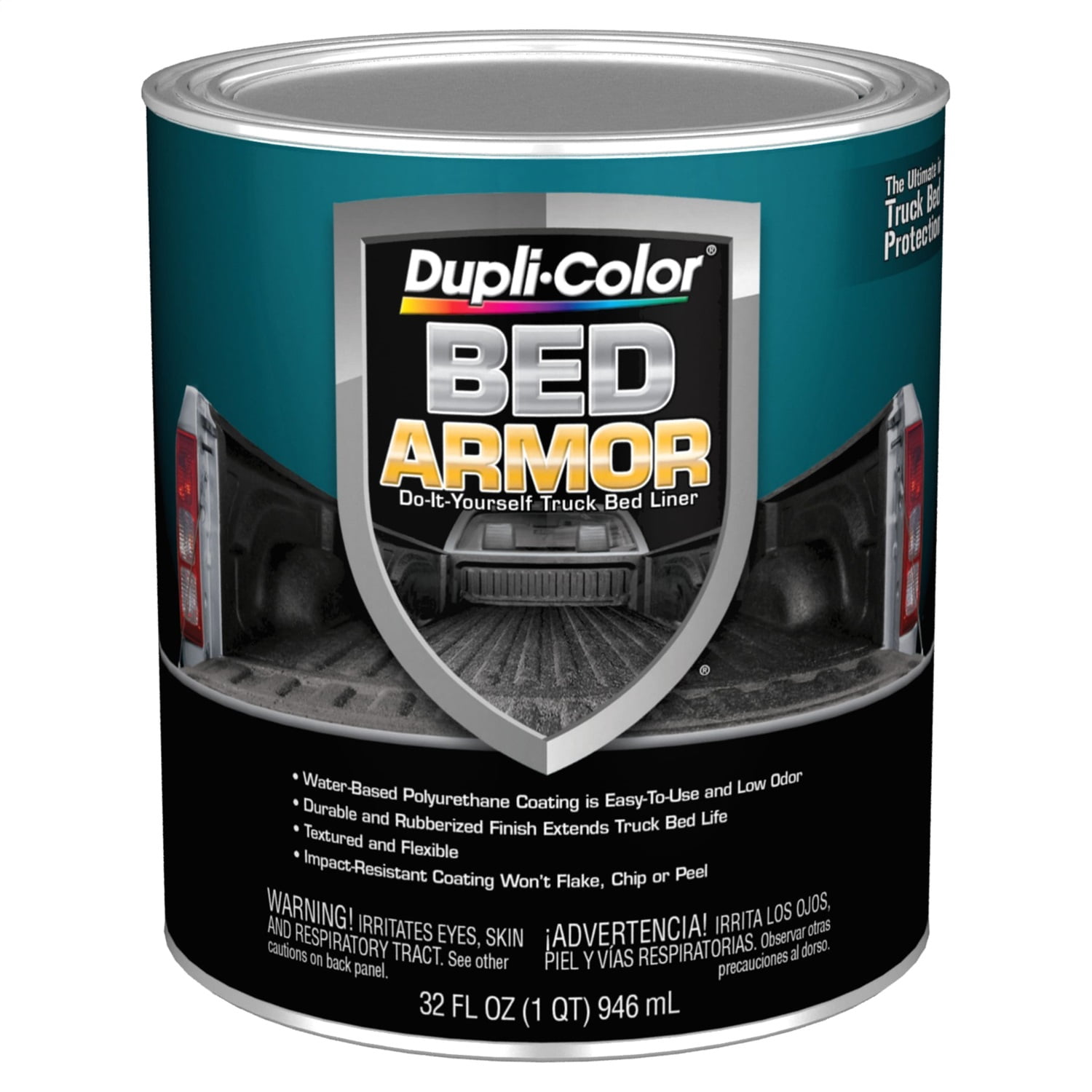
Dupli-Color Bed Armor is another water-based, rubberized polyurethane option. The BAQ2010 listing is the one-quart black coating, so it is important to distinguish it from the larger Bed Armor kit. The manufacturer catalog identifies BAQ2010 as the black quart sold separately from the gallon kit.
The Bed Armor formula is described as water-based polyurethane with rubber particles and DuPont Kevlar. Dupli-Color positions it for truck beds and other surfaces including metal, aluminum, fiberglass, and wood. The finished coating is textured and black satin rather than a smooth paint finish.
The main attraction of this particular Amazon listing is its size. A quart is much easier to justify for a smaller repair, tailgate, trailer section, toolbox, or other project where buying a full gallon would leave a large amount of material unused. If your goal is to coat an entire six-foot pickup bed, however, compare the required quantity carefully and consider the complete gallon kit instead of assuming one quart is enough.
Because it is water-based, cleanup is simpler than with many solvent-based coatings. Dupli-Color also describes the formula as low odor and says it has no working pot life, allowing unused material to be stored for later projects when properly handled.
The application process is familiar: prepare the surface, stir thoroughly, roll the coating across the prepared area, and use a brush around edges and corners. The exact number of coats and drying conditions should come from the current instructions for the product you receive.
Who should consider it?
BAQ2010 makes the most sense for owners working on a smaller area or for people who already have application tools and want a water-based quart coating rather than a complete gallon kit.
Who may want another option?
For a full pickup bed, the quart quantity can become inefficient if several containers are required. In that situation, compare the gallon Bed Armor kit or a gallon roll-on system instead.
Pros
- Water-based rubberized polyurethane
- Low-odor approach compared with solvent-heavy formulas
- Textured black satin finish
- Suitable for multiple substrates
- Useful quart size for smaller projects
Cons
- Quart size may be inefficient for a complete pickup bed
- Application tools are not the same as buying the full kit
- Requires careful preparation for adhesion
- Final texture depends on roller technique
5. Rust-Oleum 342668 Stops Rust Truck Bed Coating, 1 Quart, Black — Smaller Project Option
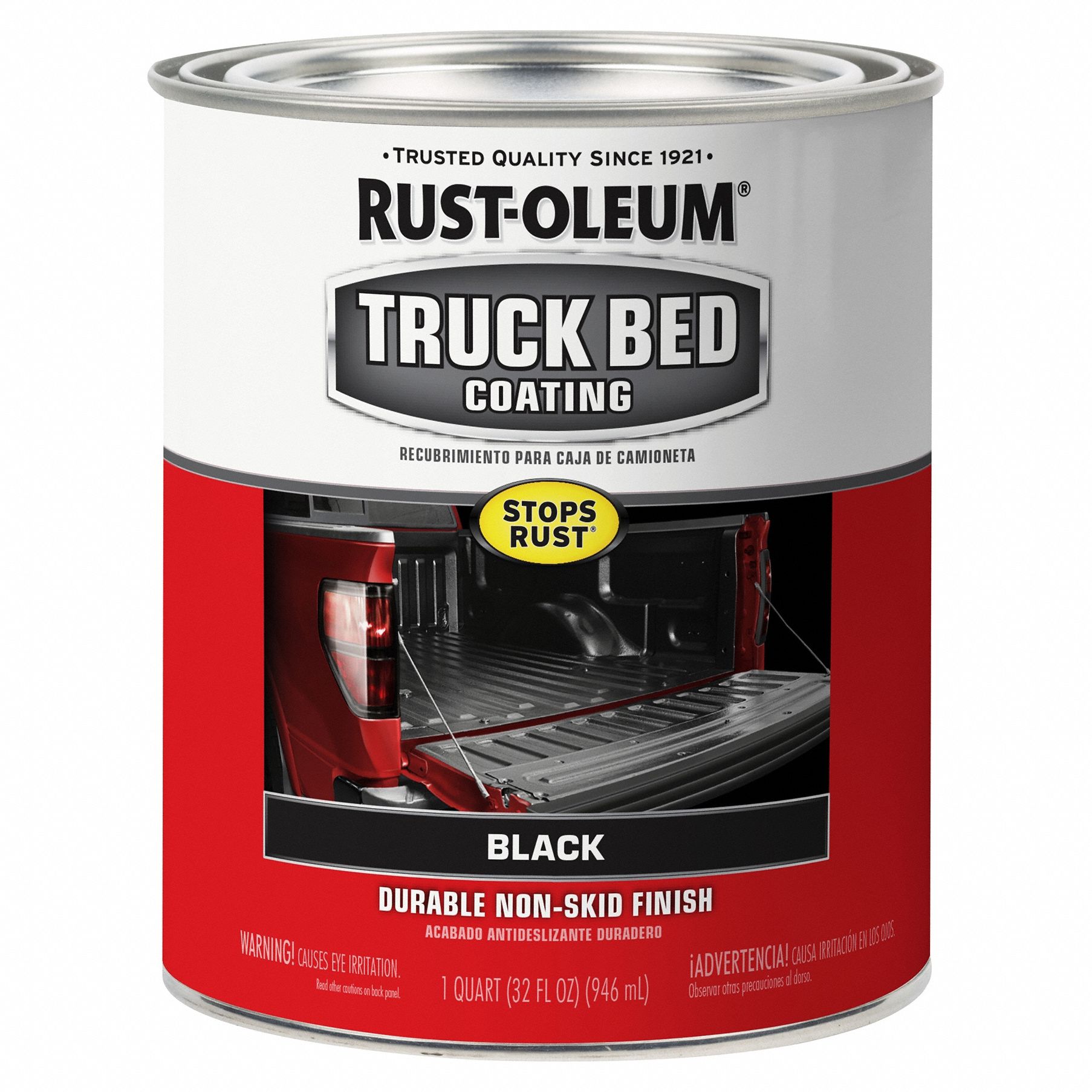
Rust-Oleum 342668 is a one-quart black truck bed coating intended for properly prepared metal truck beds and other metal automotive surfaces. The current technical information says it can be rolled, brushed, or sprayed, making it suitable for the roll-on approach covered here.
The formula is a ready-to-use black polymer coating that creates a textured protective surface. Rust-Oleum says the coating helps protect against scratches, rust, and weather and can be used on metal truck beds, bedrails, running boards, and other appropriate automotive surfaces. The current technical sheet lists a 60-120 grit preparation range for bare or rusted surfaces and recommends removing loose or peeling material from previously coated surfaces before sanding.
The quart size is the key reason to consider this product. Rust-Oleum lists both a one-quart and one-gallon version, so the smaller container can be useful for a partial restoration or a project where a full gallon is unnecessary. The manufacturer also states that two coats provide maximum durability and that the first coat dries to the touch in roughly two to four hours under suitable conditions.
Do not confuse touch-dry time with full readiness for heavy use. Rust-Oleum’s current technical information recommends at least 24 hours before light-duty use and up to five days for full cure for heavy-duty truck-bed use. Temperature and humidity can change the actual timeline.
Who should consider it?
This is a practical choice for a smaller metal-surface project, especially when you want a ready-to-use coating that can be rolled or brushed without mixing components.
Who may want another option?
If you are coating an entire truck bed with two coats, calculate the total required volume before ordering. A gallon kit can be more convenient and economical than trying to stretch several quarts over a large surface.
Pros
- Ready-to-use coating
- Roller, brush, or spray application
- Textured non-skid finish
- Quart size is useful for smaller projects
- Rust and abrasion protection focus
Cons
- One quart is not a full-bed solution for most larger pickups
- Designed primarily around metal surfaces
- Full heavy-duty cure takes longer than touch-dry time
- Surface preparation remains essential
Roll-On Bed Liner Comparison
The table below is intended to show the meaningful differences rather than create a false numerical ranking. Coverage figures are manufacturer or listing figures and should be treated as planning estimates because application thickness and surface condition affect actual consumption.
| Product | Type | Size | Application | Best Fit |
|---|---|---|---|---|
| Herculiner HCL1B8 | Polyurethane/rubber-granule coating | 1 gallon | Roller + brush | Full DIY pickup-bed projects |
| RAPTOR Roll-On | One-part roll-on liner | 1 gallon | Fine/coarse rollers + brush | Dedicated roll-on application |
| POR-15 OEM Bed Liner | Water-based rubberized coating | 1 quart | Roll, brush, or spray | Smaller jobs and multi-surface use |
| Dupli-Color BAQ2010 | Water-based rubberized polyurethane | 1 quart | Roller or brush | Smaller projects |
| Rust-Oleum 342668 | Ready-to-use polymer coating | 1 quart | Roll, brush, or spray | Metal-bed repairs and smaller areas |
How to Prepare a Truck Bed for a Roll-On Liner
Preparation is arguably the most important part of a roll-on bedliner project. A high-quality coating cannot compensate for grease, loose paint, active rust scale, or a glossy surface that gives the coating little to grip.
1. Empty and inspect the bed
Remove cargo, mats, accessories, tie-down hardware that interferes with the coating, and anything else that can trap dirt. Inspect the bed floor, sidewalls, wheel wells, seams, drain areas, and tailgate. Pay particular attention to rust-through, deep corrosion, loose factory coating, and previous bedliner material that is lifting.
2. Repair structural problems first
A bedliner is a protective coating, not a substitute for repairing rotten metal. If the bed has holes, severe corrosion, cracked seams, or structural damage, deal with those issues before coating. Rolling a liner over a damaged surface may hide the problem without fixing it.
3. Degrease and wash
Remove oil, grease, wax, dirt, road film, and other contaminants using the cleaning method specified by the product manufacturer. Rinse and allow the surface to dry completely. Water trapped in seams or drain channels can become a problem if coating is applied too soon.
4. Remove loose material
Wire-brush or otherwise remove loose rust and peeling paint. The goal is a sound surface, not simply a darker surface. Any coating that is already failing can become the weak layer beneath the new liner.
5. Scuff the surface
Follow the abrasive grade specified by your product. Rust-Oleum’s current technical information, for example, calls for 60-120 grit preparation on applicable bare or rusted surfaces. Other products may specify different preparation. The exact instructions for the coating you buy should take priority.
6. Mask carefully
Mask bed rails, tailgate hardware, drain plugs, wiring, factory trim, lights, and other areas that should remain uncoated. Roll-on material is thick and textured, so trying to remove dried overspray or drips later is much harder than masking properly at the start.
7. Do a final inspection
Before opening the coating, look across the bed from several angles. Dust, sanding residue, loose fibers, and small pieces of tape can ruin the finish. Make sure the surface is clean, dry, and ready before mixing or pouring anything.
How to Apply a Roll-On Truck Bed Liner
Step 1: Read the current instructions
Do not assume all roll-on products have the same drying time, coat thickness, temperature range, or surface-preparation requirements. Read the instructions for the exact product and container size you purchased.
Step 2: Stir thoroughly
Textured coatings can contain particles that settle during storage. Stir according to the manufacturer’s instructions before and during application. Do not add solvents, water, tint, or other materials unless the product specifically allows it.
Step 3: Cut in the edges
Use the brush to reach corners, seams, wheel-well transitions, and other areas where a roller cannot produce controlled coverage. Keep the brush application consistent with the thickness you plan to roll.
Step 4: Roll the main surfaces
Work in manageable sections rather than pouring coating over the entire bed at once. Keep a consistent wet edge and avoid repeatedly rolling an area after the material has started to set. Excessive back-and-forth movement can disturb the texture and produce an uneven finish.
Step 5: Watch the edges and ribs
Truck beds contain ribs, corners, wheel wells, and vertical panels that consume more attention than a flat floor. Make sure coating is not collecting in low points while raised ribs remain thin. Check the sidewalls from different angles as you work.
Step 6: Apply additional coats only as directed
Many roll-on systems rely on more than one coat for the intended build and protection. Do not rush the second coat. The first coat needs to reach the condition specified by the manufacturer before another layer is applied.
Step 7: Respect the cure time
The most common DIY mistake is treating “dry to the touch” as “ready for heavy hauling.” Those are different milestones. Keep cargo, tools, and abrasive materials out of the bed until the product instructions say the coating is ready for the intended use.
What to Consider Before Buying
Full bed or smaller repair?
Start with the size of the project. A one-gallon kit makes more sense for a full six-foot bed than a quart product, while a quart can be a better choice for a tailgate, partial repair, trailer section, or toolbox. Measure the areas you actually intend to coat instead of buying based only on the word “gallon.”
What surface are you coating?
Check whether the product is intended for steel, aluminum, painted metal, fiberglass, wood, or other substrates. Do not assume that a product suitable for a steel pickup bed is automatically approved for every surface in your project.
How aggressive should the texture be?
A heavily textured surface can provide useful grip, but it can also be harder to clean. A very rough finish can catch dirt, sawdust, gravel, and other debris. If you regularly slide expensive cargo across the bed, think about whether maximum grip or easier loading is more important to you.
Do you want water-based cleanup?
Water-based formulas can simplify cleanup and may be more comfortable to use in some DIY environments. Solvent-based coatings can offer different characteristics and may be chosen for their chemistry and cured finish. Neither label alone determines the quality of the finished bed; application and surface preparation still matter.
How much preparation are you willing to do?
Every roll-on liner becomes a preparation project once you include cleaning, sanding, masking, drying, and inspection. If you are looking for a quick cosmetic change with minimal preparation, a roll-on bedliner may not be the right project.
Where will you apply it?
Ventilation is important. Some coatings have strong vapors and require protective equipment. Follow the product safety sheet and application instructions. If you cannot provide a safe, well-ventilated working environment, consider having the job done professionally.
What will you haul?
A weekend-use truck that carries coolers and camping gear does not place the same demands on a liner as a work truck that regularly carries concrete blocks, scrap metal, tools, or landscaping material. Your cargo determines how much emphasis you should place on abrasion resistance, texture, repairability, and coating build.
Coverage and Number of Coats
Coverage is one of the easiest specifications to misunderstand. A manufacturer may publish a coverage figure for a specific number of coats, while an online listing may quote a different number based on a thinner application. Those figures are not necessarily contradictory.
Herculiner currently states that its one-gallon HCL1B8 kit covers one six-foot truck bed and that an additional quart is needed for an eight-foot bed. RAPTOR lists about 65 square feet in two coats for its roll-on kit. POR-15 states that one gallon of OEM Bed Liner covers approximately 100-120 square feet and is enough for two coats on a standard six-foot truck bed. Rust-Oleum publishes separate coverage and application guidance for its 342668 product.
The practical lesson is to calculate your project around the manufacturer’s recommended application thickness, not the maximum theoretical spread rate. A rough bed, deep texture, wheel wells, tailgate, and careful edge coverage all consume material. It is usually better to have enough coating to complete the recommended coats than to buy the minimum quantity and end up trying to stretch the final section.
Should you apply two coats?
If the product instructions call for two coats, follow them. Additional material can improve build and consistency, but more is not automatically better. Thick puddles can dry unevenly and may create a different texture from the rest of the bed. The goal is an even coating at the thickness specified by the manufacturer.
Maintenance, Repairs, and Touch-Ups
A roll-on liner is not maintenance-free simply because it is tough. Keep the bed reasonably clean so abrasive debris does not stay trapped in the texture. A textured coating can hold dirt more readily than a smooth painted surface, so periodic washing helps keep the finish usable.
Cleaning
Use the cleaning method recommended by the product manufacturer. Avoid aggressive chemicals unless the coating documentation says they are compatible. If the liner is designed for soap-and-water cleaning, start with that rather than reaching immediately for a strong solvent.
Small scratches and worn areas
Minor wear does not always mean the entire bed needs to be recoated. Clean and inspect the affected area, remove loose coating, lightly abrade where required, and use the same product or a compatible repair system according to its instructions. A touch-up can be much easier when you have retained some of the original coating.
Peeling is a different problem
If the liner is peeling in large sections, do not simply roll more material over the loose edges. The failing layer has to be removed or stabilized before a new coating can bond reliably. Large-scale peeling is often a sign that the original surface preparation was inadequate or that the substrate underneath is compromised.
Protect the edges
The bed rails, tailgate lip, and high-contact areas can receive more abuse than the middle of the floor. Check those areas occasionally, especially if you regularly load steel tools, lumber, masonry, or other abrasive cargo.
Common Roll-On Bed Liner Mistakes
Skipping surface preparation
This is the mistake that can undermine an otherwise good product. Dirt, grease, rust scale, and glossy paint can prevent proper adhesion. The coating may look excellent initially and still fail later because the substrate was never ready.
Applying over loose old liner
New coating cannot turn an unstable old coating into a stable base. Remove loose or peeling sections and follow the product’s instructions for existing bedliner surfaces.
Trying to cover the whole bed in one heavy coat
It is tempting to build thickness quickly, but a thick wet layer can produce sagging, uneven curing, or inconsistent texture. Follow the specified coat sequence instead.
Working in poor weather
Temperature, humidity, dew, and rain can change drying and curing. If the instructions specify a temperature range or require protection from moisture for a certain period, treat those requirements as part of the application process.
Underestimating masking
Roll-on liner can end up on places you did not intend to coat. Masking the bed rails and hardware takes time, but removing dried textured coating from unwanted areas takes much longer.
Loading the bed too soon
A surface that feels dry is not necessarily fully cured. Follow the manufacturer’s light-duty and heavy-duty use guidance before putting tools or cargo back into the bed.
Choosing by price alone
The cheapest container is not necessarily the cheapest finished project. Compare the quantity required, included tools, number of coats, coverage, and preparation supplies. A slightly more expensive kit that includes rollers and brushes may be cheaper than buying every accessory separately.
FAQs
What is the best roll-on truck bed liner?
There is no single product that is best for every truck. Herculiner HCL1B8 is a strong starting point for a conventional full-bed DIY project because it is specifically built as a roll-on kit and includes application tools. RAPTOR’s dedicated Roll-On Bed Liner Kit is another strong option if you want a one-part gallon system with multiple roller types. Water-based products such as POR-15 and Dupli-Color can make more sense when cleanup and flexibility are important.
Is roll-on bed liner as good as spray-in bed liner?
Not automatically. A professionally sprayed liner can provide a more controlled and uniform application, while roll-on products trade some finish consistency for simpler equipment and lower DIY complexity. A carefully prepared roll-on liner can still provide useful protection for a working truck bed.
Do roll-on bed liners need a primer?
It depends on the product and the substrate. Some products are designed for properly prepared metal without a separate primer, while other situations may require spot priming or a specific preparation system. Follow the instructions for the exact coating rather than applying a generic primer automatically.
Can I roll bed liner over an existing bedliner?
Sometimes, but only when the existing coating is sound and compatible with the new product. Loose, peeling, contaminated, or damaged material should not simply be covered. Clean and mechanically prepare the existing liner according to the new coating manufacturer’s instructions.
How many coats of roll-on bed liner should I apply?
Use the number of coats specified by the product. Several of the products in this guide are designed around two-coat applications. More coats do not necessarily improve the result if they are applied too thickly or outside the recommended recoat window.
Can roll-on bed liner be applied to aluminum?
Some products specifically list aluminum among their supported surfaces, while others focus on metal truck beds more generally. Herculiner and POR-15, for example, publish broader substrate information. Always verify the exact product instructions for aluminum before starting.
Is a water-based bed liner less durable?
Water-based describes the carrier or formulation; it does not by itself tell you how durable the cured coating will be. Water-based rubberized polyurethane products can still be designed for impact, abrasion, flexibility, and outdoor exposure. Compare the manufacturer’s stated properties and application requirements rather than assuming durability from the label alone.
Can I use a roll-on liner on a tailgate?
Yes, many truck-bed coatings are also intended for tailgates and other automotive surfaces. The important questions are whether the product is approved for the substrate and whether the surface can be prepared properly. A quart-size product can be practical when the project is limited to a tailgate or small repair.
How long should I wait before using the truck?
There is no universal time. Dry-to-touch, light-duty use, and full cure are different milestones. Rust-Oleum, for example, distinguishes its touch-dry time from the longer period recommended before heavy-duty use. Always use the current instructions for the exact product and the temperature and humidity conditions during your project.
Final Thoughts
The best roll-on truck bed liner is the one that matches the size and demands of your project rather than the product with the most aggressive marketing claims. For a conventional DIY pickup-bed coating, Herculiner HCL1B8 remains a straightforward option because the kit is built around roller application and includes the basic application tools. If you prefer a dedicated one-part roll-on system, the RAPTOR Roll-On Bed Liner Kit gives you another clear choice with a gallon of coating and two roller types.
For owners who care more about water-based application and cleanup, POR-15 OEM Bed Liner and Dupli-Color Bed Armor offer a different approach. Quart-size products such as Rust-Oleum 342668 are useful when the project is smaller and buying a full gallon would create unnecessary waste.
Whatever you choose, do not underestimate preparation. Clean the bed thoroughly, remove loose material, scuff the surface as directed, mask carefully, apply the coating evenly, and respect the curing schedule. Also remember that truck-bed size and condition affect how much product you need. If you are working on a full six-foot or eight-foot bed, verify coverage before ordering so you do not run short halfway through the job.
If you want a dedicated full-bed roll-on kit and the Herculiner format fits your project, you can check the current Herculiner HCL1B8 listing on Amazon. For a spray-applied alternative, see our best spray-in bed liner guide.