A truck bed tent turns the bed of a pickup into a raised sleeping area without requiring a rooftop-tent rack or a permanent camper setup. For weekend camping, road trips, fishing trips, tailgating, and short outdoor getaways, that can be a practical way to sleep above wet or uneven ground while keeping the campsite attached to the vehicle.
The difficult part is choosing the right tent. Truck beds are not standardized, and a tent that fits a 5.5-foot bed may be completely wrong for a 6.5-foot or 8-foot bed. Designs also differ in important ways: some have sewn-in floors, some are floorless, some include awnings or cab-access panels, and weather protection varies by fabric, rainfly, seams, and fit.
For this guide, we compared current product information from manufacturers and Amazon listings for five truck bed tents that cover different use cases. The recommendations below are based on published specifications, fitment information, construction, setup design, and practical differences between the products. We have not personally tested these tents and do not present manufacturer claims as hands-on testing.
Before ordering any truck bed tent, confirm your truck’s exact bed length and configuration against the product’s current fitment information. The same truck model can have several bed lengths, and product variations can look almost identical while fitting very differently.
For most pickup owners, the Napier Backroadz Truck Tent is the strongest all-around starting point because it combines a sewn-in floor, full rainfly, simple color-coded setup, and multiple bed-size versions. If you want more features, the Napier Sportz Truck Tent adds a larger awning and rear cab-access panel. The Rightline Gear Truck Bed Tent is the standout choice if you prefer a floorless design that can be installed without first emptying the bed. For a 5.5- to 5.8-foot bed, the JOYTUTUS Pickup Truck Tent 2.0 offers a useful combination of two-person capacity and PU2000 waterproofing. For full-size-bed buyers who want to spend less, the Guide Gear Full Size Truck Tent is a simple budget option.
- Our Top Picks
- Types of Truck Bed Tents
- How We Chose
- Detailed Reviews
- Choosing a Tent for a Short Bed
- How Waterproof Is a Truck Bed Tent?
- Can Two People Sleep Comfortably?
- What to Consider Before Buying
- Installation and Setup
- Using a Truck Bed Tent Safely
- Truck Bed Tent Comparison
- Maintenance and Storage
- FAQs
Our Top Picks
These five tents represent different approaches rather than five versions of the same design. Bed size is especially important, so each recommendation should be treated as a starting point rather than a universal fit.
Napier Sportz Truck TentBest for features and short-bed camping
Rightline Gear Truck Bed TentBest floorless design
JOYTUTUS Pickup Truck Tent 2.0Best value for 5.5–5.8 ft beds
Guide Gear Full Size Truck TentBest budget full-size option
Types of Truck Bed Tents
Before comparing individual products, it helps to understand the basic design choices. The most important difference is whether the tent has a floor and how much of the truck bed it encloses.
Floorless truck bed tents
A floorless tent attaches around the truck bed while leaving the bed surface exposed. This can be convenient if you want to keep some gear in the bed and do not want to remove everything before pitching the tent. The Rightline Gear design is the clearest example in this group.
The floorless approach also changes the camping experience. Your truck bed remains part of the interior, so the cleanliness of the bed matters more, and you may want a separate sleeping pad or groundsheet depending on your setup.
Cab-access designs
Some tents include a rear panel that lines up with the truck’s rear cab window. This can provide a way to reach the cab from the tent or pass a charging cable between the two areas when the truck has a compatible configuration. It is a convenience feature rather than a universal fitment guarantee.
How We Chose
We focused on characteristics that affect actual ownership instead of simply choosing the products with the most aggressive marketing claims.
- Fitment: bed length, truck size, and the availability of different configurations.
- Weather protection: rainfly coverage, waterproof or water-resistant coatings, taped seams, storm flaps, and floor design where those specifications are published.
- Setup: pole arrangement, color coding, straps, and whether the design can be assembled from the ground.
- Sleeping space: stated capacity and available headroom where published by the manufacturer.
- Bed access: whether the design has a full floor, is floorless, includes cab access, or adds an awning.
- Materials: published fabric and pole materials rather than assumptions based on appearance.
- Ownership: warranty information, storage features, and the amount of equipment included.
We also looked for meaningful differences between the products. A list containing five nearly identical tents would not help a buyer much, so each pick has a distinct reason for being included.
Detailed Reviews
1. Napier Backroadz Truck Tent — Best Overall
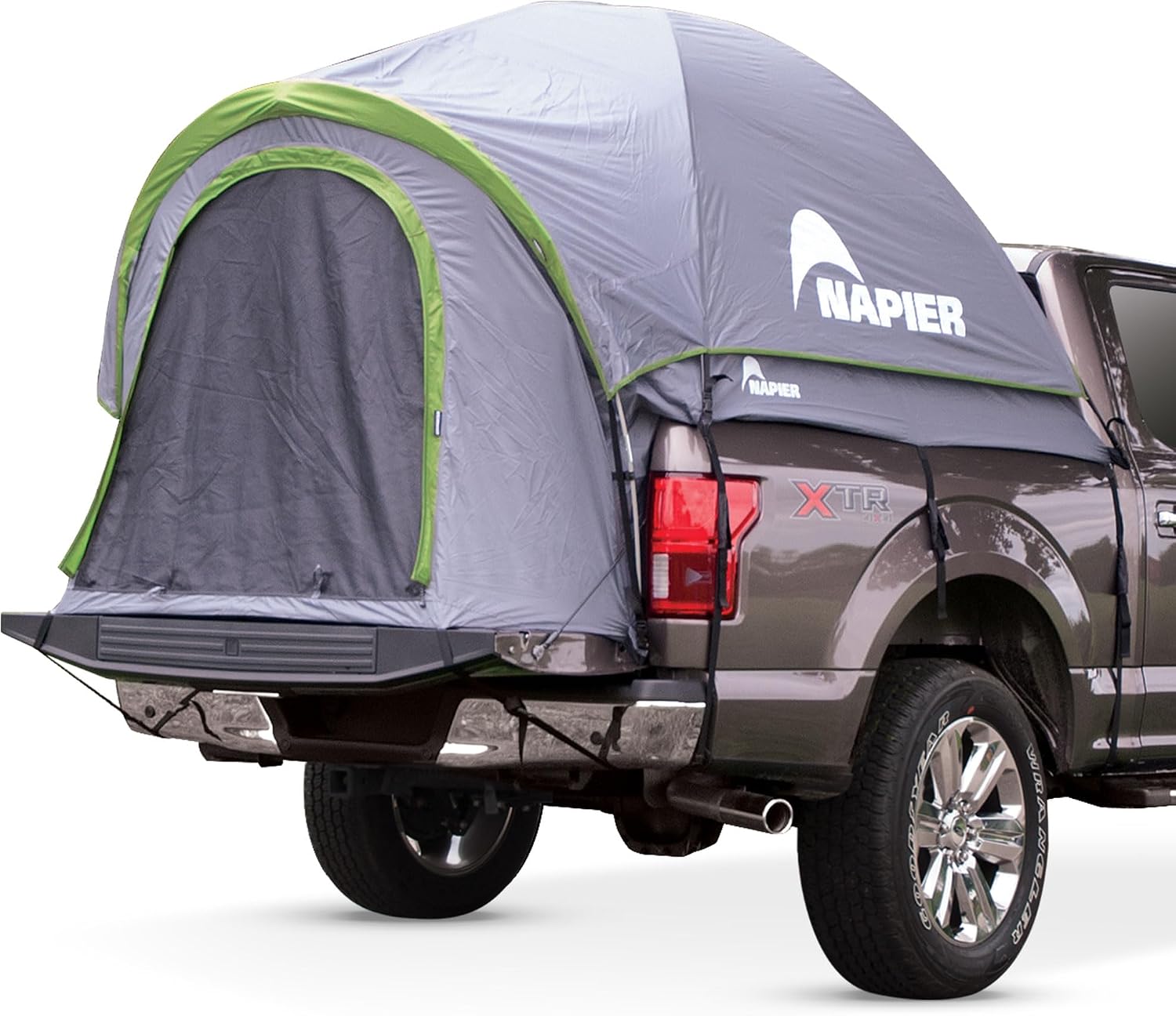
The Napier Backroadz is a sensible starting point for buyers who want a traditional enclosed truck bed tent from an established truck-tent brand. The current Backroadz range is offered in multiple bed-size configurations, so the exact version matters more than the family name. The Amazon listing used for this recommendation is the full-size regular-bed version, so owners of 5.5-foot, 8-foot, or midsize beds should select the appropriate variation rather than assuming this exact listing fits every pickup.
Napier’s current product information lists a two-person capacity, about five feet of center height, a four-pole shock-corded fiberglass frame, a full rainfly with taped seams, storm flaps, a polyethylene floor, and a 1500mm PU coating for the Backroadz 13/19-series designs. The company also lists a gear loft, gear pocket, lantern holder, carrying bag, and a one-year warranty.
The setup system is one of its most practical strengths. Napier uses color-coded poles and sleeves and states that setup can be completed in about 10 minutes once the system is familiar. That does not mean every first-time installation will take exactly 10 minutes; campsite conditions, the truck configuration, and experience can all affect the process.
The full floor makes the Backroadz feel closer to a normal camping tent than a floorless design. It also creates a clearer separation between your sleeping area and the truck bed. For campers who want a straightforward overnight shelter and do not need an awning or cab-access panel, that simplicity can be an advantage.
There are limitations. A five-foot center height is comfortable for sitting and moving around but is not standing height for most adults. The 1500mm waterproof coating and rainfly provide weather protection, but a truck bed tent should not be treated as an absolute guarantee against water intrusion. Proper setup, seam condition, rain direction, and truck-bed fit all matter.
Who should consider it?
- Truck owners looking for a traditional enclosed bed tent
- Campers who want a full floor and rainfly
- Buyers who want several bed-size options from one product family
- People who value a relatively simple pole system
- Two-person campers who do not need standing height
Who may want something else?
If you want an awning, cab access, or a floorless design, another product in this guide will fit that use case better. Buyers with a very short or very long bed should also check the specific Napier variation before ordering.
Pros
- Traditional enclosed truck-bed design
- Full rainfly and sewn-in bathtub-style floor
- Color-coded setup system
- Gear loft, pocket, and lantern holder
- Multiple bed-size configurations
Cons
- Exact fit depends on the selected variation
- Not designed for standing-height use
- No built-in awning on the Backroadz design
- 1500mm coating is not the same as a guarantee of complete waterproofing
2. Napier Sportz Truck Tent — Best for Features and Short Beds
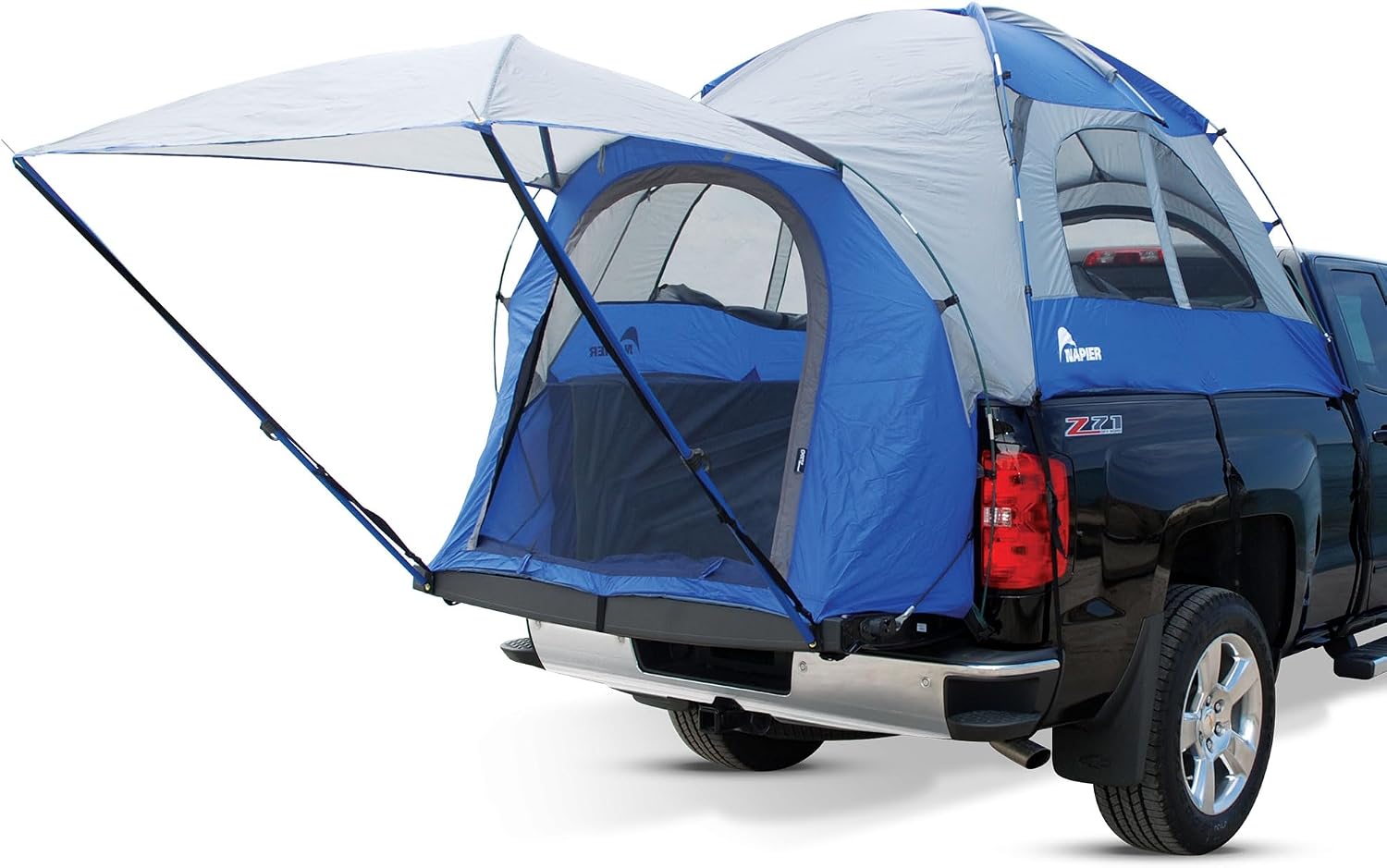
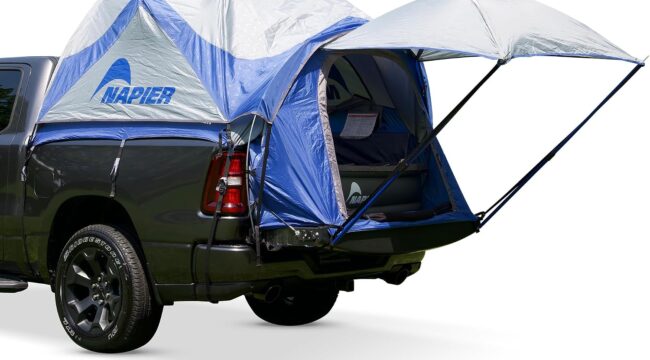
The Napier Sportz is the more feature-rich choice in this group. The current Sportz range is available for several truck-bed sizes, and the Amazon listing used here is the compact short-bed version. That makes it particularly relevant to owners of smaller pickups, but the product family also has regular-bed, long-bed, and other compact configurations.
Napier lists two-person capacity and 5 feet 7 inches of center height. The tent uses six shock-corded fiberglass poles, a full rainfly, taped seams, zipper storm flaps, sealable windows and vents, and a polyester taffeta/polyester oxford construction. The manufacturer also lists a four-foot freestanding awning with adjustable height.
The awning is a genuine difference rather than a cosmetic extra. If you spend several hours at a campsite, the shaded area can provide a place to sit, keep small items protected, or create a more comfortable transition between the tent and the tailgate. That makes the Sportz a better match for camping trips where the truck is the center of the campsite rather than simply a place to sleep.
Another useful feature is the rear cab-access panel. On a compatible truck, it can provide access between the tent and the truck’s interior and can be useful for storage or routing power. Compatibility with the truck’s rear window and cab arrangement must still be checked before purchase.
The added features also make the Sportz more involved than the Backroadz. There are more poles and components, especially because of the awning. Napier states a setup time of under 15 minutes, but first-time assembly can take longer while you learn the pole layout and strap positions.
The current Sportz specifications also list a 2000mm PU coating, three windows plus two vents, and spring/summer/fall use. Those specifications describe the product’s construction; they do not mean the tent is a four-season shelter or that it can safely be used in severe weather beyond its intended design.
Who should consider it?
- Campers who want an awning as well as a sleeping compartment
- Owners of compatible short-bed or compact pickups
- People who value rear cab access
- Two-person campers who want more headroom than a basic bed tent
- Frequent campers who will use the extra features
Who may want something else?
If you only need a simple overnight shelter, the additional poles and awning may not justify the extra complexity. A floorless tent can also be more convenient if you want to leave equipment in the truck bed.
Pros
- 5-foot-7-inch center height
- Built-in freestanding awning
- Rear cab-access panel
- Full rainfly, bathtub floor, taped seams, and storm flaps
- Multiple truck-bed sizes are available
Cons
- More components than a basic truck tent
- Higher cost than simple budget designs
- Exact bed and cab configuration must be verified
- Not intended as a universal four-season shelter
3. Rightline Gear Truck Bed Tent — Best Floorless Design
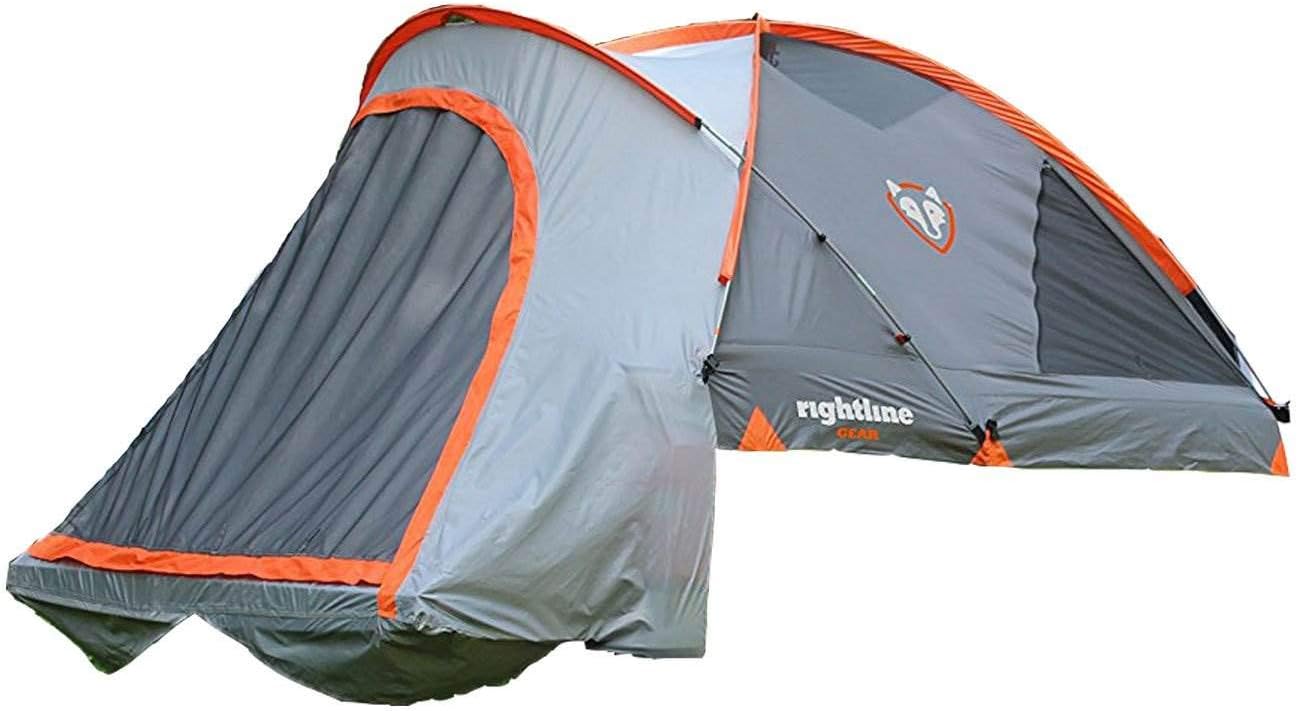
The Rightline Gear Truck Bed Tent is different from the other recommendations because it is floorless. Instead of creating a separate fabric floor over the truck bed, the tent attaches around the bed and leaves the bed surface available underneath. That design is particularly useful when you want to set up without first unloading everything from the truck.
The product family includes several sizes. The Amazon listing associated with this product line has been sold in configurations such as the full-size standard 6.5-foot bed and midsize applications, so buyers should select the correct style for their truck rather than treating the general product name as universal.
Rightline’s design includes color-coded poles and straps, a sky-view vent, gear pockets, a lantern hook, and glow-in-the-dark zipper pulls. The floorless construction also means the tent can be assembled with your feet on the ground rather than requiring you to climb into the bed while raising the poles.
One of the biggest advantages is practical convenience. Imagine arriving at a campsite with a cooler, recovery gear, camping boxes, or other equipment already arranged in the bed. With a floorless tent, you can potentially keep those items in place underneath the tent structure instead of unloading the whole bed just to create a sleeping area.
The same feature can be a drawback. Because there is no separate sewn-in floor, the cleanliness and condition of the truck bed become part of the sleeping environment. A dirty, wet, or rough bed may be less comfortable, and campers who want a completely enclosed floor may prefer one of the other tents here.
Rightline’s published information for the truck-tent range has also emphasized weather-resistant construction and sealed seams. Even with those features, correct installation matters. The straps need to be properly positioned, and the tent should be tensioned according to the instructions before exposure to bad weather.
Who should consider it?
- Truck owners who want to leave some gear in the bed
- Campers who prefer a floorless design
- People who want setup from the side of the truck rather than climbing into the bed
- Buyers who like a more open connection with the truck bed
- Owners willing to keep the bed clean for sleeping
Who may want something else?
If you want a dedicated waterproof floor beneath your sleeping area, choose a conventional enclosed truck tent. The floorless design is also less attractive if your truck bed is routinely dirty, muddy, or occupied by sharp cargo.
Pros
- Floorless design can keep existing bed gear in place
- Color-coded poles and straps
- Sky-view ventilation feature
- Gear pockets and lantern hook
- Can be assembled with your feet on the ground
Cons
- No sewn-in sleeping floor
- Truck-bed cleanliness becomes more important
- Exact size variation must be selected
- Not the best match for buyers wanting a traditional enclosed tent floor
4. JOYTUTUS Pickup Truck Tent 2.0 — Best Value for 5.5–5.8 ft Beds
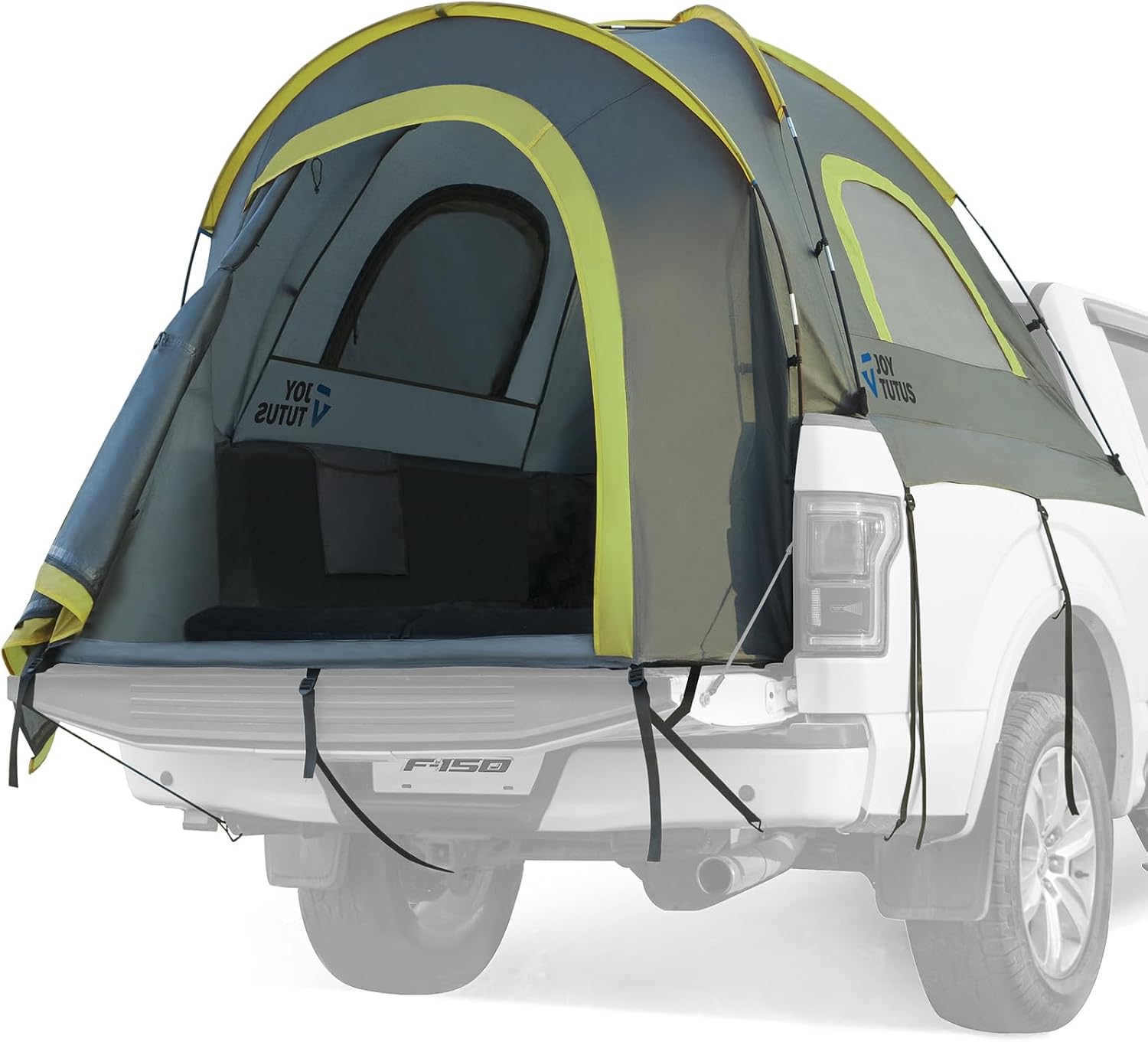
The JOYTUTUS Pickup Truck Tent 2.0 is a useful option for buyers who have a 5.5- to 5.8-foot truck bed and want a two-person enclosed tent with a strong emphasis on weather protection. The exact Amazon listing used here is the green 5.5- to 5.8-foot version, so it should not be treated as a universal fit for every pickup.
JOYTUTUS lists 210D polyester Oxford fabric with a PU2000 waterproof coating, a waterproof polyethylene floor, and a polyester taffeta rainfly with taped seams. The tent has four shock-corded fiberglass or aluminum poles depending on the selected version, storm flaps around the windows and doors, and built-in storage features including a gear loft, gear pocket, and lantern holder.
The two-person capacity makes it a natural fit for couples or two friends who are comfortable sharing the available sleeping area. As with any two-person truck tent, the usable space depends on the truck bed width and the amount of bedding or gear brought inside. A tent being rated for two people does not mean two adults will have the same room they would get in a large ground tent.
One of the strongest reasons to consider this model is the combination of price-oriented positioning and a relatively complete feature set. It has a full floor, rainfly, storage, ventilation, and a 2000mm coating without moving into the premium pricing of heavy canvas truck tents.
There are still reasons to be careful. The fitment range is specific, and the 5.5- to 5.8-foot version should be matched to the actual bed. The manufacturer also distinguishes between fiberglass and aluminum pole options, so buyers should check the variation selected on Amazon before assuming the pole material.
JOYTUTUS lists a one-year warranty on the product page for this version. Warranty terms can change by product variation, so retain the purchase documentation and check the current listing if warranty coverage is important to you.
Who should consider it?
- Owners of compatible 5.5- to 5.8-foot beds
- Two-person weekend campers
- Buyers prioritizing waterproof construction and a full floor
- Campers who want storage features without premium pricing
- People who prefer a conventional enclosed truck tent
Who may want something else?
Owners of 5-foot, 6.5-foot, or 8-foot beds should choose the correct JOYTUTUS size rather than this exact listing. If you want a built-in awning or cab-access panel, the Napier Sportz is a better match.
Pros
- PU2000 waterproof coating
- Full floor and rainfly
- Designed for two people
- Storage loft, pockets, and lantern holder
- Multiple truck-bed size options in the product family
Cons
- The exact 5.5–5.8 ft version is not universal
- Two adults have limited space compared with a large ground tent
- Pole material varies by selected version
- One-year warranty is shorter than some premium outdoor products
5. Guide Gear Full Size Truck Tent — Best Budget Full-Size Option
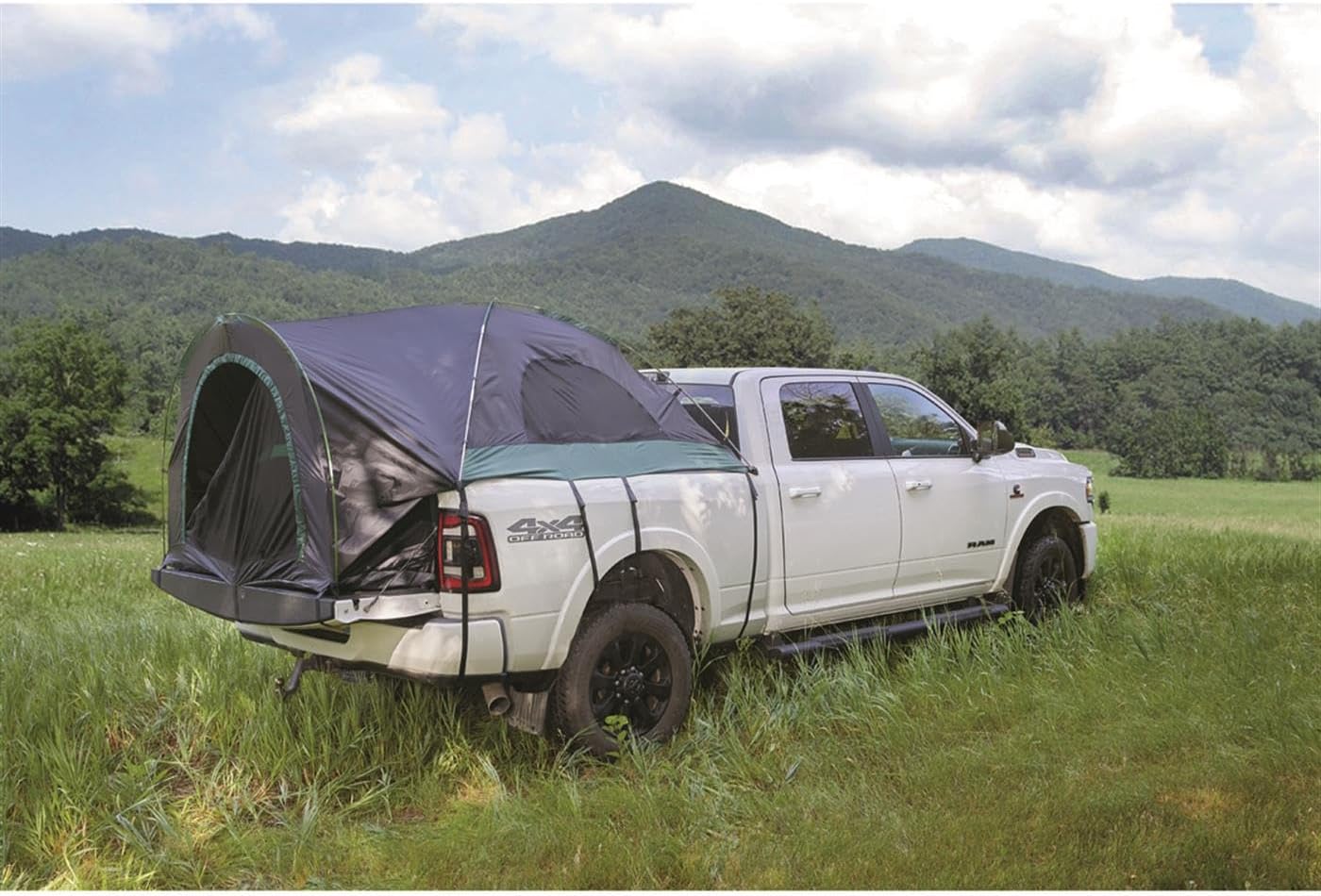
The Guide Gear Full Size Truck Tent is the simple choice in this lineup. It is designed around a full-size pickup bed measuring roughly 79 to 81 inches, uses a traditional enclosed layout, and is intended to give buyers a relatively inexpensive way to try truck-bed camping.
Published product information lists a two-person capacity, a 63-by-79-inch footprint, 63 inches of center height, 190T polyester construction, a 1500mm water-resistant coating, mesh windows, and a sewn-in polyethylene floor. It also includes a full rainfly and a carrying bag.
The four-pole design keeps the basic structure straightforward. There is no large awning, no complicated cab-access system, and no premium frame architecture to learn. That simplicity is part of the appeal if you only plan to camp occasionally and would rather put more of your budget into a mattress, sleeping bag, or other camping equipment.
The main limitation is also clear: this is a basic tent. Buyers looking for more ventilation, more headroom, a more sophisticated weather system, or premium long-term construction may be happier spending more on one of the Napier options.
Fitment deserves particular attention because the 79- to 81-inch measurement is the key to this product. The listing has historically been described for full-size pickups from several manufacturers, but truck beds can differ in width, rail design, and tailgate geometry even when the nominal bed length is similar. Treat the manufacturer’s fit guidance as the final check.
Who should consider it?
- Occasional campers who want a low-cost truck-bed tent
- Owners of compatible full-size beds around 79–81 inches
- Two-person campers who do not need an awning
- Buyers who prefer a simple four-pole design
- Truck owners trying truck-bed camping for the first time
Who may want something else?
If you camp frequently, want a more refined setup, or need a short-bed-specific configuration, consider a more feature-rich model. This is also not the best choice for buyers who want standing-height interior space.
Pros
- Simple enclosed truck-bed design
- Two-person capacity
- Full rainfly and sewn-in floor
- 1500mm water-resistant coating
- Relatively lightweight and compact
Cons
- Designed around full-size 79–81 inch beds
- Basic feature set
- No built-in awning
- Limited headroom compared with taller designs
Choosing the Best Truck Bed Tent for a Short Bed
Short-bed trucks create one of the biggest fitment traps in this category. A product may be advertised as fitting a “full-size truck” while still requiring a particular bed length. Ford F-150, Ram 1500, Silverado 1500, Sierra 1500, Tundra, and other full-size pickups can all be sold with different bed configurations.
For a 5.5- to 5.8-foot bed, the JOYTUTUS 2.0 is one of the most straightforward choices in this guide because the selected version is specifically built around that range. The Napier Sportz family also offers short-bed and compact configurations, while the Backroadz range has several size options.
Do not try to make a longer-bed tent work simply because the product appears flexible. The attachment points, floor dimensions, and tailgate position all affect the final fit. A tent that is too long may leave unsupported fabric, awkward straps, or openings where water can enter.
If you own a very short bed, measure the actual usable bed length with the tailgate closed and compare that measurement with the manufacturer’s fitment chart. If your truck has a spray-in or drop-in liner, bed rail caps, a toolbox, or other accessories, check those details as well.
How Waterproof Is a Truck Bed Tent?
Waterproofing is one of the most misunderstood parts of truck tent shopping. Product listings may use terms such as waterproof, water-resistant, PU coating, rainfly, or taped seams, but those features do not make every tent equally resistant to prolonged rain.
The Napier Backroadz uses a 1500mm PU coating with a full rainfly and taped seams. The Sportz is listed with a 2000mm PU coating, a full rainfly, taped seams, storm flaps, and a bathtub floor. JOYTUTUS lists PU2000 coating, a waterproof floor, and a taped-seam rainfly. Guide Gear uses a 1500mm water-resistant coating and a full rainfly. Rightline Gear’s floorless design relies more heavily on the tent shell, seams, and the way it wraps around the truck bed.
Those specifications are useful for comparison, but they should not be turned into a promise that the sleeping area will remain perfectly dry in every storm. Water can enter through poorly positioned straps, open vents, tailgate gaps, worn seals, condensation, or incorrect setup.
For wet-weather camping, pitch the tent with the rainfly fully installed, tension the fabric according to the instructions, close storm flaps where appropriate, and avoid allowing loose fabric to pool water. Keep sleeping bags and other moisture-sensitive equipment inside waterproof bags as an additional precaution.
What to Consider Before Buying
1. Measure the truck bed
Start with the actual bed length. Do not select a tent based only on the truck model. The same pickup can have multiple bed lengths, and a tent that fits one configuration may not fit another.
2. Check the generation and year
Truck beds can change between generations. Mounting points, bed rail shapes, tailgates, and cab windows can all affect fitment. If the manufacturer provides a year-by-year fitment selector, use it.
3. Check the bedliner
Bedliners are normally compatible with many truck tents, but the type of liner can change how straps sit and how the tent seals around the bed. A sprayed liner, drop-in liner, mat, or aftermarket rail system can create different clearance conditions.
4. Decide whether you need a floor
A full floor is useful if you want a separate sleeping surface and better separation from the truck bed. A floorless tent is more convenient if you want to leave gear underneath. This is a lifestyle decision as much as a technical one.
5. Think about weather
If you mostly camp in dry summer conditions, you may not need the most elaborate weather system. If you regularly camp where rain is common, prioritize a full rainfly, taped seams, storm flaps, a well-designed floor, and good ventilation.
6. Consider headroom
Five feet of center height is different from 5 feet 7 inches. If you are tall or dislike crouching, the extra height of a Sportz-style design may matter. Remember that center height is not the same as usable standing space across the entire tent.
7. Think about daytime use
If you only sleep in the tent, an awning may not matter. If the truck becomes your basecamp for a whole day, an awning can add useful sheltered space. Decide whether you will actually use the feature before paying for it.
8. Check cab access
A rear access panel can be convenient, but it only helps if it aligns with your truck’s rear window and configuration. Do not assume that a cab-access tent automatically works with every truck.
Installation and Setup
The first setup is usually the one that takes the longest. Even a tent advertised with a 10- or 15-minute setup time can take substantially longer when you are learning the pole sequence, identifying straps, and working out how the tent should sit on your specific truck.
Practice at home first
Set the tent up in daylight before the first trip. This lets you identify the poles, learn the strap locations, check the fit, and make sure every component is present before you are at a campsite.
Clear the sleeping area
For a tent with a sewn-in floor, remove anything that would interfere with the sleeping surface. Keep sharp objects, dirty equipment, and loose cargo away from the tent fabric.
Follow the pole order
Do not force a pole simply because it appears to reach a particular sleeve. Color-coded systems exist to reduce mistakes, so follow the sequence in the supplied instructions.
Secure the straps
The tent should be firmly attached to the truck bed without crushing or damaging fabric. Make sure straps are routed as instructed and do not place them where they can interfere with tailgate operation.
Install the rainfly correctly
A rainfly only works as intended when it is properly positioned and tensioned. Check that it covers the intended seams and openings and that water has a path away from the sleeping area.
Check the fit before sleeping
Walk around the truck and inspect the tent from every side. Look for loose fabric, incorrectly routed straps, poles that are not fully seated, and openings that should be closed. A few minutes of checking can prevent problems later in the night.
Using a Truck Bed Tent Safely
A truck bed tent is camping equipment, not a permanent vehicle accessory. Never drive with the tent installed unless the manufacturer specifically provides a tested travel configuration for that exact product. For the tents in this guide, treat the installed tent as a stationary camping shelter and remove it before driving.
Do not use open flames, fuel-burning stoves, lanterns, or other combustion appliances inside a fabric tent. Carbon monoxide can build up quickly in enclosed spaces. Follow the manufacturer’s ventilation and safety instructions and keep heat sources outside the sleeping area.
Pay attention to weather conditions. A tent that is suitable for ordinary three-season camping is not automatically suitable for severe storms, high winds, heavy snow, or extreme temperatures. If conditions become unsafe, pack the tent away and move to an appropriate shelter.
Also remember that the truck bed itself can become hot or cold quickly. Use suitable sleeping insulation and ventilation rather than assuming the tent fabric will regulate temperature for you.
Truck Bed Tent Comparison
| Product | Best for | Capacity | Key design | Weather features | Important fit note |
|---|---|---|---|---|---|
| Napier Backroadz | Overall | 2 | Enclosed floor | 1500mm PU, rainfly, taped seams | Select the correct bed-size version |
| Napier Sportz | Features / short beds | 2 | Floor + awning + cab access | 2000mm PU, rainfly, taped seams, storm flaps | Several truck and bed configurations |
| Rightline Gear | Floorless convenience | 2 | Floorless | Water-resistant shell and sealed-seam design | Select exact size/bed variation |
| JOYTUTUS 2.0 | 5.5–5.8 ft value | 2 | Enclosed floor | PU2000, rainfly, waterproof floor | Exact listing is for 5.5–5.8 ft beds |
| Guide Gear Full Size | Budget | 2 | Enclosed floor | 1500mm coating and rainfly | Designed around 79–81 in full-size beds |
This table is a starting point, not a substitute for the manufacturer’s fitment chart. In particular, the Rightline, Napier, and JOYTUTUS product families are sold in multiple configurations, while the Guide Gear option is much more specific to full-size beds.
Frequently Asked Questions
What is the best truck bed tent?
For most buyers, the Napier Backroadz is a strong starting point because it offers an enclosed floor, full rainfly, simple setup, and several bed-size configurations. The best choice still depends on your truck and camping priorities.
What is the best truck bed tent for camping?
The best truck bed tent for camping depends on how you camp. The Backroadz suits straightforward overnight use, the Sportz adds an awning and cab access, the Rightline Gear prioritizes floorless convenience, and the JOYTUTUS 2.0 offers a feature-rich option for compatible 5.5- to 5.8-foot beds.
What is the best truck bed tent for a short bed?
Look for a product variation specifically matched to your short-bed measurement. The JOYTUTUS 2.0 used in this guide is the 5.5- to 5.8-foot version, while Napier offers several short-bed and compact Sportz and Backroadz configurations.
Can two people sleep in a truck bed tent?
Yes. All five tents in this guide are designed around two-person use. Comfort depends on bed width, sleeping-pad size, personal gear, and how much room you need to move inside the tent.
Are truck bed tents waterproof?
Many are designed to provide strong rain protection through coated fabrics, rainflies, taped seams, storm flaps, and enclosed floors. They should not be treated as guaranteed waterproof shelters in every condition. Correct setup and the truck’s configuration also affect water intrusion.
Can I leave gear in the truck bed with a bed tent?
A floorless design such as the Rightline Gear tent is particularly useful for this because it leaves the bed surface available underneath the tent. With a sewn-in floor, you generally need to clear the sleeping area first.
Can you drive with a truck bed tent installed?
Do not drive with a tent installed unless the manufacturer specifically says the exact product has a safe travel configuration. A conventional truck bed tent should be treated as a stationary camping shelter.
Is a floorless truck bed tent better?
Not universally. A floorless design is better when you value quick setup and want to keep gear in the bed. A tent with a sewn-in floor is usually the better choice if you want a separate, enclosed sleeping surface.
Final Thoughts
The best truck bed tent is the one that fits your truck correctly and matches the way you actually camp. A simple enclosed tent can be enough for occasional weekend trips, while an awning, cab-access panel, or floorless design becomes more valuable when you spend more time at the campsite.
For a broad starting point, the Napier Backroadz Truck Tent is worth considering because it combines the core features most truck campers need without adding unnecessary complexity. Before ordering, confirm the exact bed length, year, configuration, and any accessories that could affect fitment.
Most importantly, do not treat a truck-bed tent as a universal accessory. Measure first, practice the setup at home, use the rainfly when conditions require it, and keep moisture-sensitive gear protected. A properly matched tent can turn a pickup into a practical campsite without committing you to a permanent camper or rooftop-tent system.