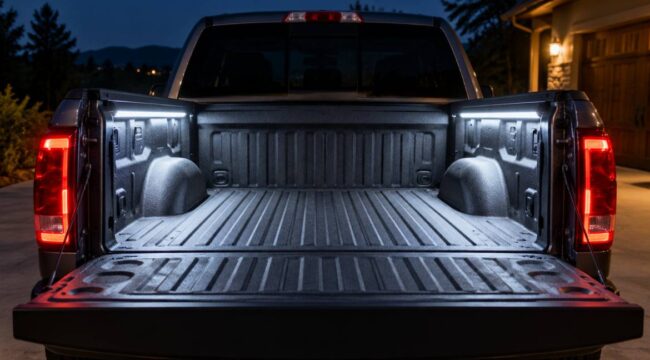
A dark truck bed can turn a simple job into a frustrating one. Tools disappear into the corners, cargo labels are hard to read, and loading or unloading after sunset often means holding a flashlight in one hand while trying to work with the other. Factory cargo lamps help on some trucks, but they do not always illuminate the full bed evenly, especially when a toolbox, tonneau cover, bedliner or other accessory blocks part of the light.
Aftermarket bed lighting solves that problem in a few different ways. Long LED strips can spread light along the bed rails, multi-strip kits can cover more of the cargo area, and compact pod systems can put light in places where a flexible strip is difficult to mount. RGB kits add color and remote control, while simple white kits focus on practical visibility.
The best choice depends on how you use the truck. A contractor who needs to find tools at night has different priorities from someone who wants subtle lighting for camping or tailgating. Brightness, coverage, waterproofing, installation, wiring, control method and the available mounting surface all matter.
For this guide, we compared current Amazon product information and identifiable product specifications for truck-bed lighting kits. We focused on the actual configuration being recommended rather than assuming that every product from a brand has the same features. We have not personally tested these lights, so the recommendations below are based on documented product characteristics, not claimed hands-on testing.
Before installing any 12-volt lighting kit, confirm the product instructions, your truck’s electrical setup and the condition of the mounting surface. If your truck has a factory cargo-light circuit, check the vehicle-specific requirements before tapping into it.
For most truck owners who want straightforward white bed lighting, the Nilight TR-05 is a strong starting point: it uses two 60-inch strips with 180 LEDs, 6000K white light and IP67 protection. If you want more coverage and output, the three-strip Nilight TR-09 increases the setup to 270 LEDs. The MICTUNING 3-piece kit is another full-bed strip option with 270 LEDs and both one-way and two-way splitters. For a lower-profile pod design, the Xprite 8-piece kit uses eight compact pods with 24 LEDs. If you want color-changing lighting and RF remote control, the Nilight TL-31 adds RGB control while retaining two 60-inch strips.
Our Top Picks
These five kits cover the main approaches a truck owner is likely to consider. The first three are long white strip systems aimed primarily at useful cargo illumination. Xprite takes a compact pod approach, while the Nilight TL-31 is the option for owners who specifically want RGB lighting and remote control.
Nilight TR-09Best for maximum coverage among the strip kits
MICTUNING 3Pcs 60 InchBest three-strip alternative
Xprite White 8 PCSBest low-profile pod-style option
Nilight TL-31 RGBBest for RGB and remote control
Types of Truck Bed Lights
Before comparing individual products, it helps to understand the basic layouts. The mounting style affects coverage, installation and how much work is required to route the wiring.
LED Strip Lights
Strip kits are the most common choice for practical bed illumination. A long flexible strip can be mounted along a bed rail or side wall, producing light across a large area instead of concentrating it at one point. Two-strip kits usually place one strip on each side, while three-strip kits can add another light source across the front or another section of the bed.
The main advantage is coverage. Because the LEDs are spread along the length of the strip, you can reduce the number of dark areas around the cargo. The trade-off is installation: you need a clean mounting surface, a sensible wire-routing path and enough room for the strip and connectors.
Pod-Style Truck Bed Lights
Pod systems use several small lighting modules connected by wires. They can be easier to position around obstacles and can work well when a continuous strip would be difficult to route. Their compact housings can also be tucked underneath rails or into other tight spaces.
The disadvantage is that you have more individual mounting points and more wire sections to manage. The lighting pattern can also be less continuous than a long strip, depending on where the pods are placed.
White Versus RGB Bed Lighting
White light is usually the practical choice for loading cargo, reading labels and finding tools. A 6000K white output is common in the products reviewed here and gives a cool, daylight-like appearance.
RGB lighting is more flexible visually. A kit such as the Nilight TL-31 can provide multiple colors and effects, which can be useful for camping, tailgating or personalizing the truck. For pure work lighting, however, color options should not be treated as a substitute for useful white illumination.
Hardwired 12-Volt Kits
The products in this guide are vehicle-powered kits rather than rechargeable portable lamps. That means they can provide consistent power without remembering to recharge a battery, but installation requires a proper connection to the truck’s 12-volt electrical system. Some kits include an inline fuse and switch, while others may need additional planning if you want them to operate with factory cargo lighting.
Hardwired Kits vs. Rechargeable and Portable Lights
Most of the best truck bed LED lights are wired 12-volt systems because they can stay connected to the truck and provide consistent power. That makes them useful for regular loading, tool access and other tasks where you do not want to remember to recharge a separate lamp.
A rechargeable light can make sense when you want something temporary or do not want to modify the truck’s wiring. If you are specifically searching for the best rechargeable truck bed light, treat that as a different buying category: battery runtime, charging method, magnetic or hook mounting and weather resistance become more important than strip length and wiring.
The same distinction applies to a best truck bed work light. A portable work light is useful when you need to move the light around the cargo area, while a fixed bed-light system provides broader illumination without needing to be repositioned. For a permanent installation, a best truck bed light strip is usually easier to plan around the bed rails than a single portable lamp.
If you are comparing the best LED truck bed lights, the best truck bed lighting setup is not necessarily the brightest or most feature-heavy option. Match the format to how often you use the bed, whether you want a permanent installation, and whether you need task lighting or occasional visibility.
In other words, the best truck bed lighting setup is not necessarily the brightest or most feature-heavy option. Match the format to how often you use the bed, whether you want a permanent installation, and whether you need task lighting or occasional visibility.
How We Choose
We focused on the details that affect real use rather than choosing products simply because they appear in search results.
- Lighting layout: number and length of strips or pods and how much of the bed they can cover.
- LED count: used as a documented product characteristic, not as a guarantee of real-world brightness.
- Light color: white or RGB and whether a product documents a color temperature or color-control system.
- Weather protection: documented IP ratings where available.
- Controls: inline switch, wired switch or RF remote control.
- Installation: adhesive mounting, hardware, splitters and wiring supplied with the kit.
- Fit: whether the product is marketed as universal or requires a vehicle-specific configuration.
- Use case: work lighting, general cargo access, low-profile installation or decorative/RGB lighting.
We also verified the Amazon ASIN for each recommended configuration before using it in the article. Product availability, sellers, prices and variations can change, so the Amazon listing should be checked again before purchase.
Detailed Reviews
1. Nilight TR-05 2PCS 60 Inch 180 LEDs Bed Strip Kit — Best Overall for Practical White Lighting
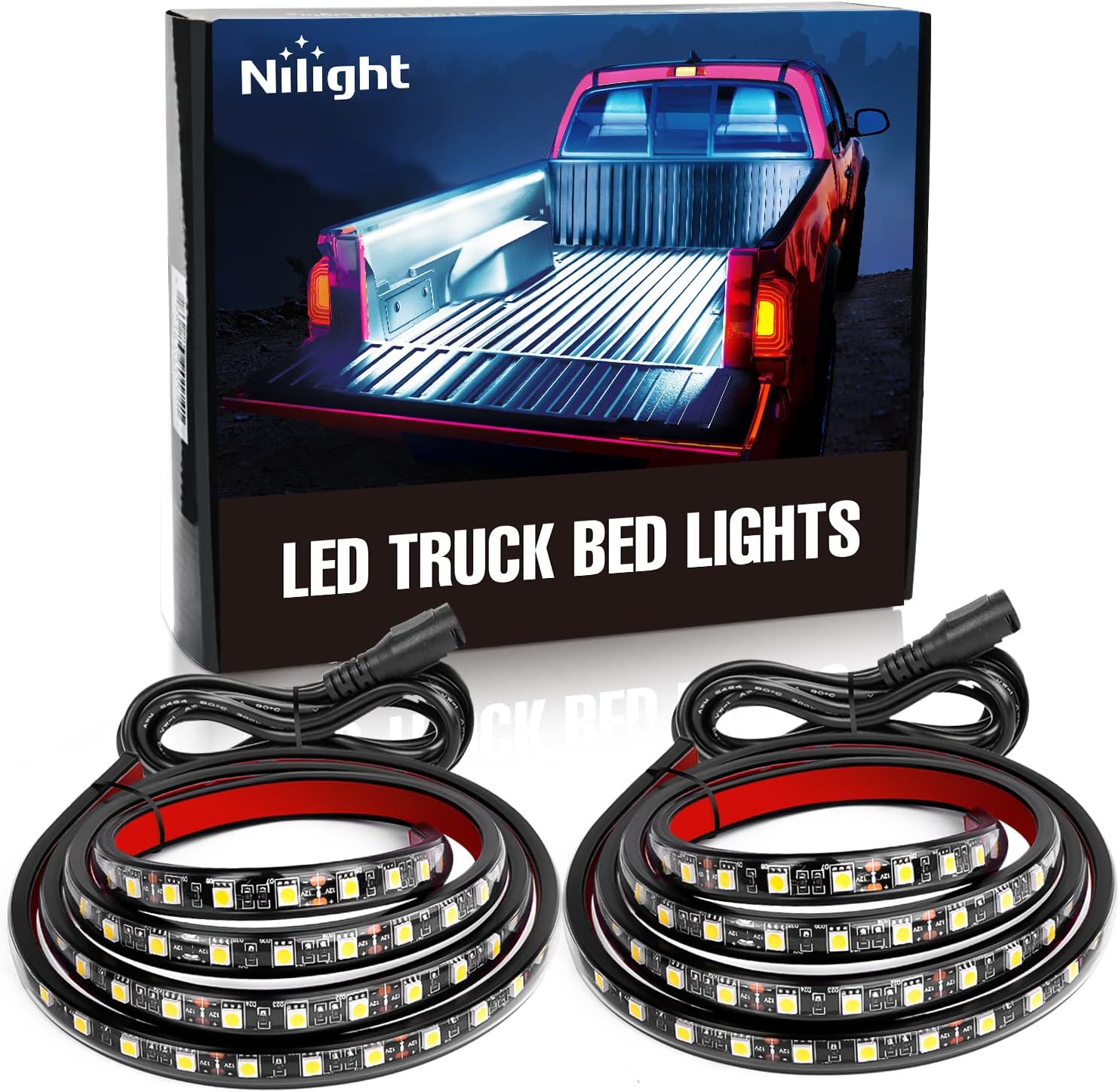
The Nilight TR-05 is a straightforward truck-bed lighting kit built around two long flexible LED strips. Each strip is 60 inches, and the two-strip package contains 180 5050-SMD LEDs in total. The listed light is 6000K white with a stated 2400-lumen output, making the kit primarily about practical visibility rather than decorative effects.
For a typical pickup, two long strips are a sensible layout because they can be positioned along opposite sides of the bed. That creates a broad spread of light without requiring a large number of separate mounting points. The kit also includes an on/off switch, blade fuse, two-way splitter and extension cable, so the basic wiring components are part of the package.
The TR-05 is rated IP67, which is important for a component mounted in an exposed truck bed. IP protection does not mean the installation can be ignored, though. Connections still need to be routed and secured properly, and the mounting surface should be prepared according to the instructions.
Nilight lists the strips for 12-volt vehicle use and states a two-year warranty. The product is marketed as a universal-fit lighting kit for applications including pickup trucks, SUVs, RVs and boats. That does not remove the need to check your own truck’s available mounting space and electrical connection point.
Who should consider it?
- Truck owners who mainly want useful white cargo lighting
- DIY installers who prefer a simple two-strip layout
- Owners who want a switch and basic wiring hardware included
- Drivers who want long strips rather than several small pods
Who may want another option?
If you want three strips for broader coverage, the TR-09 or MICTUNING kit is a better match. If RGB effects are important, the TL-31 is the more appropriate choice.
Pros
- Two 60-inch strips
- 180 total 5050-SMD LEDs
- 6000K white light
- IP67-rated housing
- Includes switch, fuse and splitter
Cons
- White-only lighting
- Two-strip layout may leave less coverage than a three-strip kit
- Installation still requires 12-volt wiring
- Adhesive performance depends on proper surface preparation
2. Nilight TR-09 3PCS 60 Inch Bed Light Strip 270 LED — Best for Maximum Strip Coverage
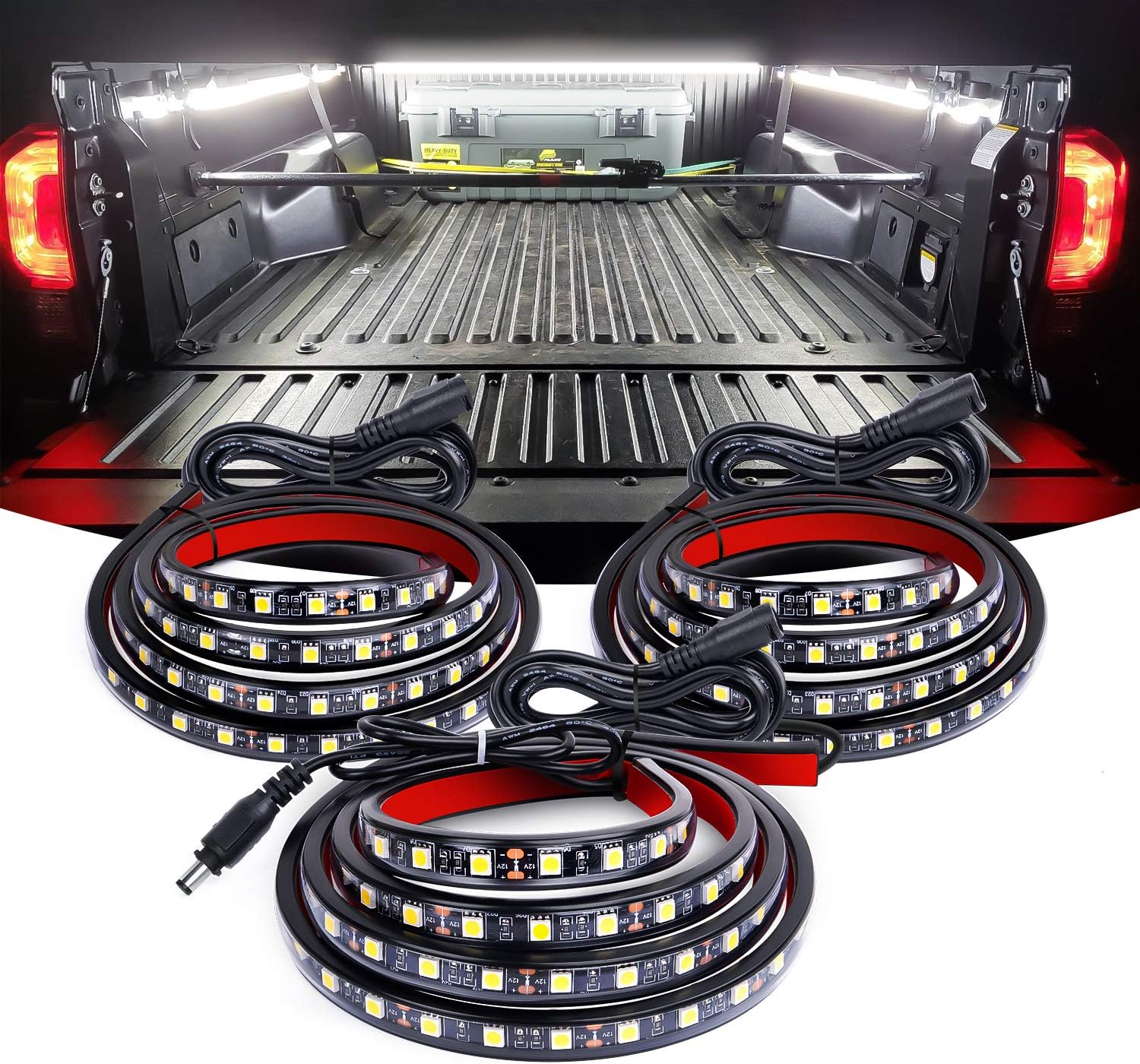
The Nilight TR-09 takes the basic strip concept and adds a third 60-inch strip. The package contains 270 LEDs in total, and the Amazon listing identifies the model as TR-09 with 6000K white light, IP67 protection and a 12-volt DC power source.
That extra strip is the main reason to choose it. Two strips can illuminate the sides of a bed effectively, but a third strip gives you another mounting position for improving coverage. Depending on the truck and the layout of the cargo area, it can be used where the first two strips leave a darker section.
The listed output is 3900 lumens, although lumen figures should be treated as manufacturer or listing specifications rather than a promise of measured brightness on your particular truck. Bed color, liner texture, mounting angle and the position of cargo can all change how much useful light reaches the floor.
The kit includes an on/off switch, blade fuse, splitter and extension cable. It is marketed as a universal-fit product for pickups, SUVs, RVs and boats. Nilight also lists a two-year warranty for this model. As with any universal accessory, the practical fit depends on whether the strips can be mounted where you want them without interfering with a tonneau cover, toolbox or other equipment.
Who should consider it?
- Owners who want more strip coverage than a two-strip kit
- Work-truck users who frequently access cargo at night
- Truck owners who prefer bright white task lighting
- DIY installers comfortable routing an additional strip
Who may want another option?
If you do not need three strips, the TR-05 can provide a simpler installation. If you want compact mounting points rather than long flexible strips, the Xprite pod kit is a different approach.
Pros
- Three 60-inch strips
- 270 total LEDs
- 3900-lumen listing specification
- 6000K white light
- IP67 protection and included wiring hardware
Cons
- More wiring to route than a two-strip kit
- Uses more mounting space
- White-only lighting
- Actual coverage still depends on placement and cargo
3. MICTUNING 3Pcs 60 Inch Truck Bed Lights — Best Three-Strip Alternative
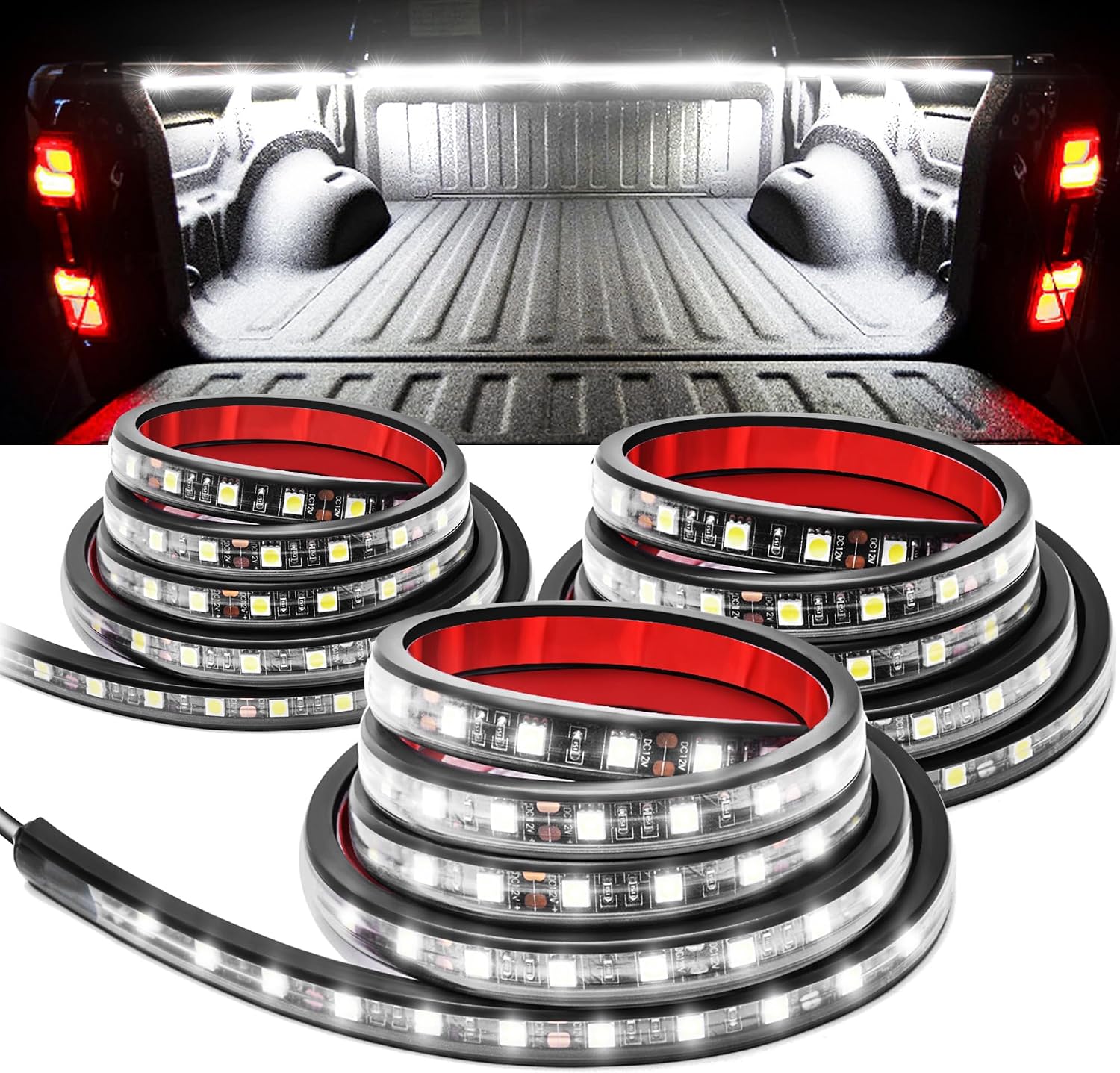
The MICTUNING three-piece kit is another full-size strip system, but its included wiring layout gives it a slightly different installation approach. It includes three 60-inch white LED strips, with 270 LEDs across the set, plus a one-way splitter, two-way splitter, mounting set, on/off push button and extension cord.
The strips use 5050-SMD LEDs and are designed for 12-volt applications. The housing is listed as IP67 sealed, and the manufacturer information describes the kit for truck beds as well as applications such as RVs, SUVs, vans and boats. That broad application range makes it a flexible choice when you want a strip system rather than a vehicle-specific replacement lamp.
One of the useful characteristics of this kit is the ability to distribute the three strips around the bed rather than being limited to two long runs. The exact layout will depend on your truck. Before sticking anything down, it is worth placing the strips temporarily and checking where the wiring will travel around the bedliner, tailgate and other accessories.
The included hardware also makes it easier to build a clean installation without immediately shopping for additional connectors. That does not mean every truck will use every supplied component; a shorter bed may have excess wire or a different routing requirement.
Who should consider it?
- Owners who want three long white strips
- Truck users who want flexible strip placement
- DIY installers who value included splitters and mounting hardware
- Owners looking for an alternative to the Nilight three-strip kit
Who may want another option?
If simplicity matters more than maximum strip coverage, the two-strip TR-05 is easier to keep tidy. If you want color control, the TL-31 is a better fit.
Pros
- Three 60-inch strips
- 270 total 5050-SMD LEDs
- IP67 sealed housing
- Includes one-way and two-way splitters
- Includes switch, mounting set and extension cord
Cons
- Three-strip installation requires more routing
- White-only lighting
- Extra wiring can be unnecessary on some short beds
- Adhesive mounting still depends on surface preparation
4. Xprite White 8 PCS Truck Pickup Bed Light Kit — Best Low-Profile Pod Option
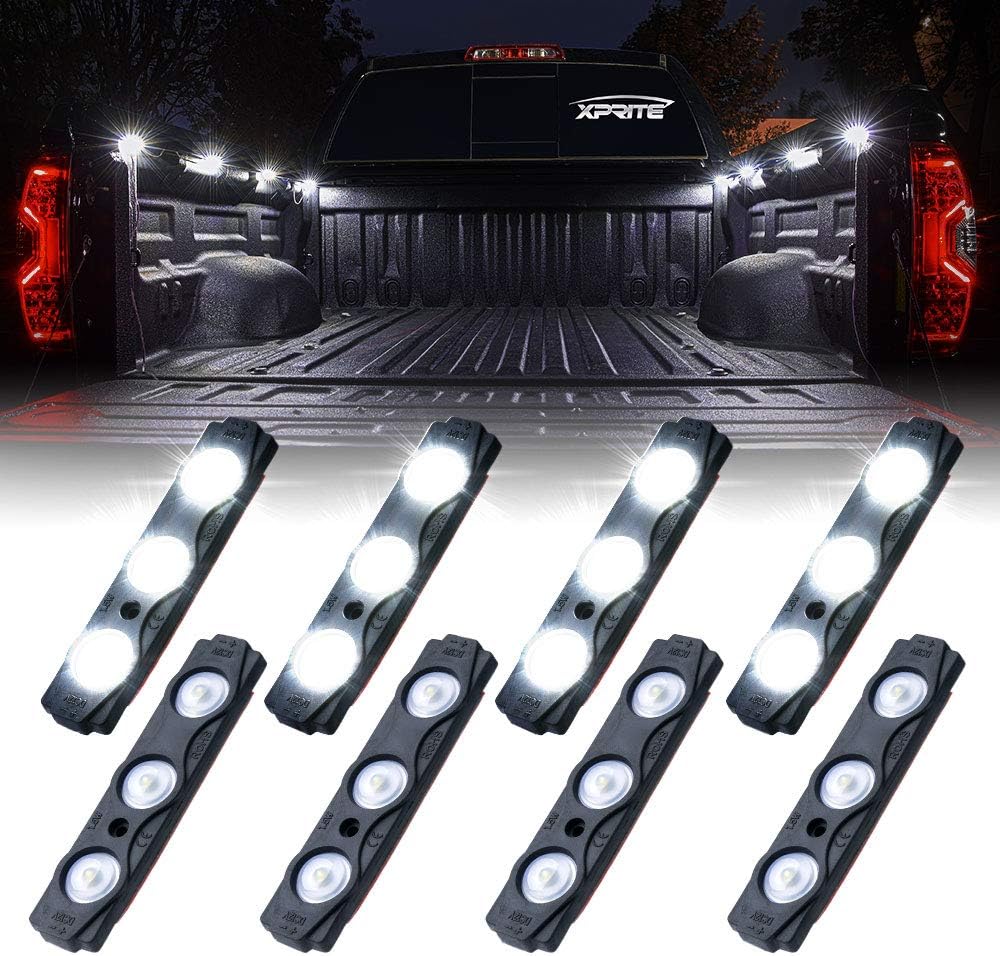
The Xprite kit is built around eight compact lighting pods rather than long flexible strips. The white configuration contains 24 SMD LEDs in total, with three LEDs per pod. The product is designed for 12-volt applications and is marketed for truck beds, footwells, running boards and other interior or exterior vehicle locations.
The pod layout can be useful when you want to place individual light sources around the bed rather than mounting a continuous strip. Each pod is listed as only 0.25 inches thick, which makes the design relatively easy to hide beneath a bed rail or in another narrow location.
Xprite lists an IP67 waterproof rating and a shock-resistant design. The kit uses 3M adhesive for installation and also includes screws if you want additional mechanical fastening. It includes a switch and two strands of wiring, with 21 feet of power wire per strand and two feet between individual pods according to the product information.
The main trade-off is coverage style. Eight small pods can provide useful distributed lighting, but they do not create the same continuous line of illumination as a long strip. The lower total LED count also makes this a better choice for compact, low-profile lighting than for someone specifically chasing the highest documented output.
Who should consider it?
- Owners who want a low-profile installation
- Drivers who need to work around bed rails or other obstacles
- People who prefer individual mounting points
- Truck owners who want a simple white pod system
Who may want another option?
For maximum bed illumination, a 180- or 270-LED strip kit is more appropriate. If you want remote-controlled color changes, choose the Nilight TL-31 instead.
Pros
- Eight compact pods
- 24 SMD LEDs
- Low-profile 0.25-inch design
- IP67 waterproof and shock-resistant design
- Adhesive and screw mounting options
Cons
- Less continuous coverage than long strips
- Only white in this configuration
- More individual mounting points
- Wiring between pods needs to be planned carefully
5. Nilight TL-31 2PCS 60Inch RGB Truck Bed Light Strip Kit — Best for RGB and Remote Control
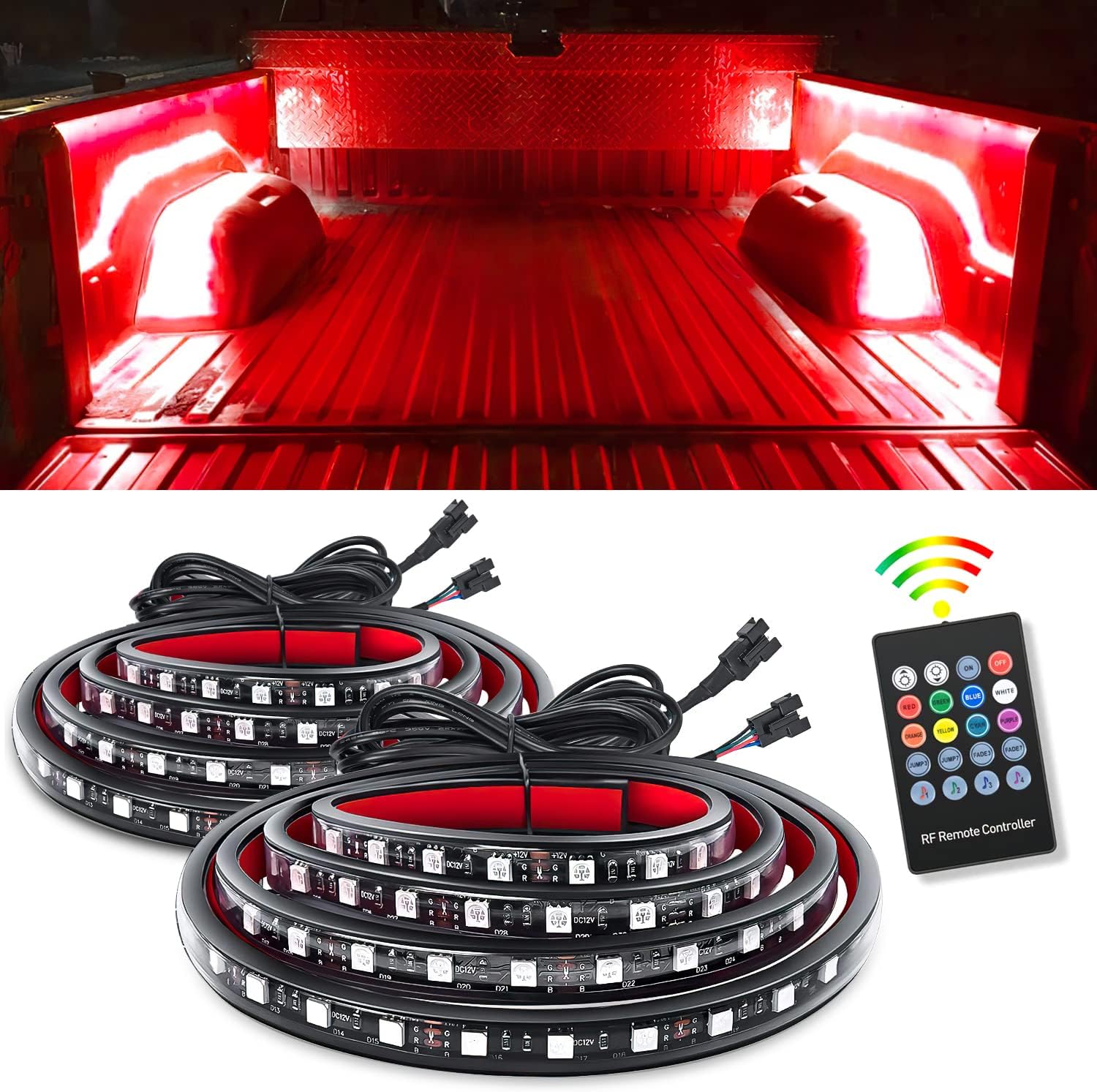
The Nilight TL-31 is the option for truck owners who want their bed lighting to do more than provide plain white illumination. It uses two 60-inch strips with 180 5050-SMD LEDs and adds RGB color control through an RF remote.
The product information lists eight solid colors, four music-sync modes and adjustable brightness and speed. The RF remote is useful because it does not require the same direct line of sight as an infrared remote. For camping or tailgating, those controls can make the kit much more flexible than a basic on/off white-light system.
The TL-31 is also rated IP67 and operates from a 12-volt DC supply. The package includes an on/off switch, blade fuse, splitter, extension wire, mounting hardware and RF remote. Nilight lists a two-year warranty and a stated lifespan of up to 50,000 hours for the lighting system.
There is a practical distinction to keep in mind: RGB flexibility is not automatically the same thing as better work lighting. If your main purpose is finding tools or reading labels, a straightforward white kit is easier to evaluate around that specific task. The TL-31 makes more sense when you value both usable illumination and the ability to change the appearance of the bed.
Who should consider it?
- Owners who want color-changing truck bed lighting
- Campers and tailgaters who want adjustable effects
- Drivers who prefer RF remote control
- People who want two long strips rather than individual RGB pods
Who may want another option?
If your only goal is practical white work lighting, the TR-05 or TR-09 is a simpler choice. If you want a low-profile pod layout, consider Xprite.
Pros
- Two 60-inch RGB strips
- 180 5050-SMD LEDs
- RF remote control
- Eight solid colors and four music modes
- IP67 protection
Cons
- More controls than needed for simple work lighting
- RGB effects add installation complexity
- White performance should be judged for the intended task rather than color options
- Still requires a 12-volt installation
Truck Bed Lights Comparison
The table below compares the documented characteristics that are most useful when deciding between these five configurations. It intentionally avoids subjective brightness scores or unverified measurements.
| Product | Layout | LEDs | Light | Protection | Control |
|---|---|---|---|---|---|
| Nilight TR-05 | 2 × 60-inch strips | 180 | 6000K white | IP67 | Wired switch |
| Nilight TR-09 | 3 × 60-inch strips | 270 | 6000K white | IP67 | Wired switch |
| MICTUNING 3Pcs | 3 × 60-inch strips | 270 | White | IP67 | On/off switch |
| Xprite White 8 PCS | 8 pods | 24 | White | IP67 | Wired switch |
| Nilight TL-31 | 2 × 60-inch strips | 180 | RGB | IP67 | RF remote + switch |
What to Consider Before Buying
1. Decide whether you need work lighting or accent lighting
This is the first decision because it changes how you should judge every other feature. If you routinely load tools, packages or equipment at night, broad white illumination is the priority. A simple white strip kit can be more useful than an RGB system with many effects you never use.
2. Look at coverage, not just LED count
A higher LED count is useful information, but it does not automatically tell you how well the bed will be illuminated. Two products with similar LED counts can use different layouts, housings and spacing. Mounting position also matters. A strip pointed toward the bed floor can behave differently from one mounted behind a rail and aimed sideways.
3. Choose between strips and pods
Long strips are usually the easiest way to create continuous coverage. Pods give you more freedom around obstacles and can be hidden in narrow locations. Think about your bedliner, tie-down points, toolbox, bed rails and tonneau-cover hardware before choosing the layout.
4. Check the IP rating
Truck beds are exposed to rain, dust, mud and car washes. An IP67 rating is a useful documented feature because these kits are designed for an exposed vehicle environment. It does not mean every electrical connection is automatically waterproof, so the complete installation still matters.
5. Think about the mounting surface
Adhesive-backed lighting depends heavily on surface preparation. Dust, wax, oil, moisture and rough or textured surfaces can reduce adhesion. Bedliners can be particularly challenging because their texture prevents a tape-backed strip from making full contact. Clean the area and follow the manufacturer’s mounting instructions before applying the adhesive.
6. Plan the wiring before sticking anything down
Dry-fit the strips or pods first. Identify where the power connection will be made, where the switch will sit and how the wires will travel around the bed. This is especially important with three-strip kits because a little extra planning can prevent a bundle of unnecessary wire from ending up under the bed or beside the tailgate.
7. Consider how your tonneau cover works
If you use a tonneau cover, make sure the lights do not interfere with its rails, seals or moving parts. A low-profile installation can be useful here, but do not mount a light where it will be pinched every time the cover closes. If you are also comparing cover styles, our truck bed cover guide can help with that part of the setup.
8. Check the truck’s factory lighting circuit before tapping into it
Some owners prefer their aftermarket bed lights to operate with the factory cargo-light switch or courtesy-light system. That can produce a clean result, but the correct connection varies by vehicle. Do not assume that the wiring approach used on one F-150, Tacoma, Silverado or Ram will be appropriate for another truck.
9. Consider the switch location
A switch mounted too far inside the bed can be awkward when the tailgate is closed. A switch near the tailgate can be convenient, while a hidden switch can provide a cleaner appearance. RGB systems add another consideration because the remote receiver needs to remain usable from the locations where you expect to operate it.
10. Do not confuse lighting output with electrical safety
Use the supplied fuse or the protection specified by the manufacturer, and make secure electrical connections. Avoid loose wires around moving components, sharp metal edges, exhaust heat and locations where cargo can snag the wiring.
11. Confirm the exact Amazon variation
Several products in this category are sold in different colors, lengths, LED counts and configurations. Make sure the Amazon listing you open matches the exact model described in this article. The ASINs used here identify the recommended configurations, but listings and variations can change over time.
Installation and Wiring
Installing truck bed lights is usually manageable for someone comfortable with basic 12-volt wiring, but the quality of the final result depends more on preparation and routing than on simply sticking the lights in place.
Clean the mounting surface
Remove dirt and residue from the area where the adhesive will sit. Allow the surface to dry completely. If the manufacturer specifies a particular preparation method or adhesion promoter, follow that instruction.
Dry-fit the lights first
Place the strips or pods without removing the adhesive backing. Check the direction of the light, the path of the wires and the position of the switch. Open and close the tailgate and move any tonneau-cover components that could contact the lights.
Secure the wiring
Keep wires away from hinges, tailgate mechanisms, exhaust components, sharp edges and areas where cargo can catch them. Use suitable clips, ties or the supplied hardware to keep the wiring controlled. Do not leave long loops hanging underneath the bed.
Use the supplied fuse and switch
Where the kit includes an inline blade fuse and switch, use them as directed by the manufacturer. If you are integrating the lights into another circuit, confirm that the circuit is appropriate for the added load and that the connection is protected.
Test before finalizing the installation
Turn the lights on before pressing every section firmly into its final position. Confirm that all strips or pods illuminate, the switch works and the wires are not being pulled tight. With RGB systems, test the remote and all major functions before hiding the receiver.
Recheck the installation after use
After the first few trips, inspect the adhesive, wires, connectors and mounting points. If a strip begins to lift or a wire starts rubbing against metal, fix it before the problem becomes larger.
Maintenance and Common Problems
Adhesive lifting
This is one of the most common problems with adhesive-backed lighting. The usual causes are an unclean mounting surface, rough bedliner texture, moisture during installation or insufficient contact. Additional mechanical mounting may be appropriate if the product supports it.
Dark sections or uneven lighting
Recheck the mounting angle and cargo placement. A toolbox, cooler or other large object can block light even when the LEDs themselves are working correctly. Moving the strip slightly higher or changing its direction can sometimes improve the useful coverage.
One section stops working
Inspect the connectors and wiring before assuming the entire kit has failed. Look for loose plugs, damaged wires or a connection that has been pulled during loading. If the kit has an inline fuse, check it according to the manufacturer’s instructions.
Water or corrosion around connections
IP-rated light housings do not make every connector on a vehicle automatically waterproof. Route connections away from direct water paths and follow the supplied instructions for protecting the wiring.
Remote-control problems on RGB kits
Check the remote battery, receiver location and wiring. Because RF systems still depend on a powered receiver, a lighting fault can sometimes be caused by the power or controller connection rather than the LED strips themselves.
Frequently Asked Questions
What are the best truck bed lights?
The best option depends on how you use the bed. The Nilight TR-05 is a strong general-purpose choice for two-strip white lighting, while the TR-09 and MICTUNING three-strip kits are better suited to owners who want broader strip coverage. Xprite is a compact pod-style alternative, and the Nilight TL-31 is the RGB choice.
Are LED truck bed lights worth it?
They can be especially useful if you regularly load or unload cargo at night, work from your truck, camp or access tools after dark. The main benefit is better visibility without having to hold a flashlight while working.
What color is best for truck bed lighting?
For practical work and cargo visibility, white light is usually the most straightforward choice. The products reviewed here include several 6000K white configurations. RGB can be useful when you want color effects or adjustable ambiance, but the additional features are not necessary for basic task lighting.
Are truck bed LED lights waterproof?
Several of the kits in this guide are listed with IP67 protection. That is a useful feature for an exposed truck bed, but the rating of the light housing does not eliminate the need to protect and route electrical connections correctly.
Can I install truck bed lights myself?
Many universal kits are designed for DIY installation, particularly when they include adhesive backing, a switch, fuse and splitters. You should still be comfortable with basic 12-volt wiring and follow the product instructions. If you are not confident working on the truck’s electrical system, professional installation is the safer option.
Do truck bed lights drain the battery?
Any powered accessory consumes electricity while it is on, so battery impact depends on the kit, how it is wired and how long it remains illuminated. A properly installed switched system should be turned off when it is no longer needed. Do not assume that leaving an aftermarket light on for hours is harmless simply because it uses LEDs.
Can truck bed lights work with a tonneau cover?
Yes, many can, but the installation needs to account for the cover’s rails, seals and moving parts. Low-profile lighting can be easier to position, but the exact compatibility depends on your truck and tonneau-cover design.
What is better: strip or pod truck bed lights?
Strips are usually better when you want continuous coverage along the sides of the bed. Pods can be better when you need to work around obstacles or want several small mounting points. The right choice is mainly about the layout of your truck and the type of light distribution you want.
How many LED strips do I need for a truck bed?
Two long strips are enough for many installations, especially when one is placed along each side. A three-strip kit gives you another location for light and can improve coverage, but it also adds wiring and another mounting run.
Can I connect aftermarket bed lights to the factory cargo light?
Sometimes, but the correct method depends on the truck’s electrical design. Before tapping into a factory circuit, confirm the circuit’s capacity and the manufacturer’s recommended wiring method for your particular vehicle.
Final Thoughts
The best truck bed lights are the ones that match the way you actually use the bed. For straightforward nighttime work, a two-strip white kit such as the Nilight TR-05 keeps the setup relatively simple. If you want more strip coverage, the Nilight TR-09 and MICTUNING three-piece kits add another 60-inch strip. Xprite takes the compact pod route, while the Nilight TL-31 makes more sense when RGB colors and remote control are part of the reason you are upgrading.
Before ordering, check the exact product variation, mounting surface, tonneau-cover clearance and wiring path for your truck. If you mainly need practical cargo visibility, prioritize useful white illumination and a clean, protected installation over extra effects. If the lighting is also part of your camping or tailgating setup, RGB control may justify the additional features. Either way, the installation is just as important as the light kit itself.