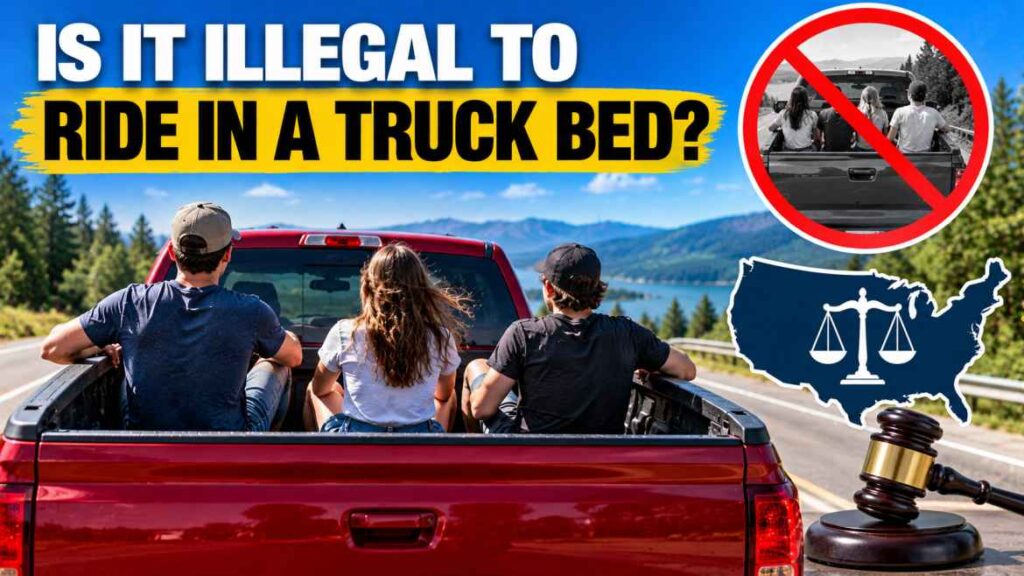
Whether it is legal to ride in a truck bed depends on the state and, in some cases, the age of the passenger, road type, vehicle configuration and reason for the trip. There is no single nationwide rule that makes riding in an open pickup bed legal or illegal everywhere.
Quick Answer
Some states have no specific state law restricting passengers in pickup cargo areas, while others impose age, speed, road, vehicle or activity restrictions. The Insurance Institute for Highway Safety’s June 2026 state-by-state summary lists restrictions in many states and no specific state law in others. Even where it is legal, an open truck bed is not designed as a passenger compartment and offers little protection in a crash.
This article is a general information guide, not legal advice. State laws can change, and local rules may also matter. Verify the current statute or official state guidance before carrying a passenger in a truck bed.
Why Riding in a Truck Bed Is Dangerous
Pickup beds do not provide the restraint systems and occupant protection found in a passenger compartment. A person in an open bed can be thrown from the vehicle during a crash, sudden stop or sharp maneuver. There is also no conventional seat belt, airbag system or enclosed occupant structure protecting the passenger.
IIHS specifically notes that pickup beds are not designed for people and offer no protection in a crash. Legality and safety are therefore two separate questions: something can be permitted under a state’s law and still be a poor safety choice.
State-by-State Summary
The table below summarizes the June 2026 information published by IIHS. “No state law” means IIHS did not identify a state law specifically restricting riding in cargo areas; it does not mean that every circumstance is automatically safe or lawful. Restrictions and exceptions can be detailed, so the official state statute should be checked for a specific situation.
| State / District | General status in June 2026 |
|---|---|
| Alabama | No state law |
| Alaska | No state law |
| Arizona | No state law |
| Arkansas | Restricted, with listed exceptions |
| California | Restricted, with specific exceptions |
| Colorado | Restricted; enclosed cargo-area situations have an exception |
| Connecticut | Restricted by age, with exceptions |
| Delaware | No state law |
| District of Columbia | Restricted, with listed exceptions |
| Florida | Restricted, with age and road-type exceptions |
| Georgia | Restricted, with age and road-type exceptions |
| Hawaii | Restricted, with age and vehicle-condition exceptions |
| Idaho | No state law |
| Illinois | No state law |
| Indiana | No state law |
| Iowa | No state law |
| Kansas | Restricted, with age and road-related exceptions |
| Kentucky | No state law |
| Louisiana | Restricted, with age and road-related rules |
| Maine | Restricted, with age and activity exceptions |
| Maryland | Restricted, with age and speed-related exceptions |
| Massachusetts | Restricted, with age and trip-related exceptions |
| Michigan | Restricted, with age and speed-related exceptions |
| Minnesota | No state law |
| Mississippi | No state law |
| Missouri | Restricted, with multiple exceptions |
| Montana | No state law |
| Nebraska | Restricted, with age and parade exceptions |
| Nevada | Restricted, with age and activity exceptions |
| New Hampshire | No state law |
| New Jersey | Restricted, including an employee-duty exception |
| New Mexico | Restricted by age |
| New York | Restricted with trip-length, seating and age-related exceptions |
| North Carolina | Restricted, with age and activity exceptions |
| North Dakota | No state law |
| Ohio | Restricted, with age, speed and vehicle exceptions |
| Oklahoma | No state law |
| Oregon | Restricted, with age and activity exceptions |
| Pennsylvania | Restricted, including a speed condition for adults |
| Rhode Island | Restricted, with age-related rules |
| South Carolina | Restricted, with age, speed and activity exceptions |
| South Dakota | No state law |
| Tennessee | Restricted, with age and road-related exceptions |
| Texas | Restricted for people under 18, with several exceptions |
| Utah | No state law |
| Vermont | No state law |
| Virginia | Restricted, with age and farming exceptions |
| Washington | No state law |
| West Virginia | No state law |
| Wisconsin | Restricted, with several exceptions |
| Wyoming | No state law |
Why State Exceptions Matter
State laws can be much more specific than a simple “legal” or “illegal” label suggests. A state may allow adults but restrict children, permit riding only below a particular speed, allow certain agricultural activities, create exceptions for parades or emergencies, or treat an enclosed cargo area differently from an open bed.
Texas is a useful example. Current Texas law prohibits operating an open-bed pickup when a child younger than 18 is occupying the bed, but the statute lists exceptions including certain emergencies, parades, beach driving, specified farm operations and a vehicle that is the only vehicle owned or operated by members of a household.
Open Bed vs Covered Cargo Area
Do not assume a camper shell or other enclosure automatically turns a pickup bed into a normal passenger compartment. State statutes can define covered or enclosed cargo areas differently, and an enclosure does not automatically create approved seating or restraint systems.
If a vehicle has manufacturer-designed passenger seating outside the cab or a professionally engineered passenger compartment, different rules may apply. Check the exact vehicle and state requirements.
What About Children?
Children deserve particular caution because many state restrictions focus on minors. Even where an adult might legally ride in a cargo area, the same state may prohibit or restrict children from doing so.
Do not rely on an old family practice or advice from another state. Age thresholds and exceptions vary considerably.
What About Parades, Farms and Hayrides?
Several states include exceptions for parades, farming, hunting, emergencies or hayrides. These exceptions are not universal and can come with conditions involving speed, location, age or vehicle configuration.
An event organizer should verify the current law rather than assuming that a traditional activity is automatically exempt.
What About Highways?
Road type can matter. Some laws distinguish interstate or limited-access highways from local roads, county roads or other routes. A trip that is permitted under one set of circumstances may not be permitted on another road.
Is It Safe If It Is Legal?
No. Legal permission does not mean the cargo bed provides adequate crash protection. The safest place for passengers is a designated seating position equipped with the appropriate restraint system.
What Should You Do Before Carrying a Passenger?
- Check the current law in the state where the vehicle will operate.
- Check whether local rules add restrictions.
- Confirm whether the passenger’s age changes the rule.
- Check whether the road type, speed or purpose of the trip matters.
- Do not assume a camper shell creates a legal passenger seat.
- Use the vehicle’s normal passenger seating whenever possible.
Where to Verify the Law
For a real-world legal decision, use the current state code, department of motor vehicles or state transportation agency rather than relying only on a general internet article. IIHS’s June 2026 table is a useful starting point, but IIHS itself says its material is for general information and should be independently verified.
See the IIHS pickup-bed passenger restrictions page for the current state-by-state summary and then check the official statute for the state involved.
FAQ
Is it illegal to ride in a truck bed in every state?
No. IIHS’s June 2026 summary lists several states with no state law specifically restricting riding in cargo areas, while other states impose restrictions.
Can adults ride in a truck bed where children cannot?
In some states, yes. Age is one of the factors used in several state laws. The exact rule depends on the state and circumstances.
Can I ride in a truck bed during a parade?
Some states provide parade exceptions, but the conditions vary. Check the law for the specific state and event.
Does a tonneau cover make truck-bed passengers legal?
No general rule says that it does. A tonneau cover is a cargo accessory, not automatically an approved passenger compartment.
Bottom Line
There is no single nationwide answer to whether riding in a truck bed is legal. State laws vary by age, road, speed, vehicle configuration and activity, and several states have no specific cargo-area restriction. Regardless of the law, an open pickup bed is not designed to protect passengers in a crash. Use a proper passenger seat and restraint whenever possible, and verify the current state law before relying on an exception.