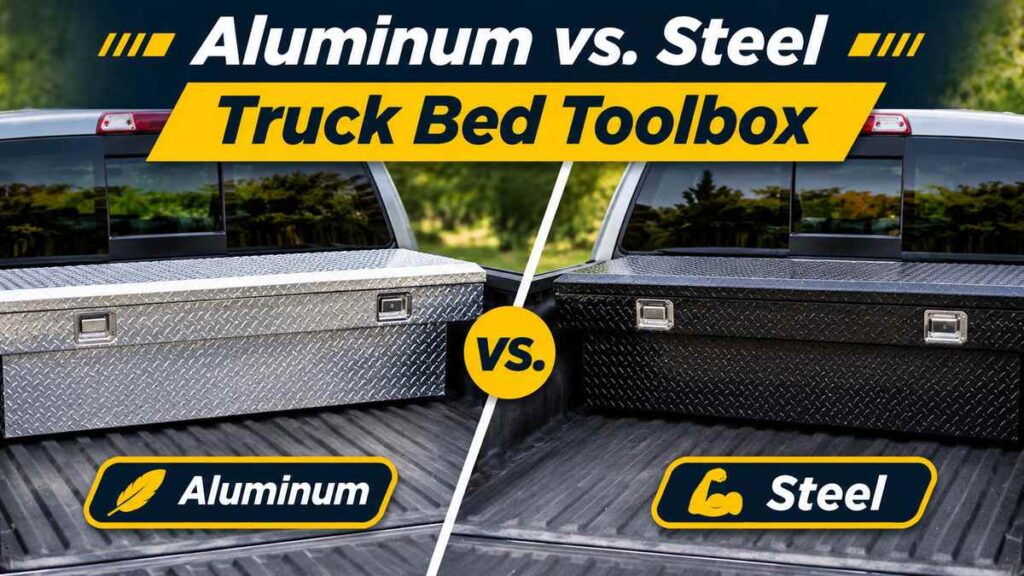
Choosing between an aluminum vs. steel truck toolbox comes down to what you carry, how much weight your truck can spare, the conditions the box will face, and how much maintenance you are willing to do. Aluminum is usually the lighter, corrosion-resistant choice; steel can make sense when impact resistance, a coated finish, or a lower purchase price matters more. Neither material automatically makes a toolbox secure or weatherproof—the design, construction, lock, seal, mounting, and fit still matter.
Choose an aluminum truck toolbox if low weight and corrosion resistance are priorities, especially for a daily-driven pickup or a truck that sees wet weather. Consider a steel truck toolbox if you prefer a heavier box and find a model with the construction, finish, and security features that suit demanding work use. Compare actual model weights, steel coating, aluminum thickness, lid reinforcement, seals, locks, warranty, and truck fitment rather than assuming every box made from one material outperforms every box made from the other.
- Aluminum vs. Steel at a Glance
- What Aluminum Toolboxes Do Well
- What Steel Toolboxes Do Well
- Durability, Rust, and Maintenance
- Weight, Payload, and Installation
- Security and Weather Protection
- Crossover, Side-Mount, Chest, and Low-Profile Boxes
- Under-Tonneau vs. Crossover Toolboxes
- How to Choose the Right Material
- Frequently Asked Questions
- Final Verdict
Aluminum vs. Steel Truck Toolboxes at a Glance
| Factor | Aluminum toolbox | Steel toolbox |
|---|---|---|
| Weight | Usually lighter for a comparable design | Usually heavier |
| Corrosion | Does not rust like iron-based steel, though finishes and hardware can still corrode | Can rust if the protective coating is damaged or neglected |
| Impact and dent resistance | Depends heavily on alloy, thickness, shape, and reinforcement; thin panels can dent | Often a good choice for a rigid, impact-tolerant box, depending on gauge and construction |
| Maintenance | Wash and inspect; care for seals, hinges, locks, and finish as directed | Inspect coating for chips, scratches, and rust; repair exposed metal promptly |
| Price | Can cost more, but varies by design and brand | Can be less expensive in some categories; heavy-duty models can still cost more |
| Best fit | Buyers prioritizing lower weight and corrosion resistance | Buyers prioritizing a particular steel construction, finish, or work-duty design |
This is a general comparison, not a guarantee about every model. For example, a thick, well-reinforced aluminum box can be more suitable for a given job than a thin steel box with a weak lid or latch. Compare the specifications of the exact products you are considering.
What Aluminum Truck Toolboxes Do Well
Aluminum is common in pickup toolboxes because it offers a useful balance of low weight and corrosion resistance. A lighter box is easier to handle during installation and adds less to the truck’s payload than a heavier box of similar size. That can matter if you regularly carry tools, materials, camping gear, or other cargo in addition to the toolbox.
Aluminum also does not form iron rust in the way ordinary steel does. It can still oxidize, stain, suffer galvanic corrosion around dissimilar metals, or have hardware and finish problems, so it is not maintenance-free. Still, buyers who park outdoors or work in damp conditions often value its resistance to red rust.
Construction is important. Aluminum boxes may use smooth sheet or diamond-tread plate, and thickness varies. A textured surface may help hide scuffs, but the pattern alone does not tell you how strong the box is. Look for details about the material thickness, seams, lid design, reinforcement, hinges, and latch mounting. Manufacturer specifications for individual products are more useful than assuming all aluminum toolboxes are built alike.
Aluminum toolbox advantages
- Usually weighs less than a comparable steel design.
- Resists the red rust associated with exposed carbon steel.
- Often easier to lift, reposition, or remove when the design allows it.
- Available in many crossover, chest, side-mount, and low-profile configurations.
Aluminum toolbox trade-offs
- Thin panels can dent, and hinges, latches, seams, and lids may be the weak points of an inexpensive design.
- Some aluminum models cost more than similarly sized basic steel options.
- Corrosion resistance does not guarantee a waterproof box or a theft-resistant lock.
What Steel Truck Toolboxes Do Well
Steel is worth considering when you want a rigid box for frequent work use and have found a model whose gauge, reinforcement, finish, and hardware suit your needs. Steel construction can offer good resistance to knocks and deformation, but thickness and design matter: the word “steel” alone does not tell you how well a particular lid, hinge, or lock will hold up.
Steel boxes often rely on paint, powder coating, or another protective finish to slow corrosion. That coating is part of the toolbox’s durability. A deep scratch or chip that exposes bare steel should not be ignored, particularly if the truck sees rain, road salt, coastal air, or wet job sites. Follow the manufacturer’s cleaning and touch-up guidance.
Steel toolbox advantages
- Can be a practical choice for work-oriented designs built around a robust steel shell.
- May offer a lower entry price in some sizes and configurations.
- Can be a good fit when a particular steel model provides the required latch, lock, and mounting features.
Steel toolbox trade-offs
- Usually adds more weight, reducing the payload available for tools and cargo.
- Damaged protective coatings can expose steel to rust.
- Greater weight can make installation or removal more difficult, especially for larger boxes.
Durability, Rust, and Maintenance
It is tempting to describe steel as “stronger” and aluminum as “weaker,” but that oversimplifies the decision. Resistance to dents, twisting, prying, and repeated lid use depends on the alloy or steel grade, thickness, formed shape, welds, seams, lid reinforcement, hinge layout, and how the box is mounted. A heavy box can still have a poorly supported lid; a lighter box can be well engineered for its intended use.
For aluminum, inspect for bent panels, cracked welds, loose hardware, worn hinges, and damage around the mounting points. For steel, inspect those same structural areas and pay particular attention to chipped paint, bubbling finish, rust at seams, and corrosion around fasteners. For either material, clean out grit and moisture, keep seals clear, and maintain locks and hinges according to the manual.
Weather protection is a separate issue from material. A well-sealed steel toolbox can protect tools better from rain than a poorly sealed aluminum one. Check the gasket design, lid overlap, drain or water-management details if provided, and the manufacturer’s limitations. Treat terms such as “weather-resistant” and “waterproof” carefully; do not assume a toolbox can be submerged or withstand direct high-pressure washing.
Weight, Payload, and Installation
Toolbox weight is not just an installation concern. It becomes part of the truck’s load, along with tools, passengers, accessories, and cargo. Check the payload rating on your truck’s door-jamb label and consult the owner’s manual for the vehicle’s limits. Do not choose a steel box without accounting for its actual listed weight, especially if the truck already carries a bed cover, rack, drawers, or heavy equipment.
Compare the listed weight of the exact models you are considering rather than relying on a broad rule of thumb. Dimensions and material thickness can differ substantially between boxes, and a larger aluminum box may still weigh more than a smaller steel one. If you expect to remove the box seasonally or transfer it between vehicles, weight and mounting method become even more important.
Installation depends on the box style and the truck. Many crossover boxes use brackets or J-hooks, while some chest and side-mount designs may require different hardware or drilling. Follow the model-specific instructions, verify lid clearance against the cab, check bed-rail compatibility, and ensure the box is secured to appropriate mounting points. Do not drill without checking what is beneath the bed and how the installation affects the vehicle’s finish or warranty.
Security and Weather Protection: Material Is Only One Part
Neither aluminum nor steel automatically makes a toolbox theft-proof. Security depends on the lock, latch design, hinge exposure, lid overlap, mounting hardware, and how accessible the contents are. A locked toolbox can deter casual access, but it should not be treated as a guarantee against forced entry. If you carry expensive tools, compare the actual locking system and consider whether the box can be removed easily from the truck.
Similarly, weather protection comes from the whole design. Look for a continuous gasket, well-aligned lid, sturdy hinges, and a shape that sheds water. Check product documentation for what the manufacturer claims and inspect the seal periodically. If tools must stay dry, consider placing sensitive electronics or precision tools in additional protective cases inside the toolbox.
Crossover vs. Side-Mount vs. Chest Toolboxes
Material and mounting style answer different questions: aluminum versus steel is about construction; crossover versus side-mount or chest is about where the box sits and how it uses the bed. Decide on the layout first, then compare material choices among models that fit your truck.
Crossover toolbox
A crossover, sometimes called a saddle toolbox, spans the bed behind the cab and usually rests on the bed rails. It leaves much of the bed floor open but occupies space near the front of the bed. Check rail-to-rail fit, lid clearance, and whether its height blocks part of the rear-window view.
Side-mount toolbox
A side-mount box sits along a bed side or rail, depending on its design. It can provide convenient access from outside and preserve the center of the bed for larger items, but the box may narrow usable bed space. Check the mounting system and compatibility with bed caps, racks, and other rail accessories.
Chest toolbox
A chest-style box sits on the bed floor. It can suit buyers who want a lower profile or need a layout that may work beneath a compatible tonneau cover. The trade-off is that it uses floor space and can make it harder to slide large cargo in and out. Measure the wheel-well spacing and the lid’s opening path.
Low-profile vs. full-height toolbox
A low-profile crossover box lowers the lid relative to a standard-height design, which can improve rear visibility and help clear some accessories. A full-height box may offer more usable volume, depending on its shape. Neither profile is inherently better; compare internal dimensions, lid clearance, and the space available with your truck’s cab and bed accessories.
Under-Tonneau Toolbox vs. Crossover Toolbox
If you want to keep a tonneau cover on the truck, do not assume a standard crossover toolbox will fit underneath it. Crossover boxes sit at or above the bed rails, where many covers need to mount or travel. Some tonneau systems are designed for a compatible toolbox, but compatibility depends on the specific cover, box height, mounting rails, and truck model.
A lower chest or other compact box may fit below a cover, but you must compare actual dimensions and allow room for the lid to open. Check the cover and toolbox manufacturers’ fitment guidance before ordering. Do not rely on labels such as “low profile” alone as proof that two accessories will work together.
How to Choose the Right Toolbox for Your Truck
- Decide where the box should sit. Choose crossover, side-mount, chest, or another layout based on cargo space and access.
- Measure your truck. Check bed width, rail shape, cab clearance, wheel-well space, and any cover or rack interference.
- Compare actual weight. Include the toolbox and its contents when considering payload.
- Inspect construction details. Compare metal thickness, seams, lid reinforcement, hinges, and mounting points.
- Check the seal and lock. These features can matter more to daily usefulness than material alone.
- Consider your environment. If the box will face rain, road salt, or coastal conditions, pay attention to corrosion protection and maintenance guidance.
- Read the warranty and instructions. Confirm what is covered and whether the intended installation is permitted.
For a shortlist of specific models and layouts, see our Best Truck Bed Tool Boxes guide. Use it to compare available options after deciding what material, dimensions, and mounting style suit your needs.
Frequently Asked Questions
Is aluminum or steel better for a truck toolbox?
Aluminum is usually the better starting point when low weight and corrosion resistance are priorities. Steel may suit buyers who prefer a particular heavy-duty steel design or want to keep the initial price down. Compare the exact construction and features before deciding.
Do aluminum truck toolboxes rust?
Aluminum does not develop red iron rust like ordinary steel, but it can oxidize and can suffer corrosion under some conditions. Hardware and dissimilar-metal contact can also corrode, so cleaning and inspection still matter.
Are steel toolboxes more secure?
Not automatically. Security depends on panel thickness, lid and hinge construction, lock and latch design, mounting hardware, and installation. Compare those features rather than using material as the only measure.
Does an aluminum toolbox improve fuel economy?
A lighter toolbox adds less weight than a heavier comparable box, but the real effect on fuel consumption depends on the truck, driving conditions, load, and other factors. Do not assume a specific fuel-economy improvement without reliable testing for the setup.
Can a toolbox fit under a tonneau cover?
Some combinations can work, but fitment is specific to the truck, cover, and toolbox. Check dimensions and manufacturer compatibility guidance, including clearance for opening the lid.
Should I buy a low-profile or full-height crossover toolbox?
Choose low profile if rear-window visibility or clearance is important. Choose full height if the added storage volume is worth the height for your truck. Compare internal dimensions and confirm cab and cover clearance.
Final Verdict: Aluminum or Steel?
For many pickup owners, aluminum is the sensible starting point because it keeps weight down and resists red rust. Steel deserves consideration when a particular model’s construction, finish, price, or work-duty design better matches the job. Neither material is a substitute for checking the lid, lock, gasket, mounting system, and fitment.
Choose the mounting style that works with your bed and accessories first. Then compare the actual toolbox weight, material thickness, corrosion protection, internal dimensions, and warranty. If you want to compare specific options, continue to our Best Truck Bed Tool Boxes guide.
Product designs and specifications vary. Confirm dimensions, materials, ratings, installation requirements, and warranty details with the manufacturer before purchase.