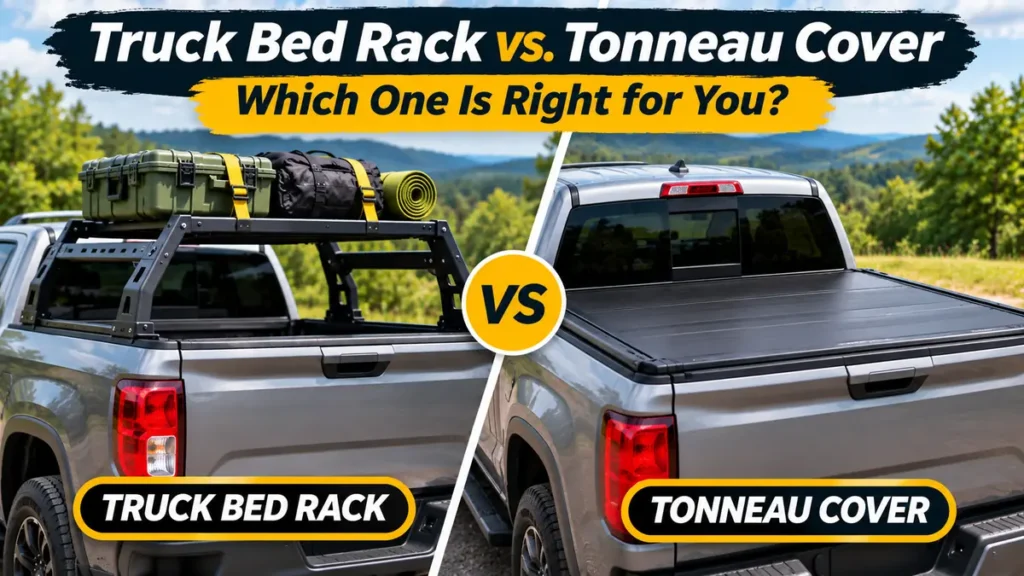
A truck bed rack and a tonneau cover solve different problems. A rack adds elevated support for cargo and accessories, while a tonneau cover closes off the bed to help shield cargo from weather and view. You may not need to choose just one: some rack-and-cover combinations are designed to work together. The key is matching the exact rack, cover, truck, and mounting system.
Choose a truck bed rack when you need to carry gear above the bed—such as bikes, boards, recovery equipment, or a compatible rooftop tent—and want accessory mounting points.
Choose a tonneau cover when your priority is covering cargo inside the bed, improving weather resistance, reducing visibility into the bed, or keeping a lower-profile setup.
Want both? It can work with a rack and cover specifically designed to be compatible, often through T-slot accessory rails or a manufacturer-approved mounting kit. Many ordinary covers and racks compete for the same bed-rail space, so never assume they will fit together.
- Truck Bed Rack vs. Tonneau Cover at a Glance
- What Each Accessory Does
- When a Truck Bed Rack Makes Sense
- When a Tonneau Cover Makes Sense
- Can You Use a Rack With a Tonneau Cover?
- Compatibility and Fitment Checks
- Trade-Offs, Cost, and Everyday Use
- Which Setup Should You Choose?
- Frequently Asked Questions
- Final Verdict
Truck Bed Rack vs. Tonneau Cover at a Glance
| Factor | Truck bed rack | Tonneau cover |
|---|---|---|
| Main job | Carry cargo or accessories above the bed | Cover the bed and cargo below it |
| Best suited to | Gear that needs elevated support or specialized mounting points | Everyday cargo that benefits from a covered bed |
| Weather protection | Usually little or none on its own | Helps shield cargo; actual water resistance varies by design and installation |
| Security and visibility | Does not enclose cargo by itself | Can conceal cargo and some hard covers offer lockable access; security varies |
| Bed access | Usually leaves the bed open, depending on the rack | Depends on style: roll-up, folding, retractable, or one-piece |
| Height and profile | Adds structure above the bed and can increase vehicle height | Usually a lower-profile addition, though canisters and rails take up space |
| Can they be combined? | Only with compatible cover rails, mounts, or approved adapters | Only with a rack designed for that cover and truck configuration |
These are general differences, not guarantees about every product. Rack height, cover construction, mounting hardware, cargo ratings, and access features vary by model. Check the specifications for the exact parts you plan to install.
What Each Accessory Does
A truck bed rack adds elevated carrying space
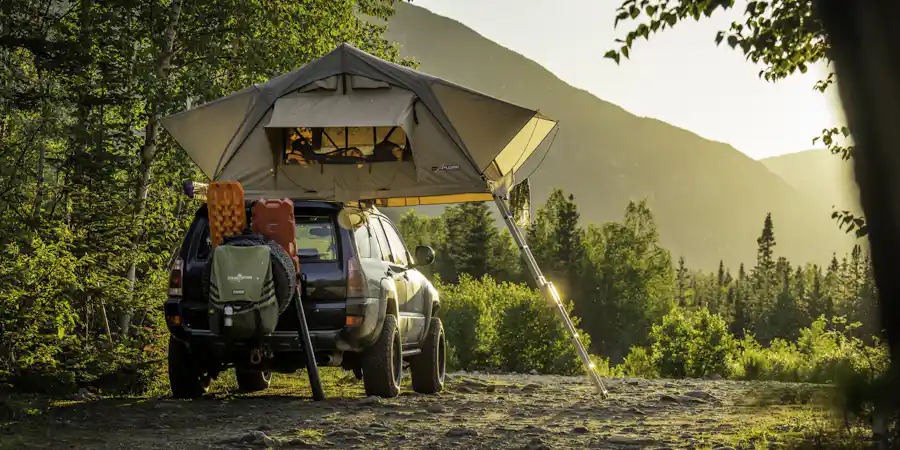
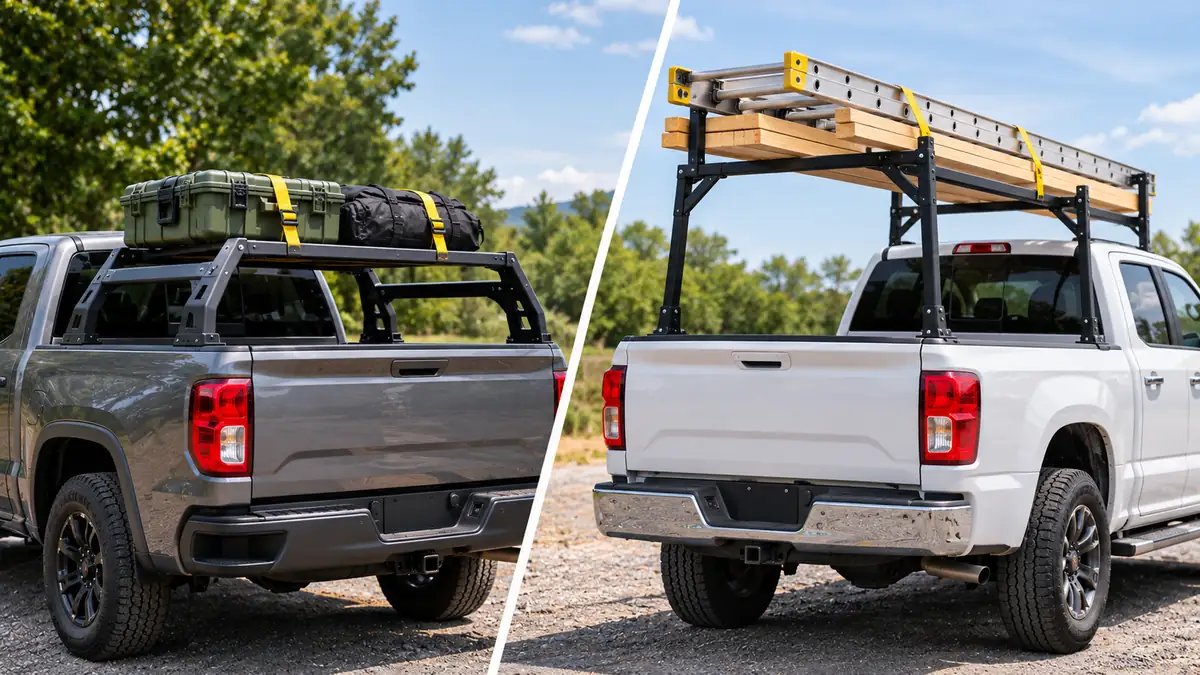
A bed rack mounts to the truck’s bed rails, stake pockets, tracks, or another approved mounting point. Crossbars, uprights, or a platform provide support for gear that would be awkward to carry directly on the bed floor. Depending on the model, owners may use racks for bikes, kayaks, boards, recovery equipment, cargo cases, awnings, or rooftop tents.
Racks vary widely. A low-profile bar system is different from a mid-height modular rack or a tall overland platform. Their accessory compatibility and load ratings also differ. Do not assume that a rack designed for light cargo can support a tent or that every rack can be safely used off-road.
If you’re still deciding between rack styles, see our Best Truck Bed Racks guide. For a related comparison of rack designs, read Truck Bed Rack vs. Ladder Rack.
A tonneau cover closes off the bed
A tonneau cover sits over the truck bed. Depending on its design, it may roll, fold, retract into a canister, or lift as a single panel. It can help keep rain, road spray, dust, and debris away from cargo, although no cover should be assumed completely waterproof. Seals, drains, installation, and weather conditions affect how much moisture enters.
A cover can also make cargo less visible from outside the truck. Hard covers may provide a more rigid barrier and may integrate with the truck’s locking tailgate, but a tonneau cover is not a substitute for a secure enclosed cargo area in every situation. Soft and hard covers differ in construction, access, price, and resistance to forced entry.
For a broader product overview, visit our Best Truck Bed Covers guide. If you’re comparing cover construction, our hard vs. soft tonneau cover comparison explains the main trade-offs.
When a Truck Bed Rack Makes Sense
A rack is useful when the shape of your cargo makes the bed floor inconvenient or when you want mounting points above the bed. Long gear, bicycles, camping equipment, and certain accessories may be easier to organize on crossbars or a platform. A rack can also leave room below for other cargo, though the rack’s uprights and supports may limit how the bed is loaded.
Think about the exact equipment first. A tent, awning, bike carrier, or kayak mount may require particular crossbar spacing, mounting hardware, and a rated load capacity. Some systems publish separate static, on-road, and off-road limits; those ratings are not interchangeable. The truck’s payload and bed-rail limits still matter.
The main compromise is that a rack does not cover cargo in the bed. It can also add height, weight, wind exposure, and loading complexity. Measure the truck with the rack installed and consider garages, parking structures, branches, and any other height restrictions on your regular routes.
When a Tonneau Cover Makes Sense
A tonneau cover is usually the more direct choice if your everyday goal is to cover tools, luggage, groceries, or other cargo in the bed. It helps keep items out of direct view and can reduce exposure to weather and road debris. The level of protection depends on the cover style, its seals, how it is installed, and the conditions in which you drive.
Cover style affects how much access you retain. A roll-up cover can open much of the bed with relatively little panel storage; a folding cover stacks panels near the cab; a retractable cover moves into a canister that occupies some bed space; and a one-piece hinged cover lifts as a panel. Compare usable bed space, access to tall cargo, installation hardware, and maintenance—not just the outside appearance.
A cover can be less suitable when you frequently carry cargo that rises above the bed rails, or when a rack or other accessory needs the same mounting area. Some covers have integrated accessory tracks, but these are model-specific systems rather than universal rails.
Can You Use a Rack With a Tonneau Cover?
Yes, some setups are designed for both. The most important detail is the mounting interface. Certain covers have T-slot or accessory rails that accept compatible rack feet or brackets. Other systems use vehicle-specific rails or adapters that preserve clearance for the cover. Some rack designs mount independently to approved points on the truck and may work alongside particular inside-the-rail covers.
However, many traditional rack mounts clamp over or occupy the bed rails where a tonneau cover also needs to sit. A cover that physically fits under a rack is not necessarily compatible: the rack may block the cover from opening, interfere with its seals, change how it is supported, or violate the manufacturer’s installation instructions.
Manufacturer guidance illustrates why the pairing must be checked individually. ADARAC’s official FAQ describes compatibility with certain cover types and calls out a specific clearance measurement for its mounting area. BillieBars’ tonneau fitment guide lists cover-specific rack options and notes that some installations may require weatherstripping or rail modifications. These are examples of particular systems—not proof that all racks fit all covers.
Before buying, confirm both products’ exact model names and part numbers with the manufacturers. If either company does not explicitly approve the combination, ask its support team rather than relying on photos, forum comments, or a generic statement that the products are “compatible.” Avoid cutting rails or changing hardware unless the manufacturer provides instructions for that exact setup.
Compatibility and Fitment Checks
Start with your truck: make, model year, bed length, bed-rail design, factory tracks, and bedliner type. The same accessory may fit one configuration but not another. Also account for toolboxes, tie-downs, bed caps, tailgate accessories, and other hardware that may occupy the mounting area.
Then check the rack-to-cover connection. Confirm whether the rack mounts into T-slots, clamps to a rail, uses a dedicated adapter, or attaches separately to the bed. Verify that the fasteners and load path are approved for the combined setup. A cover’s accessory rails have their own limits, and a rack’s advertised capacity may depend on how it is mounted.
Finally, check operation and clearance. Can the cover open, fold, or retract as intended with the rack installed? Does a canister reduce the available bed length? Can you reach clamps and locks? Do the rack feet interfere with the cover’s seals or drainage? If the cover opens only partially with the rack fitted, decide whether that compromise works for your cargo.
Read the installation instructions for both accessories and follow specified torque values. After installation, check that all panels and latches move freely, seals sit as intended, and fasteners remain secure. If the instructions conflict, stop and contact the manufacturers instead of improvising.
Trade-Offs, Cost, and Everyday Use
Buying a rack and cover separately can cost more than choosing one accessory, especially if the combination requires special rails, brackets, or adapters. Compare the complete installed cost—not only the headline price. Include any required hardware, professional installation, and possible cover-specific accessories.
Maintenance also depends on the design. Covers may need seal cleaning, drain checks, latch adjustment, or lubrication according to the manual. Racks need periodic checks of fasteners, mounting points, crossbars, and finishes. A combination adds more joints and interfaces to inspect, so follow both manufacturers’ maintenance schedules.
Consider how you use the truck on an ordinary week. If you rarely carry oversized gear, a cover may solve the main problem. If you often haul bikes or camping equipment, a rack may be more useful. If you need covered cargo and elevated gear at the same time, a compatible combo can be practical—but only if the cover remains usable and the mounting system is approved for the load.
Which Setup Should You Choose?
Choose a rack alone if:
- Your main need is elevated support for gear or accessories.
- You do not regularly need to cover cargo in the bed.
- The rack fits your truck and is rated for your intended cargo and driving conditions.
Choose a tonneau cover alone if:
- You mostly carry cargo inside the bed and want it covered or less visible.
- You prefer a lower-profile setup and do not need elevated mounting points.
- The cover style gives you the bed access you need for daily use.
Choose a compatible rack-and-cover system if:
- You want covered storage below and carrying capacity above.
- The exact rack, cover, and truck configuration are approved to work together.
- The cover can still open and operate in a way that suits your routine.
- The combined load limits, installation requirements, and total cost make sense.
Frequently Asked Questions
Does a truck bed rack replace a tonneau cover?
No. A rack supports cargo or accessories above the bed; a tonneau cover closes off the bed. They serve different purposes, and one does not automatically provide the benefits of the other.
Can I add a rack to my existing tonneau cover?
Sometimes. The cover must have a compatible mounting interface or an approved rack adapter, and the truck configuration must be supported. Check the exact cover model and rack instructions before purchasing.
Do all T-slot tonneau covers fit all truck bed racks?
No. T-slot dimensions, hardware, rail design, load limits, and vehicle fitment can vary. A T-slot is a mounting approach, not a universal compatibility guarantee.
Will a rack stop my tonneau cover from opening?
It depends on the combination. Some systems are designed to preserve cover operation, while others can block folding panels, retracting mechanisms, latches, or access to the bed. Confirm operation for the exact pairing.
Is a tonneau cover waterproof?
Do not assume any tonneau cover is completely waterproof. Many help reduce water entry, but seals, drains, installation, wear, and weather conditions affect performance. Follow the cover manufacturer’s care and installation instructions.
Can I carry a rooftop tent on a rack mounted to a tonneau cover?
Only when the rack, cover mounting system, and truck configuration are specifically approved for that use. Check the relevant static and dynamic ratings, the truck’s limits, and any off-road restrictions. Do not assume the cover rails can carry a tent just because they accept a rack.
Final Verdict
A truck bed rack and a tonneau cover are not direct substitutes. The rack expands how you carry gear above the bed; the cover helps protect and conceal cargo below. Choose based on the job you need to solve first, then consider whether a compatible combination can do both.
If you want both, make fitment the deciding factor. Verify the exact truck, bed, rack, cover, mounting hardware, load limits, and cover operation with the manufacturers before ordering. A properly matched setup can be versatile, but a mismatched one can interfere with access, sealing, or safe mounting.