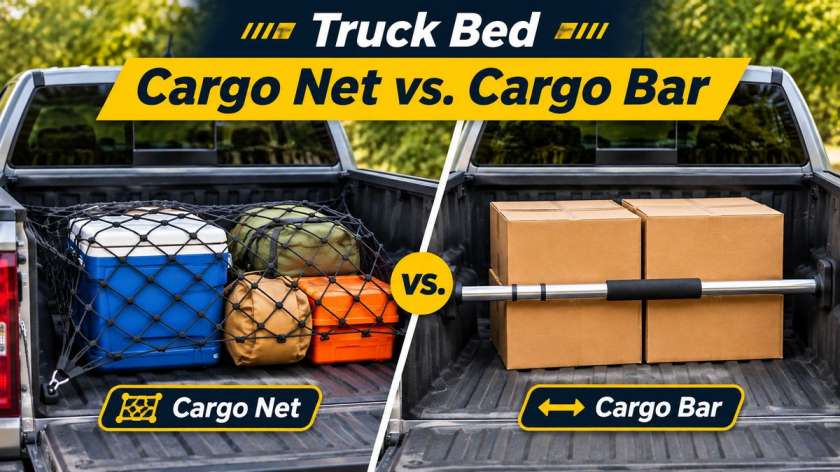
A cargo net and a cargo bar can both help keep items from moving around in a pickup bed, but they solve different problems. A net stretches over cargo to contain loose or irregularly shaped items. A cargo bar spans the bed and acts as a movable divider, helping brace boxes, bins, and other items against sliding in a particular direction.
If you are choosing between a truck bed cargo net vs. cargo bar, start with the shape of your load and how it could move. Small, mixed items are usually easier to contain with a net; uniform boxes or storage bins that need a physical stop may be easier to manage with a bar. For heavy, tall, fragile, or high-risk cargo, neither should automatically replace properly rated tie-down straps attached to suitable anchor points.
Choose a cargo net when you need flexible coverage over multiple loose items, bags, light gear, or irregular shapes. Choose a cargo bar when you need an adjustable divider to limit sliding by boxes, totes, coolers, or tool cases. If cargo can tip, bounce, roll, or move in more than one direction, use an appropriate combination of blocking, a net or bar, and rated tie-downs according to the load and product instructions.
Cargo Net vs. Cargo Bar at a Glance
| Factor | Cargo net | Cargo bar |
|---|---|---|
| Main job | Flexible containment across or around a load | Creates a rigid divider or brace across the bed |
| Best suited to | Mixed small items, bags, light gear, and irregular shapes | Boxes, totes, coolers, and items that can sit against a barrier |
| Coverage | Can cover a broad area or wrap around a load, depending on design | Usually contacts cargo along a narrow line or edge |
| Adjustment | Stretch, webbing, hooks, and attachment points vary by model | Typically adjusts to span a specified range of bed widths |
| Installation | Needs suitable attachment points and correct tension | Needs compatible bed width and secure contact surfaces |
| Limitations | May stretch or allow small objects through openings; not all nets are load-rated for heavy restraint | Does not wrap around cargo and may not prevent lifting, tipping, or movement in other directions |
| Best role in a securement plan | Containment or supplementary restraint within the product’s rating | Blocking or separation, often alongside other restraint when needed |
These are broad category differences, not universal specifications. Some cargo nets use adjustable straps and reinforced webbing; some cargo bars include a net or divider. Check the exact product’s design, stated capacity, fitment range, and instructions before relying on it.
What Is a Truck Bed Cargo Net?
A truck bed cargo net is a flexible mesh or webbing assembly that attaches to points around the load or bed. Depending on the design, it may stretch over cargo like a blanket, wrap around a group of items, or form a barrier near the tailgate. Elastic bungee nets are common for light, mixed cargo, while webbing-style nets may use buckles, straps, and multiple attachment points.
The net’s main advantage is coverage. If you are carrying grocery bags, camping gear, sports equipment, jackets, soft bags, or several small packages, one net can manage items of different shapes without requiring a separate strap across every piece. Smaller mesh can help contain smaller objects, while larger mesh may be easier to stretch over bulky cargo. The right choice depends on the object size and the net’s intended use.
A net is only as useful as its anchors and condition. Hooks must connect to suitable points, not to fragile trim or improvised locations that can pull free. Sharp corners can cut or abrade netting, and a highly stretched net may exert force differently from how it is intended to be used. If the load is heavy, extends above the bed rails, or could shift significantly during braking, follow the manufacturer’s instructions and add properly rated straps when needed. The Best Truck Bed Cargo Nets guide covers the main styles and features to compare.
What Is a Truck Bed Cargo Bar?
A truck bed cargo bar is an adjustable crossbar that spans the inside width of the bed. Most models use end pads and a tensioning or ratcheting mechanism to press against the bed walls. Once installed at the correct width, the bar can act as a movable divider behind a group of items or in front of the tailgate.
For example, if several storage bins are grouped together, a cargo bar positioned against their rear edge can help limit sliding toward the tailgate. It can also separate cargo from other items in the bed. Some designs include a cargo net or additional divider, but that does not mean every bar provides the same coverage or restraint.
Fit matters. A bar’s adjustment range must match the actual width where it will sit, and the end pads must make suitable contact with the bed surfaces. Over-tightening can damage some truck-bed walls or liners, while a bar installed at an angle or against weak surfaces may not remain secure. Do not use a cargo bar as a lifting point, a jack, a vertical support, or a substitute for the tie-down system required by the cargo. See the Best Truck Bed Cargo Bars guide for features such as adjustment range, pad design, and tensioning style.
Key Differences: Cargo Net vs. Cargo Bar
1. Shape and size of the cargo
A net is often more convenient when a load contains several unrelated items or has an uneven outline. The mesh can cover the group rather than needing a bar to meet a flat side. A cargo bar is often more convenient when items form a reasonably stable row and have a surface that can sit against the bar. Neither option makes an unstable stack safe by itself.
2. Direction of movement
A bar creates a physical stop where it contacts the cargo. It is useful for limiting movement in the direction of the barrier, but it does not automatically prevent items from moving sideways, lifting, tipping, or rolling around the ends. A net can provide broader containment, although its effectiveness depends on coverage, stretch, attachment layout, and load rating. Consider every direction the cargo could move, not just the direction that is easiest to block.
3. Installation and adjustment
A net typically requires several attachment points and enough reach to cover the load. Hooks and straps should be connected as instructed, and the net should be tensioned evenly without overstretching it. A bar usually requires fewer steps, but you must measure the width at the intended installation position and make sure the bar’s range and pads suit that location. A bar that is too short, too long, or pressed against an unsuitable surface is not a safe fit.
4. Durability and maintenance
Netting can wear from abrasion, UV exposure, sharp edges, damaged hooks, or repeated overstretching. Inspect the mesh, seams, elastic cords, webbing, buckles, and attachment hardware. Cargo bars have fewer flexible components but still need checks for bent tubes, damaged locking mechanisms, worn pads, and parts that no longer hold tension. Replace damaged equipment rather than relying on a repair that the manufacturer does not approve.
5. Storage and everyday convenience
A net often folds into a compact bundle and can be kept in a storage compartment when not in use. A bar can usually be removed and stored along a bed wall or in the cab, but it is longer and takes up more space. If you frequently change between large loads and an empty bed, consider how quickly the system can be installed and removed without being left loose in the vehicle.
When a Cargo Net Makes More Sense
A cargo net is a strong starting point when your load includes:
- Several small or mixed items: bags, light equipment, or packages that could scatter or roll around.
- Irregular shapes: items that do not form a clean, flat edge for a bar to brace against.
- Flexible or soft gear: duffels, camping accessories, folded chairs, and similar items that benefit from broad containment.
- Frequent changes in cargo: a net can adapt to different arrangements when its dimensions and rating are appropriate.
Do not choose a net based only on its advertised stretch. Check the mesh openings, overall dimensions, attachment hardware, and stated load limitations. A highly elastic net may hold light items in place but still allow a heavy object to build momentum. For heavy or tall cargo, a net may be a supplement rather than the primary restraint.
When a Cargo Bar Makes More Sense
A cargo bar is often the more practical choice when:
- You carry boxes or storage bins: a row of similarly sized items can sit against a barrier.
- You want a movable divider: the bar can separate one group of cargo from the rest of the bed.
- You load and unload frequently: an adjustable bar can be repositioned without routing a net over every item.
- You need to limit sliding toward one end: provided the bar fits correctly and the cargo is otherwise stable and adequately restrained.
Before buying, measure the inside bed width at the spot where you intend to install the bar. Check whether a bed liner, wheel-well shape, sidewall design, or accessories affect the available contact area. Read the product instructions for permitted surfaces and tensioning. A bar should not be over-tightened in an attempt to make it hold a load it was not designed to restrain.
Cargo Bar vs. Tie-Down Straps
A cargo bar and tie-down straps are not interchangeable. A bar is primarily a brace or divider; straps connect cargo to suitable anchor points and apply restraint in the directions for which the system is designed. For many loads, the correct answer is not “bar or straps” but “bar plus appropriate straps,” or straps alone when the load and configuration call for them.
Use a cargo bar to limit sliding against a barrier when the product and bed are compatible. Use rated tie-down straps when cargo needs to be secured to approved anchor points, especially if it is heavy, tall, fragile, or able to tip or move sideways. Select straps by their working load limit and intended use, and remember that the rating of the entire system depends on its weakest component—including anchors and attachment hardware. Do not treat breaking strength as the same thing as working load limit.
Straps must be routed and tightened so they restrain the cargo without damaging it. Protect webbing from sharp edges, secure loose strap tails, and avoid attaching hooks to unapproved points. If you are deciding which restraint to buy, use the Best Truck Bed Tie-Down Systems guide alongside this comparison. For a step-by-step overview, see How to Secure Cargo in a Truck Bed.
Fitment and Safe Use: What to Check Before Driving
Before loading the truck, read the instructions for the exact net or bar and check your vehicle owner’s manual for payload limits and approved anchor points. Keep the load within the truck’s ratings and distribute its weight appropriately. A restraint accessory does not increase the vehicle’s payload capacity.
- Inspect first: look for torn mesh, frayed webbing, cracked hooks, bent bars, damaged pads, and faulty locks.
- Use appropriate attachment points: connect nets and straps only where the vehicle and product instructions allow.
- Stabilize the load: place heavy items low, prevent rolling, and avoid unstable stacks.
- Protect against sharp edges: use suitable edge protection and keep sharp corners from cutting netting or straps.
- Check all directions: ask whether the load can slide forward, backward, sideways, tip, roll, or lift.
- Do not exceed ratings: check the vehicle, accessory, anchors, and tie-down components.
- Recheck during the trip: stop safely to inspect the load and tension as needed, especially after the cargo settles.
Do not assume a net or bar will hold cargo during an emergency stop simply because it feels tight while parked. If a load can cause injury or road hazards if it escapes, use a securement method designed and rated for that task, and follow applicable rules for your type of hauling.
Can You Use a Cargo Net and Cargo Bar Together?
Yes, when each accessory is compatible with the truck and used within its intended role. A cargo bar can help create a boundary for bins or boxes, while a net can contain lighter loose items that might move around or slip through gaps. Rated tie-down straps may still be necessary to restrain the main load.
For example, a bar might separate a group of storage totes from other cargo, while a net keeps a few soft bags and small items together. That arrangement is only appropriate if the bar has a proper fit, the net attaches to suitable points, and the items are not relying on these accessories beyond their ratings. Avoid piling cargo against a bar in a way that can overload it or damage the bed walls.
Frequently Asked Questions
Is a cargo net safer than a cargo bar?
Neither is automatically safer. The better option depends on the cargo, the accessory’s design and rating, how it attaches to the truck, and the directions in which the load could move. For some loads, a net offers better coverage; for others, a bar provides a useful physical stop. Heavy or unstable cargo may require rated tie-downs as well.
Can a cargo bar replace tie-down straps?
Not in every situation. A bar can help block or separate cargo, but it does not attach the load to anchor points in the same way as a properly installed tie-down system. Use rated straps whenever the load and applicable guidance require positive restraint.
Will a cargo net keep small items from falling out?
It can help, if the mesh openings are smaller than the items and the net fully covers the area that needs containment. Check the attachment points and tension, and do not assume a net can restrain heavy objects unless its instructions and rating support that use.
How do I know if a cargo bar fits my truck?
Measure the inside width of the bed at the intended mounting location, then compare it with the bar’s adjustment range. Check the shape and strength of the contact surfaces, any bed liner, and the manufacturer’s compatibility instructions. Do not force a bar to fit or overtighten it.
Should I use both a cargo net and a cargo bar?
You can use both if they serve different purposes and are installed correctly. A bar may divide or brace a group of items while a net contains loose gear. Depending on the cargo, rated tie-downs may still be required.
What should I inspect before each trip?
Check the net for cuts, fraying, stretched elastic, and damaged hooks; check the bar for bent sections, worn pads, and a locking mechanism that no longer holds tension. Confirm the load is stable, attachments are secure, and no loose ends can create a hazard. Replace damaged equipment.
Final Verdict: Which One Should You Choose?
Choose a cargo net when broad, flexible containment is the main need—especially for several small items, bags, or irregularly shaped gear. Choose a cargo bar when you need an adjustable divider or a physical stop for boxes, bins, coolers, or other cargo that can sit against it.
Neither accessory is a universal replacement for a properly rated tie-down system. Base the decision on the load’s weight, shape, possible movement, approved attachment points, and the product’s instructions. If you are still comparing options, review our guides to truck bed cargo nets, truck bed cargo bars, and truck bed tie-down systems before choosing equipment.
WheelsWire recommends checking the instructions supplied with your specific accessory and vehicle. This article is general buying guidance, not a substitute for product-specific load ratings or applicable cargo-securement requirements.