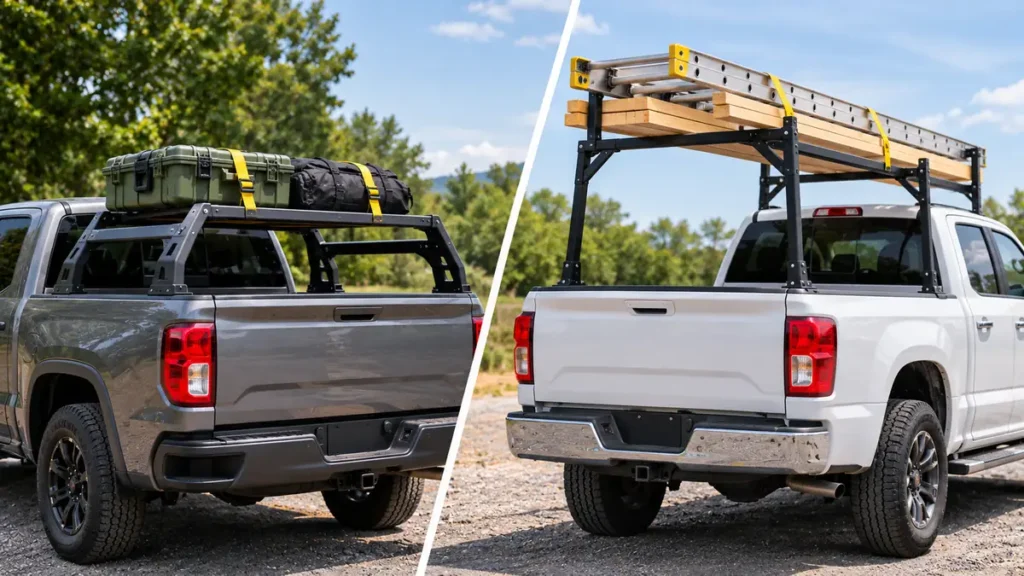
A truck bed rack and a ladder rack can both carry cargo above a pickup bed, but they are not always designed for the same job. Lower bed racks often prioritize modular gear mounting and a compact profile, while traditional ladder racks are built to support long materials such as ladders, lumber, pipe, and conduit. The right choice depends on what you haul, how high it needs to sit, and how the rack attaches to your truck.
Choose a lower truck bed rack if you mainly carry recreational gear, recovery equipment, bikes, boards, or accessories and want a compact setup with modular mounting options. Confirm that its ratings cover your intended cargo and use.
Choose a ladder rack if your regular loads are long materials—such as ladders, lumber, pipe, or conduit—that need support at separated points above the bed. A taller work rack may provide the clearance and load path you need, but it increases overall vehicle height.
The terms overlap: some ladder racks are truck-bed racks, and some adjustable bed racks can carry ladders. Compare the actual structure, mounting points, rated load, height, and accessories—not just the product name.
- Bed Rack vs. Ladder Rack at a Glance
- What Each Rack Is Designed to Do
- Structure and Load Use
- High vs. Low Truck Bed Racks
- Mounting, Fitment, and Cab Clearance
- Accessories and Tonneau-Cover Compatibility
- Materials, Maintenance, and Long-Term Value
- Which Rack Should You Choose?
- What to Check Before Buying
- Frequently Asked Questions
- Final Verdict
Truck Bed Rack vs. Ladder Rack at a Glance
| Factor | Truck bed rack | Ladder rack |
|---|---|---|
| Typical purpose | Elevated mounting for recreational gear, platforms, accessories, or mixed cargo | Support for ladders and long work materials above the bed |
| Common structure | Low, mid-height, or modular uprights with crossbars or a platform | Often two elevated support frames or crossbars spaced along the bed; designs vary |
| Typical load shape | Gear, cases, bikes, boards, recovery equipment, or a compatible tent | Ladders, lumber, pipe, conduit, and other long materials |
| Height | Often low or mid-height, but high and adjustable versions exist | Often taller to support long loads and may extend above the cab |
| Mounting | Bed rails, stake pockets, tracks, or cover-specific rails, depending on model | Bed rails, stake pockets, tracks, or vehicle-specific brackets, depending on model |
| Accessories | May support T-slot mounts, platforms, awnings, bike mounts, or tent hardware | May prioritize load stops, ladder guides, tie-down points, and work accessories |
| Main trade-off | Low clearance or modularity can limit some long-load arrangements | Height can affect garage clearance, loading, wind exposure, and daily driving |
These are common design patterns, not universal rules. Some systems are adjustable or modular and can serve both purposes. Manufacturer ratings and fitment instructions for the exact model take priority over category labels.
What Each Rack Is Designed to Do
Truck bed racks: a broad category
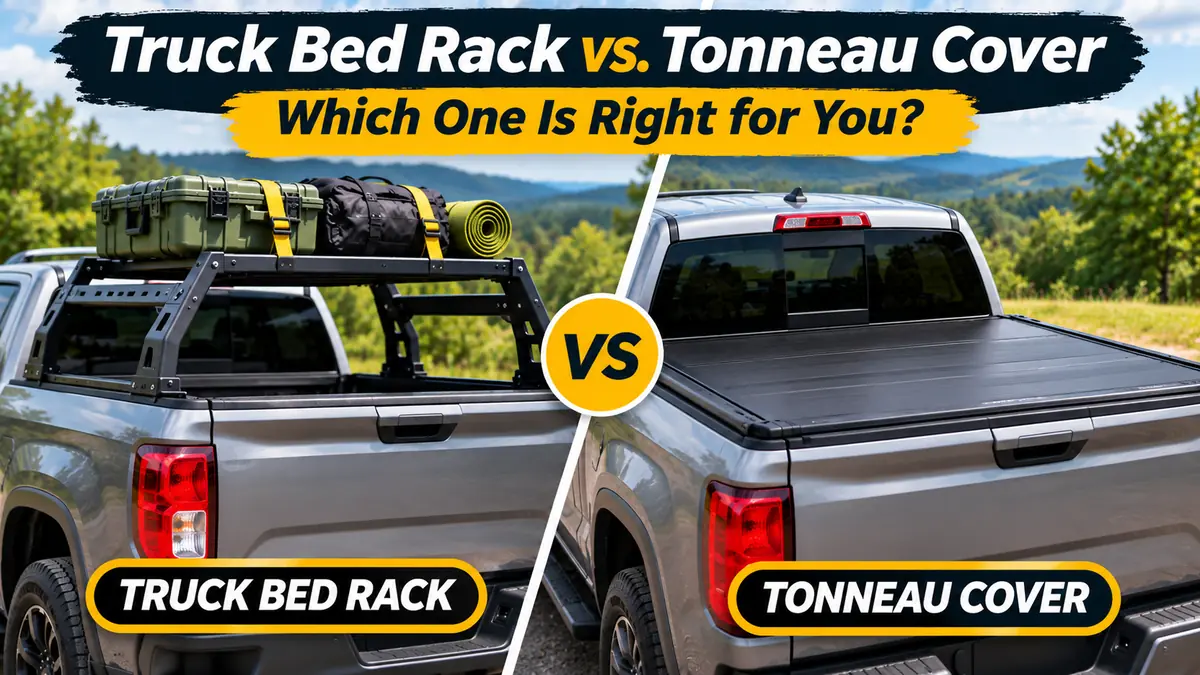
A truck bed rack adds elevated support points above the pickup bed. Depending on its shape and height, it may carry recreational gear, cargo platforms, recovery equipment, bikes, kayaks, boards, or a rooftop tent when the system is specifically rated for that use. Some bed racks stay within the bed footprint; others rise high enough to carry long materials.
Modularity is often a major reason to choose this style. Crossbar channels, T-slots, accessory brackets, and adjustable uprights can let owners configure the rack around different gear. However, accessory compatibility is product-specific: a rack that accepts a bike mount is not automatically approved for a tent or heavy construction material.
For a product-focused overview of different styles, see our Best Truck Bed Racks guide. This article focuses on choosing between rack designs rather than ranking individual models.
Ladder racks: support for long materials
A ladder rack is usually designed around carrying long objects that need support at two or more points along the truck. Common examples include extension ladders, lumber, pipe, conduit, and trim. Many work-oriented systems use elevated crossbars or a front-and-rear frame arrangement so the load can extend above the bed and, on some designs, over the cab.
The key question is how the rack supports and restrains the actual material. Check the distance between support bars, whether load stops are supplied, where straps can be routed, and whether the manual permits the type and length of material you carry. Do not assume every ladder rack is suitable for rooftop tents or off-road loads.
The categories overlap. A tall, adjustable truck bed rack can also function as a ladder carrier if its manufacturer approves that use and the load is secured as directed. Conversely, a basic ladder rack may not provide the accessory channels or platform layout that overland gear requires.
Structure and Load Use
Start with the cargo rather than the product label. Long, flexible materials need stable support points and secure restraint so they cannot slide, bounce, or shift forward during braking. A rack built around ladder stops and long-load tie-downs may be the more straightforward work solution.
Recreational equipment can have different needs. A rooftop tent, bike, kayak, awning, or storage case may require a specific mount, crossbar spacing, or orientation. A bed rack with accessory channels can make these installations easier, but the rack, mount, and cargo must all be approved for the intended use.
Load ratings need careful interpretation. Some manufacturers distinguish static load (while parked) from dynamic or on-road load (while moving), and may publish a separate off-road rating. These numbers are not interchangeable. A tent’s occupants and gear count toward the relevant static load, while the rack and all cargo count toward the truck’s overall payload and applicable bed or rail limits.
Never select a rack based on its largest advertised number alone. Confirm the rating for your configuration, mounting hardware, crossbars, and intended use. The safe limit is constrained by the weakest relevant component, including the truck’s own limits. Distribute cargo as instructed and use appropriately rated restraints.
High vs. Low Truck Bed Racks
Rack height can be as important as rack category. A low or mid-height rack keeps cargo closer to the bed and can make loading easier from the ground. It may also be easier to park in garages or other height-restricted spaces. The compromise is that tall cargo may not clear the cab, and the rack may not provide the support height required for long materials.
A high rack can create room for longer loads and can support a tent or platform above the bed when designed and rated for it. But extra height changes the vehicle’s overall clearance and can make heavy items harder to lift into place. A tall load can also affect handling and wind exposure, so securement and weight distribution matter.
Adjustable racks can bridge the gap if their height range suits both your cargo and your truck. Still, adjustability does not automatically mean a higher load rating or universal accessory compatibility. Check the manufacturer’s allowed settings and load limits at each configuration.
Think through the places you drive: garage openings, parking structures, low branches, drive-throughs, and job-site access. Measure the finished truck height with the rack and cargo installed rather than estimating from the rack’s advertised height alone.
Mounting, Fitment, and Cab Clearance
Mounting design determines whether the rack fits securely and works with existing accessories. Common approaches include clamps on the bed rails, stake-pocket mounts, factory track systems, bolted brackets, and rails designed for a compatible tonneau cover. They are not interchangeable. Some installations are designed to avoid drilling; others require model-specific hardware or carefully specified modifications.
Before ordering, confirm the truck’s make, model year, bed length, rail or track configuration, and liner type. Check for interference with a toolbox, bed cover, utility rails, tie-down points, tailgate, and other accessories. A rack may fit one trim or bed length but not another, even within the same truck model family.
Cab clearance is especially important for tall or over-cab ladder racks. Check the crossbar position, the shape and length of the cargo, the gap between the load and cab, and how the load is restrained. Do not rely on a rack’s height alone to guarantee cab clearance; the load itself can overhang or shift if it is not positioned and secured correctly.
Use the supplied installation instructions and hardware. Follow specified torque values and tightening sequences, and inspect the mounting points before loading. If the bed rails are damaged or the installation instructions do not cover your configuration, contact the rack manufacturer or a qualified installer rather than improvising.
For general installation steps, read our guide to installing a truck bed rack. It covers fitment checks, mounting methods, alignment, tightening, and final inspection.
Accessories and Tonneau-Cover Compatibility
Accessories can determine which rack is right for you. If you want bike mounts, kayak cradles, an awning, recovery gear, or a rooftop tent, check the rack’s accessory channels, crossbar dimensions, and approved load use. If you carry ladders every day, features such as load stops, ladder guides, and accessible tie-down points may matter more than a broad accessory ecosystem.
Tonneau-cover compatibility deserves its own check. Some racks mount to cover rails with T-slots; others attach to the bed rails or stake pockets and may work with certain inside-rail covers. Some combinations conflict, and a rack that clears a cover physically may still lack an approved mounting connection. Verify the exact rack-and-cover pairing using the manufacturers’ compatibility information.
RealTruck’s guide to truck racks that work with tonneau covers explains how mounting methods and T-slot rails affect compatibility. Its rack catalog also advises buyers to confirm fitment for their specific truck and cover. Treat these as model-level compatibility checks, not a guarantee that all bed racks work with all covers.
For work use, consider whether the rack leaves enough room for a toolbox or other storage. For overlanding, check accessory weight, the number and position of mounting points, and the relevant static, on-road, and off-road ratings. Avoid stacking adapters or combining accessories unless the manufacturer approves the setup.
Materials, Maintenance, and Long-Term Value
Steel and aluminum are common rack materials, but the material alone does not determine strength or durability. Tube dimensions, wall thickness, bracing, joint design, mounting hardware, finish, and the rated configuration all matter. Steel is generally heavier; aluminum is generally lighter and naturally corrosion-resistant, although finishes and hardware still need care. Compare the specifications of the actual rack rather than assuming one material is always better.
Maintenance is usually practical: inspect fasteners, clamps, crossbars, tie-down points, and protective finishes according to the manual. Look for movement, loosened hardware, cracks, corrosion, or damage after heavy use or a significant impact. Replace damaged parts rather than continuing to haul loads on a compromised rack.
Value depends on how often you use the system and what it allows you to carry. A specialized ladder rack can be the better investment for daily work hauling, while a modular bed rack may justify its cost if you regularly change between bikes, camping equipment, and other accessories. Include required crossbars, mounting kits, adapters, load stops, and installation costs when comparing prices.
Which Rack Should You Choose?
Choose a truck bed rack if:
- You mainly carry recreational or overland gear and need compatible accessory mounts.
- You want a lower or adjustable profile for everyday driving and occasional hauling.
- You need a modular system that can be configured for different gear types.
- The specific rack is rated for your intended load, mounting arrangement, and driving conditions.
Choose a ladder rack if:
- You regularly transport ladders, lumber, pipe, conduit, or other long materials.
- You want support points and load-restraint features designed around long work cargo.
- The rack’s height and crossbar spacing suit the lengths and shapes you carry.
- The mounting system is compatible with your truck and any existing bed accessories.
Consider an adjustable or hybrid design if:
Your truck serves both work and recreation, a rack that can change height or accept approved accessories may be a good compromise. Check whether the same configuration is rated for each intended use. A system being physically adjustable or modular does not mean every combination is approved.
What to Check Before Buying
- Cargo first: measure the longest, heaviest, and most awkward items you plan to carry.
- Load rating: confirm static, on-road, and off-road limits where applicable; do not treat them as equivalent.
- Truck fitment: verify model year, bed length, mounting points, bed liner, and rail configuration.
- Height and clearance: measure the complete installed height and check cab clearance and parking restrictions.
- Accessories: confirm crossbar spacing, load stops, tie-downs, and approved mounts for your gear.
- Cover compatibility: verify the exact rack and tonneau-cover combination before ordering.
- Installation: check drilling requirements, included hardware, tools, and whether professional installation is advisable.
- Complete cost: include required crossbars, brackets, adapters, accessories, and installation.
Frequently Asked Questions
Is a truck bed rack the same as a ladder rack?
Not always. “Truck bed rack” is a broad term for racks mounted to a pickup bed, while “ladder rack” usually describes a rack designed to support ladders and other long materials. Some products fit both descriptions, so use the manufacturer’s intended applications and ratings to decide.
Is a high or low truck bed rack better?
A low rack can make loading and parking easier, while a high rack may provide better clearance for long cargo. The best height depends on what you carry, whether the load needs to clear the cab, and the places you drive. Measure the full setup before buying.
Are adjustable racks better than fixed racks?
Adjustable racks offer flexibility when cargo height changes, but they may cost more and have configuration-specific load limits. Fixed racks can be simpler if the same cargo and height are used most of the time. Compare the adjustment range, locking mechanism, ratings, and required accessories.
Can I use a ladder rack with a tonneau cover?
Sometimes. Compatibility depends on how the rack and cover mount to the bed. Some combinations use T-slot rails or specific brackets, while others interfere with one another. Confirm the exact models with the manufacturers before ordering.
Can a truck bed rack carry a rooftop tent?
Only if the rack and its mounting system are specifically rated and approved for that application. Check static and dynamic ratings, the truck’s limits, mounting hardware, and any off-road restrictions. Do not assume a general cargo or ladder rack is suitable for a tent.
Do all ladder racks require drilling?
No. Some use clamps, stake pockets, or factory tracks, while others require bolts or drilling. The method depends on the rack and truck. Follow the exact installation instructions and do not modify the bed without confirming the manufacturer permits it.
Final Verdict
For frequent hauling of ladders, lumber, pipe, and other long work materials, a ladder rack designed for those loads is often the most direct solution. For recreational gear, modular accessories, and a lower or adjustable setup, a truck bed rack may be the better fit. The distinction is not absolute—some products overlap—so choose by cargo shape, height, mounting, approved accessories, and load rating.
Before buying, verify the rack for your exact truck and bed configuration, account for the rack and cargo in the truck’s payload, and confirm cover compatibility. The right system is the one that supports your real use safely without creating avoidable clearance or fitment problems.