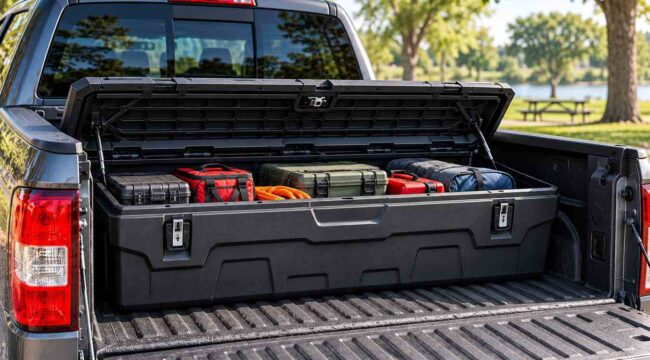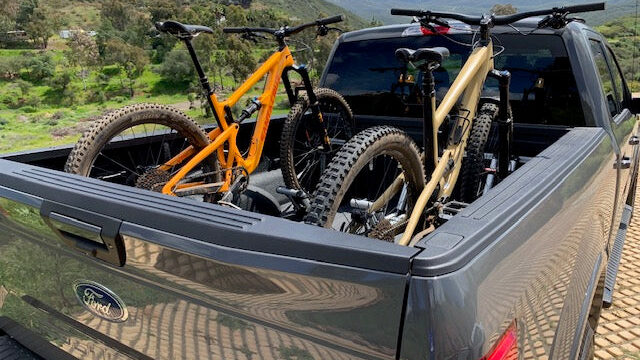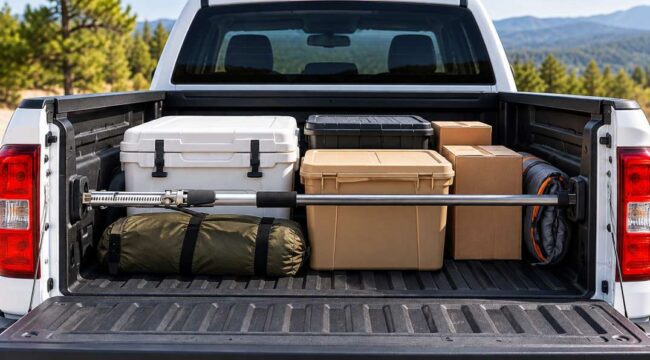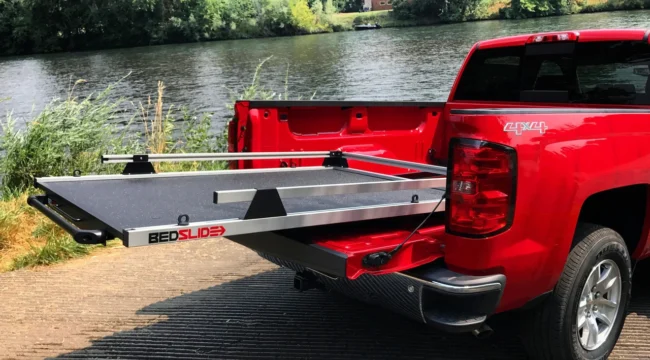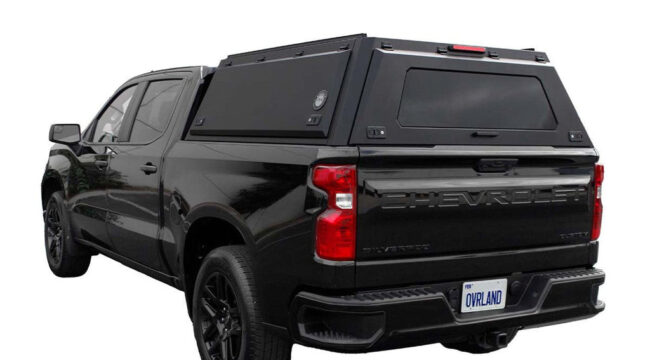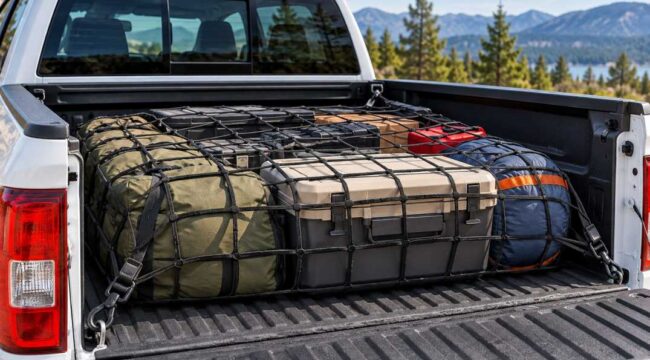
A cargo net can make a pickup bed much easier to manage when you are carrying several items at once. Coolers, bags, boxes, camping equipment, tools, groceries, yard supplies, and other loose gear can shift as the truck moves, especially when the bed is not completely full. A properly sized net spreads over the load and creates a flexible barrier that helps keep the pieces together.
The difficult part is choosing the right net. Cargo nets vary widely in size, mesh opening, elasticity, attachment hardware, construction, and intended load. A compact elastic net that works well for light bags is not automatically the right choice for a large pile of equipment. Likewise, a very large net can be awkward if you normally carry only a few small items.
For this guide, we researched current Amazon-listed cargo nets and compared products with different sizes and designs. The goal is not to claim that one net fits every truck. Instead, we explain what each product is designed to do, where it makes sense, and what you should check before buying.
One important distinction comes first: a cargo net is a cargo-containment tool. It can help prevent loose items from shifting or falling out, but it should not automatically be treated as a replacement for properly rated tie-down straps when a load requires positive restraint.
For a large, flexible bungee net, the TIRETEK Cargo Net measures 4 by 6 feet and is listed to stretch to 8 by 12 feet with 12 metal carabiners. The SKYTOU 42×50 Truck Bed Cargo Net is a compact heavy-duty net with cam buckles and S-hooks for short truck beds. For thicker elastic construction, the PAMAZY 4’x6′ Cargo Net uses 10mm cords and stretches to 8 by 12 feet. The Grit Performance Cargo Net is another 4-by-6-foot option with 5mm latex webbing, while the Amiss Adjustable Truck Bed Cargo Net is a narrower 50-by-18-inch organizer-style net for smaller loads and bed-side organization.
- Our Top Picks
- What Is a Truck Bed Cargo Net?
- How Does a Cargo Net Work?
- Types of Truck Bed Cargo Nets
- How We Chose
- Detailed Reviews
- Cargo Net Comparison
- How to Choose the Right Cargo Net
- How to Install a Cargo Net
- Common Mistakes to Avoid
- Cargo Nets vs. Tie-Down Straps
- Maintenance and Storage
- Frequently Asked Questions
Our Top Picks
These five products represent different approaches to truck-bed cargo management. The TIRETEK and Grit Performance nets are conventional 4-by-6-foot bungee nets, while PAMAZY uses thicker 10mm cord construction. SKYTOU is more compact and aimed at lighter everyday loads. Amiss takes a different approach with a narrower organizer-style net designed to hold items against a bed-side area rather than cover a full truck bed.
SKYTOU 42×50 Truck Bed Cargo NetCam-buckle and S-hook net for short truck beds
PAMAZY 4’x6′ Heavy-Duty Cargo Net10mm cord and 12 steel D-clips
Grit Performance Cargo Net4×6 ft to 8×12 ft with 12 steel D-clips
Amiss Adjustable Truck Bed Cargo Net50×18-inch organizer-style design
What Is a Truck Bed Cargo Net?
A truck bed cargo net is a flexible mesh system that stretches over cargo and attaches to multiple points around the bed. Unlike a single tie-down strap, which usually presses across a specific part of a load, a net covers a broader area.
This makes a net particularly useful when the cargo has an irregular shape or consists of several smaller items. A cooler, duffel bags, boxes, camping chairs, and tool cases can all occupy different parts of the bed, making a single straight strap less convenient.
Most pickup-bed cargo nets use elastic bungee cord or webbing. The elasticity lets the net expand over different cargo heights while maintaining tension. Attachment points can include metal carabiners, hooks, D-clips, cam buckles, or other fittings.
The mesh size also matters. A large mesh opening is convenient for bulky objects but may allow smaller pieces to work their way through. A tighter mesh can contain smaller items more effectively, although it may also add weight and make the net less flexible.
A cargo net should therefore be viewed as a system rather than simply a piece of netting. The net material, perimeter, attachment hardware, size, elasticity, and the truck’s anchor points all affect how useful the finished setup will be.
How Does a Cargo Net Work?
The basic installation is simple. You place the cargo in the bed, spread the net over it, attach the available hooks or clips to suitable anchor points, and adjust the tension so the net sits securely over the load.
Elastic nets rely on stretch to create tension. When the net is expanded over cargo, the bungee material attempts to return toward its original dimensions. That tension pulls the perimeter toward the attachment points and helps keep the net against the load.
Some nets have a relatively open mesh, while others use smaller squares. The right choice depends on what you carry. Large boxes and coolers do not require extremely fine mesh, while loose small objects benefit from tighter openings.
Attachment symmetry is important. If one side is much tighter than the other, the net may shift toward the loose side. For a better fit, distribute the hooks around the perimeter and keep the tension reasonably even.
A net also needs appropriate anchor points. Do not assume that a decorative bed rail, plastic trim piece, or weak accessory is suitable simply because a hook can physically attach to it. The anchor must be appropriate for the load and the net’s intended use.
Types of Truck Bed Cargo Nets
Bungee cargo nets
Bungee nets are made from elastic cords woven or knotted into a grid. They are popular because they can stretch over different cargo sizes without complicated adjustment.
They are particularly convenient for everyday loads such as camping gear, bags, coolers, boxes, and other mixed items. The main limitation is that elasticity does not automatically mean a net is suitable for heavy or concentrated loads.
Heavy-duty mesh nets
Heavy-duty nets may use thicker bungee cords, reinforced webbing, stronger attachment points, or tighter construction. They are useful when you frequently carry larger or more irregular loads.
Do not choose solely because a listing says “heavy duty.” Compare the actual cord or webbing construction, attachment hardware, dimensions, and any published load information.
Organizer-style cargo nets
Not every truck bed cargo net is intended to cover the entire bed. Narrower organizer nets can attach to the side of a pickup bed and keep bags, groceries, tools, or smaller equipment against one area.
These can be useful for daily drivers because they take up little space and can make a partially loaded bed easier to organize. They are not a direct replacement for a full-bed cargo net when you need to cover a large load.
Webbing cargo nets
Webbing nets use flat straps rather than round bungee cords. They can provide a more structured surface and may be appropriate for applications where a defined load rating is important.
Because these products can be substantially different from elastic cord nets, compare the manufacturer’s rated working load limit and attachment method rather than judging them by appearance alone.
How We Chose
We focused on the factors that actually affect whether a cargo net will work in a pickup bed.
Size and stretch range were important because a net must be large enough to cover the cargo and reach the available anchor points without being excessively stretched.
Mesh size was considered because smaller openings can be useful for containing smaller items, while larger openings can make a net easier to stretch around bulky cargo.
Attachment hardware was another major consideration. Metal carabiners, D-clips, hooks, and other fittings can make a meaningful difference in setup and compatibility.
Intended load type also matters. Some products are aimed at light everyday loads, while others use thicker cords and larger coverage for bigger hauling jobs.
We also wanted variety rather than five products that are effectively identical. The list therefore includes full-bed bungee nets as well as a smaller organizer-style option.
We do not claim hands-on testing of these products. Product specifications and descriptions are based on available Amazon listing information and supporting product information at the time of research. Always check the current Amazon listing before purchase because specifications, availability, and included hardware can change.
Detailed Reviews
1. TIRETEK Cargo Net for Pickup Truck Bed
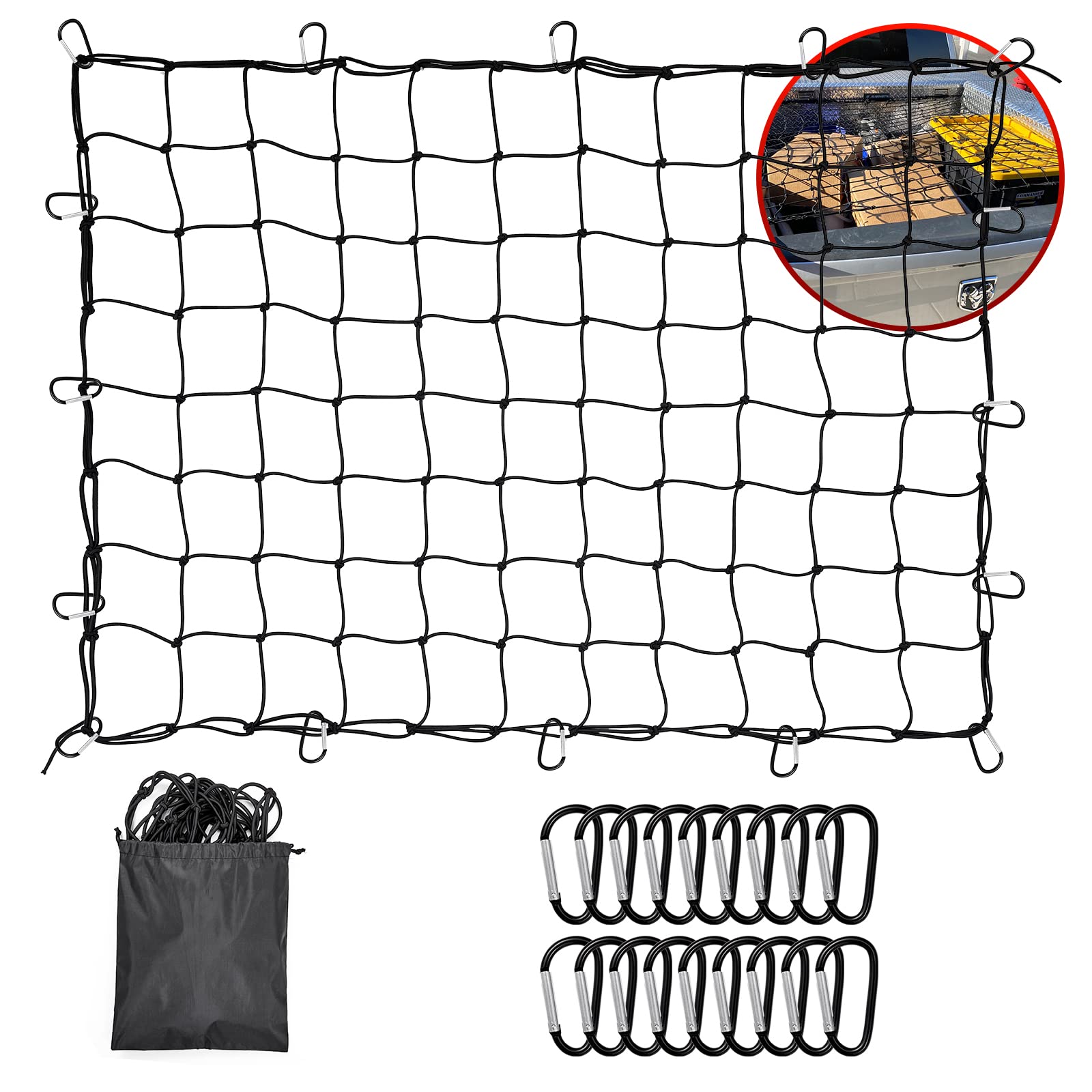
The TIRETEK cargo net is a conventional large bungee-style truck bed net. Its base size is 4 by 6 feet and the listing describes it as stretching to 8 by 12 feet. It also includes 12 metal carabiners, giving you multiple attachment points around the perimeter.
The 4-inch by 4-inch mesh is a useful middle ground for mixed cargo. It is tighter than a very open cargo net, so it can help contain smaller bags and loose equipment, while still leaving enough flexibility for coolers, boxes, tarps, and camping gear.
The 5mm latex-core bungee construction gives the net its elasticity. That is particularly useful when the cargo is not uniform in height. Instead of needing a rigid cover, the net can stretch over a pile of items and maintain tension around the edges.
The biggest thing to check before buying is the actual size of your bed and the position of its tie-down points. The advertised maximum stretch is not the same thing as a recommended working size for every load. A net should have enough coverage to reach the anchors without being forced beyond its practical range.
The 12 metal carabiners also make the product more flexible than a net with only four corner attachments. More attachment points can help distribute tension around a larger load.
Who should consider it?
Consider the TIRETEK if you want a large, elastic cargo net for mixed loads and need broad coverage from a 4-by-6-foot starting size up to a substantially larger stretched area.
Pros
- 4×6-foot starting size
- Listed stretch to 8×12 feet
- 12 metal carabiners
- 4×4-inch mesh
- 5mm latex-core bungee construction
Cons
- May be larger than necessary for compact beds
- Requires multiple suitable anchor points
- Not a replacement for properly rated tie-downs
2. SKYTOU Cargo Net Short Truck Bed Cargo Net

The SKYTOU cargo net is a compact 42-by-50-inch design for short truck beds. It uses adjustable straps with cam buckles and S-hooks rather than a large elastic bungee grid.
This makes it different from the larger 4-by-6-foot nets in this guide. If your normal cargo consists of lighter bags, soft equipment, clothing, pool gear, or similar items, a smaller net can be easier to manage and store.
The 42-by-50-inch size makes it less cumbersome in a short or midsize truck bed. You should still measure your actual cargo area and anchor spacing because truck beds differ considerably.
SKYTOU’s design uses adjustable straps and cam buckles rather than relying only on elastic stretch. That lets you fine-tune the tension around the cargo after the S-hooks are attached.
The limitation is equally important. The listing positions this version for lighter loads. It should not be treated as a heavy-duty load-restraint system simply because it uses metal carabiners.
Who should consider it?
Consider SKYTOU if you want a compact 42-by-50-inch net with adjustable cam-buckle straps and S-hooks for a short truck bed.
Pros
- 42×50-inch compact size
- Adjustable cam-buckle straps
- S-hooks for attachment
- Industrial-grade polyester and metal hardware listed
- Storage bag included
Cons
- Smaller coverage than 4×6-foot nets
- Not appropriate as a universal heavy-load restraint
3. PAMAZY 4’x6′ Heavy-Duty Cargo Net

The PAMAZY cargo net is another 4-by-6-foot full-bed-style option, but its key difference is the thicker 10mm cord construction listed for the product. The net stretches to 8 by 12 feet and includes 12 steel D-clip carabiners.
The thicker cord can make sense if you frequently cover larger or more irregular loads and want a more substantial elastic net. It is still important to distinguish cord thickness from an overall load rating. A thicker bungee cord does not automatically mean that every type of heavy cargo can be safely secured with the net alone.
The 4-by-4-inch mesh is designed for a mixture of larger and smaller items. The net can be useful over coolers, boxes, luggage, outdoor gear, and similar cargo that would otherwise have several separate straps crossing it.
The 12 steel D-clips provide multiple attachment points. When the net is spread across a large load, distributing the tension around the perimeter can be more useful than relying on only four corner connections.
Because this is a large net, compact truck owners should pay particular attention to the relaxed dimensions and the distance between anchor points. More stretch is useful only when the net can be installed without excessive tension.
Who should consider it?
Consider PAMAZY if you want a large 4-by-6-foot net and specifically want the thicker 10mm cord construction listed for this model.
Pros
- 4×6-foot starting size
- Stretches to 8×12 feet
- 10mm cord construction
- 12 steel D-clip carabiners
- 4×4-inch mesh
Cons
- May be oversized for small beds
- Thicker construction is not the same as a universal load rating
- Requires careful anchor-point placement
4. Grit Performance Truck Bed Cargo Net
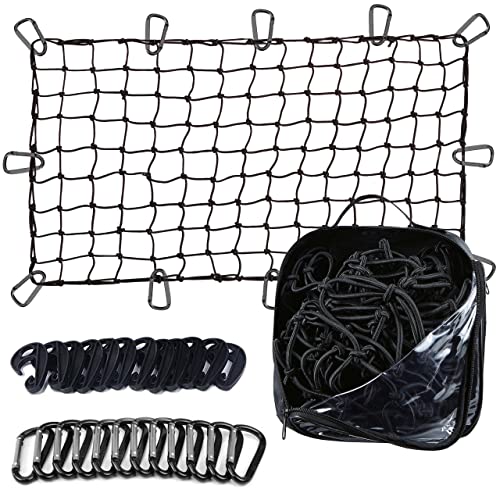
The Grit Performance cargo net is a 4-by-6-foot bungee net that can stretch to approximately 8 by 12 feet. The product information describes 5mm latex webbing, a 4-by-4-inch mesh, 12 steel D-clips, and a storage bag.
The storage bag is a useful everyday detail because elastic nets can be frustrating to store when the hooks and mesh become tangled. Keeping the net contained also makes it easier to carry it in the truck when you are not using it.
The 4-by-4-inch mesh is suitable for mixed cargo, although very small objects can still require a container or secondary restraint. A cargo net is not designed to replace a box or bag when the contents themselves are loose enough to pass through the mesh.
The 5mm construction places the Grit Performance model in a similar general category to other large elastic nets rather than the thicker 10mm PAMAZY. That does not make it inherently unsuitable for large cargo; it simply means the products use different construction approaches.
As with the other large nets, measure the truck bed before buying. A 4-by-6-foot net can be a convenient size for many pickups, but the correct choice depends on the actual anchor spacing and the height of the cargo you intend to cover.
Who should consider it?
Consider Grit Performance if you want a conventional 4-by-6-foot bungee net with 5mm latex webbing, multiple steel D-clips, and a storage bag.
Pros
- 4×6-foot starting size
- Listed stretch to 8×12 feet
- 5mm latex webbing
- 12 steel D-clips
- Storage bag included
Cons
- 4-inch mesh is not intended to contain every tiny object
- Large size may be unnecessary for small loads
- Still requires appropriate tie-down points
5. Amiss Adjustable Truck Bed Cargo Net

The Amiss Adjustable Truck Bed Cargo Net is different from the full-bed bungee nets above. It is an organizer-style net measuring about 50 by 18 inches and is designed to stretch around smaller items in the truck bed.
This format can be useful when the goal is organization rather than covering an entire load. Bags, groceries, tools, small equipment, and other items can be held against a bed-side area instead of moving freely around an otherwise empty bed.
The narrower dimensions are also easier to store. You do not need to deal with a large 4-by-6-foot net when you only want to stop a few items from sliding around.
The listing describes a nylon construction and a simple hook-and-buttonhole attachment system. Before installing it, check where the hooks can connect on your truck. The usefulness of an organizer-style net depends heavily on having compatible attachment points in the right location.
This type of product should not be confused with a large cover net. If you are hauling a pile of boxes, yard debris, camping equipment, or other cargo that fills most of the bed, a full-bed net is generally the more relevant style to investigate.
Who should consider it?
Consider the Amiss net if your main goal is keeping smaller everyday items organized in one section of the truck bed rather than covering a full-size load.
Pros
- Compact 50×18-inch format
- Useful for bed-side organization
- Stretchable nylon design
- Easy to store
- Useful for smaller everyday items
Cons
- Not a full-bed cargo cover
- Fit depends on suitable attachment points
- Not intended to replace heavy-load tie-downs
Cargo Net Comparison
| Product | Starting Size | Stretch / Size | Key Feature | General Use |
|---|---|---|---|---|
| TIRETEK | 4×6 ft | Up to 8×12 ft listed | 12 metal carabiners | Large mixed loads |
| SKYTOU | 42×50 in. | Adjustable straps | Cam buckles and S-hooks | Short-bed and compact loads |
| PAMAZY | 4×6 ft | Up to 8×12 ft | 10mm cords, 12 D-clips | Larger mixed loads |
| Grit Performance | 4×6 ft | Up to 8×12 ft | 5mm latex webbing, storage bag | General hauling |
| Amiss | 50×18 in. | Organizer-style stretch | Compact bed organizer | Smaller items |
How to Choose the Right Cargo Net for Your Truck Bed
1. Measure the usable bed area
Do not buy a cargo net based only on the advertised truck-bed length. Bed length describes the front-to-back dimension, while a net must also reach the side-to-side anchor points and cover the height of the cargo.
Measure the actual distance between the attachment points you intend to use. If you normally carry tall cargo, consider the extra height that the net must cover as well.
2. Check the relaxed size and maximum stretch
A net that stretches dramatically can look attractive on a product page, but you still need enough material to cover your cargo comfortably. You do not want to run a net at its absolute maximum extension every time you use it.
At the same time, an oversized net can sag or leave too much loose material when you carry a small load. Match the product to the loads you normally carry rather than choosing the largest number on the specification sheet.
3. Match mesh size to the cargo
Large mesh works well for boxes, coolers, bags, and other bulky items. Smaller mesh is more useful when the load contains smaller pieces that could otherwise work their way through the openings.
If you regularly haul very small items, remember that a cargo net is still not a container. Loose bolts, small tools, gravel, or similar pieces may need a box, bag, or another layer of containment.
4. Look at the attachment hardware
Metal carabiners and D-clips can be convenient because they attach quickly to suitable anchor points. Hooks can also be useful, but their compatibility depends on the truck’s tie-down design.
Do not judge the entire system by the net alone. A strong net connected to a weak anchor is still a weak cargo-management setup.
5. Consider the cargo weight and shape
Light, irregular cargo is where elastic nets are particularly convenient. For dense or very heavy items, look for a product with a clearly stated working load limit and follow the manufacturer’s instructions.
Sharp edges are another concern. Metal corners, lumber, tools, and equipment can abrade or cut elastic mesh. Protect the net from sharp contact points or use a different restraint method when necessary.
6. Decide whether you need a full-bed net
If the truck is frequently loaded with several boxes, camping supplies, luggage, or bulky equipment, a 4-by-6-foot net may make more sense than a narrow organizer.
If you simply want to stop a few bags from sliding into the tailgate area, a smaller organizer-style net can be more convenient.
7. Check your truck’s anchor points
Before ordering, identify exactly where the hooks or carabiners will attach. Some trucks have D-rings, bed rails, stake pockets, or other factory tie-down points. Accessories can change what is available.
8. Think about tonneau-cover compatibility
If you use a tonneau cover, check whether the net and cargo can sit below the cover when it is closed. A net that works perfectly with an open bed may interfere with a rolling, folding, or hinged cover when the load is tall.
How to Install a Truck Bed Cargo Net
- Clear loose debris from the bed and inspect the attachment points.
- Place the cargo so heavier items are supported properly and cannot easily roll.
- Spread the net over the cargo without twisting the mesh.
- Attach the first few hooks or carabiners around the perimeter.
- Work around the bed rather than pulling all the tension to one side.
- Connect the remaining attachment points.
- Adjust the net so it sits over the cargo with reasonably even tension.
- Check that no hook is attached to a weak or unsuitable surface.
- Push the net and cargo gently by hand to check for excessive movement.
- Use additional rated tie-downs if the load requires positive restraint.
Do not rely on maximum stretch as a substitute for correct installation. The goal is a stable, evenly distributed setup rather than the greatest possible tension.
Common Cargo Net Mistakes to Avoid
Choosing by truck model instead of measuring
A net described as universal still needs to fit your actual truck. Bed width, anchor location, rail height, and accessories can all change the usable area.
Using a small net over a large load
If the net is stretched to its limit just to reach the anchors, the setup may not provide the coverage you expect. Choose a larger net when the load requires it.
Using a large net for tiny loads
An oversized net can leave excessive slack and be more annoying to install than a smaller organizer. Match the net to the cargo you actually carry.
Attaching to weak trim
A hook should connect to a suitable anchor point, not a decorative plastic panel or loose bed accessory.
Ignoring sharp edges
Sharp cargo can damage elastic cord and mesh. Cover sharp corners or use an appropriate restraint system designed for that load.
Assuming “heavy duty” means unlimited capacity
Heavy-duty is a product description, not a universal engineering rating. Check the actual specifications and working-load information where provided.
Using the net as the only restraint for heavy equipment
For dense, wheeled, tall, or unstable cargo, use properly rated straps or other suitable restraints. A net can provide secondary containment but may not provide the required primary restraint.
Cargo Nets vs. Tie-Down Straps
A cargo net and a tie-down strap solve related but different problems.
A cargo net covers a broad area and is useful for groups of loose or irregular items. It can help prevent pieces from shifting independently or falling out of the bed.
A tie-down strap connects cargo to an anchor and can provide directional restraint. Ratchet straps are especially useful when the load needs to be held firmly against the truck.
For some loads, the best approach is to use both. Straps can provide the primary restraint while a cargo net catches smaller pieces and helps contain the overall load.
Do not assume that a cargo net’s advertised stretch or cord thickness is equivalent to a strap’s working load limit. They are different types of equipment and should be used according to their intended applications.
Maintenance and Storage
Inspect an elastic cargo net periodically for cuts, fraying, hardened bungee material, damaged knots, stretched sections, or broken hooks.
Pay special attention to the perimeter because the edges and attachment points experience repeated tension. Replace a net if the elastic material is significantly damaged or if a hook no longer closes or holds correctly.
UV exposure, heat, moisture, chemicals, and abrasion can affect elastic materials over time. When possible, store the net in a dry location out of direct sunlight.
Before folding the net, separate the hooks and carabiners so they do not become tangled in the mesh. A storage bag can make this process much easier.
Frequently Asked Questions
What is the best cargo net for truck bed use?
There is no single net that fits every truck or every load. Large 4-by-6-foot bungee nets such as the TIRETEK, PAMAZY, and Grit Performance models provide broad coverage, while smaller designs such as SKYTOU or Amiss can make more sense for lighter or more localized cargo.
What size cargo net do I need for a pickup truck?
Measure the usable bed area and the distance between your intended anchor points. Then compare those measurements with the net’s relaxed dimensions and stated stretch range.
Are cargo nets good for hauling in a truck bed?
They can be very useful for containing loose, mixed, and irregular cargo. For heavy, dense, tall, or unstable loads, use properly rated tie-downs as required.
What is the best heavy duty cargo net for truck bed use?
Look for a net with appropriate dimensions, strong attachment hardware, suitable mesh, and clearly stated construction or load information. The PAMAZY 4-by-6-foot net uses listed 10mm cords, while TIRETEK and Grit Performance use 5mm-class elastic construction.
What is the best pickup truck cargo net for small loads?
A smaller elastic design can be easier to manage for light cargo. SKYTOU’s 42-by-50-inch net is a compact option with adjustable cam-buckle straps and S-hooks for short truck beds, while the Amiss net is designed more as a compact organizer.
Can a cargo net replace ratchet straps?
Not automatically. A net is primarily a containment system. Heavy or unstable cargo may require properly rated straps or other primary restraints.
Can I use a cargo net with a tonneau cover?
Often yes, but the specific setup matters. Check the height of the loaded cargo and make sure the net does not interfere with the cover’s movement or locking system.
Is a tighter mesh better?
A tighter mesh can help contain smaller objects, but it is not automatically better for every load. Larger mesh can be easier to stretch over bulky items.
How tight should a cargo net be?
The net should be securely tensioned over the cargo without being excessively stretched. The attachment points should remain stable and the net should not have large areas of uncontrolled slack.
Can I use a cargo net on a short-bed truck?
Yes, provided the dimensions and attachment points are compatible. Smaller nets may be easier to fit, while large nets may require more careful positioning.
What should I do if my cargo net keeps slipping?
Check the net size, anchor locations, hook engagement, and tension distribution. If the net is too small or the anchors are unsuitable, increasing tension alone is not a reliable fix.
Can a cargo net hold loose branches or yard debris?
Some larger nets can be used for loose yard material, but check the product’s intended application and load information. Protect the net from sharp branches and use additional restraints when necessary.
Do cargo nets work with bed liners?
Yes, but the liner can change the position and shape of the available anchor points. Make sure the hooks attach to suitable structural points rather than loose liner material.
How do I store a truck bed cargo net?
Remove the hooks from the mesh, fold the net without excessive twisting, and keep it dry and protected from prolonged direct sunlight. A storage bag is useful when one is supplied.
Final Thoughts
The right truck bed cargo net depends less on a universal “best” label and more on the way you actually use your pickup. Start with the bed dimensions and anchor points, then match the net’s size, mesh, elasticity, and attachment hardware to your typical cargo.
For broad coverage, a 4-by-6-foot bungee net is a useful starting point. For lighter loads, a smaller elastic net can be easier to handle. If you regularly carry larger or more irregular cargo, pay closer attention to cord construction and attachment hardware rather than choosing only by price.
For a straightforward large-bed setup, the TIRETEK Cargo Net is one example of the conventional full-bed bungee format. Whatever net you choose, measure first and use properly rated additional restraints whenever the load requires them.