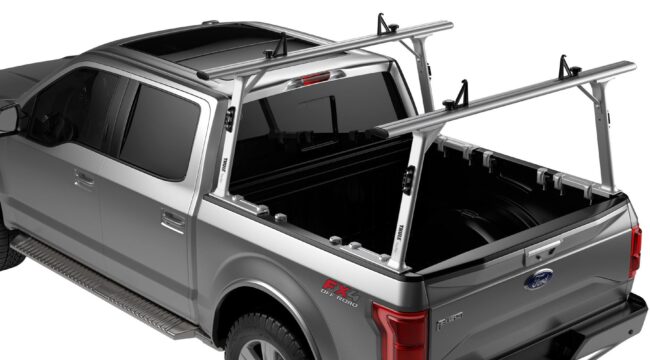
If you use a pickup for work, camping, overlanding, kayaking, cycling, or hauling long materials, a truck bed rack can turn unused space above the bed into a useful cargo platform. The right rack can carry gear over the bed while leaving room underneath for coolers, tools, storage boxes, and everyday cargo.
The challenge is that truck bed racks are not all built for the same job. Some are tall enough to carry ladders and lumber over the cab, while others sit closer to the bed for a lower profile. Some are designed around rooftop tents and overland accessories, while others focus on heavy work loads. Tonneau-cover compatibility can also vary substantially from one rack system to another.
In this guide, we compare truck bed rack systems across construction, load ratings, height adjustment, mounting style, accessory compatibility, and everyday practicality. We also cover what to look for if you want a low profile truck bed rack with a tonneau cover or a heavier setup for work and overland use.
🏆 Quick Answer: What Is the Best Truck Bed Rack?
For a versatile adjustable setup, the Yakima OverHaul HD stands out for its 19-to-30-inch adjustable height, modular HD Bar system, and documented 500-pound on-road and 300-pound off-road ratings. It can also work with select tonneau covers when the required adapter is used.
For a more budget-focused setup, the VEVOR 800-lb aluminum truck rack provides a 71-inch crossbar, no-drill C-clamp mounting, and an advertised 800-pound capacity. The OUTPRIZE steel rack adds adjustable width and both drill and no-drill mounting options.
Table of Contents
Our Top Picks
AA-Racks APX2502Low-profile aluminum rack
Thule TracRac TracOneHeavy-duty hauling rack
VEVOR 800-lb Aluminum Truck RackHigh-capacity value option
OUTPRIZE Steel Truck RackAdjustable-width work rack
Types of Truck Bed Racks
Adjustable-height truck bed racks
Adjustable racks give you control over how high the crossbars sit above the bed. This is useful when one truck handles very different jobs. You might raise the rack for kayaks, ladders, or long lumber and lower it when you want the cargo closer to the truck. The Yakima OverHaul HD is built around this idea, with a 19-to-30-inch height range.
Mid-height truck bed racks
A mid-height rack sits closer to the bed than a tall contractor-style rack. It can make loading easier and keep the overall setup more compact. Mid-height systems are common in overland builds because they can support rooftop tents and accessories without placing the load unnecessarily high. The AA-Racks APX2502 is designed around this fixed mid-height approach.
Heavy-duty ladder and work racks
Work-oriented racks are generally designed around ladders, lumber, pipe, conduit, and other long materials. They often use steel tubing or reinforced aluminum and may advertise high capacities. They can offer excellent value, but their fitment and tonneau-cover compatibility need careful checking. A capacity number alone does not tell you whether a rack will work with your bed rails.
Overland truck bed racks
An overland truck bed rack is usually designed around more than basic cargo hauling. It may need to support a rooftop tent, recovery boards, awnings, lighting, storage accessories, or other equipment. T-slots, tie-down points, accessory channels, and modular mounting systems become more important in this type of setup.
Low-profile truck bed racks
A low-profile rack is useful when you want cargo support without the bulk of a tall rack. The lower height can keep the center of gravity down and may reduce wind exposure. The trade-off is that some long loads may not clear the cab, and some low-profile systems are designed for specific accessories rather than general-purpose hauling.
Which Type Should You Choose?
For work trucks
A heavy-duty steel or aluminum rack with a high advertised capacity and adjustable width can make sense if your main jobs involve ladders, lumber, pipe, or other long materials. Prioritize the actual bed width range and mounting method before looking at capacity.
For overlanding
Look for an overland truck bed rack with a clear dynamic load rating, accessory mounting options, tie-down points, and compatibility with your rooftop tent. Off-road ratings matter because a rack needs to be rated for the conditions in which you intend to use it.
For a daily driver
An adjustable or removable rack can be more convenient than a permanently tall setup. If the truck spends most of the week without cargo, a system that can be removed or lowered may be easier to live with.
For use with a tonneau cover
Tonneau compatibility is highly model-specific. Some racks can be used with select covers when an adapter kit is installed, while others interfere with the cover rails or require the cover to be removed. Never assume that a rack will work with a tonneau simply because both products mount to a truck bed.
How We Chose
We focused on racks with documented specifications and useful applications. We considered construction, advertised load ratings, adjustability, mounting systems, accessory support, fitment considerations, and the practical differences between work-oriented and overland-oriented designs.
We also looked closely at details that can cause problems after installation, including crossbar height, bed width, tonneau clearance, whether crossbars are included, whether additional adapters are required, and whether a capacity applies on-road, off-road, or only under specific loading conditions.
Load ratings are not directly interchangeable between brands. A rack’s published number should always be considered alongside the truck’s own payload and bed-rail limitations.
We also looked for practical fitment information rather than relying only on headline capacity figures. A rack can have a high rating and still be a poor match if its clamps conflict with a toolbox, the bed rails do not provide enough mounting area, or the required crossbars and adapters are sold separately. Those details can have a bigger impact on day-to-day ownership than a single specification.
Detailed Reviews
1. Yakima OverHaul HD — Adjustable-Height Rack System
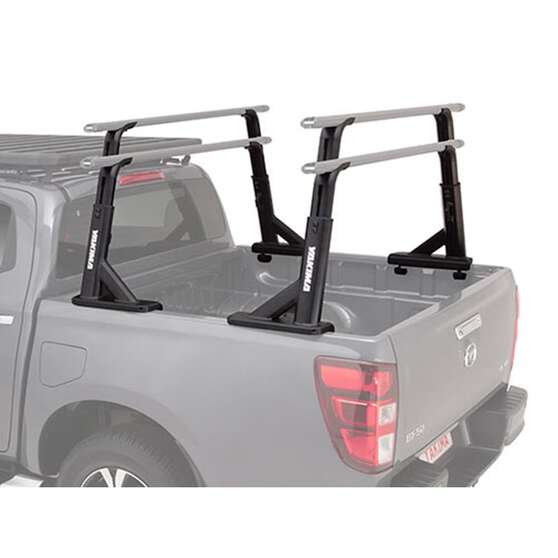
The Yakima OverHaul HD is designed for owners who want one truck bed rack system that can adapt to different cargo. Its biggest advantage is the adjustable tower height. The rack can be positioned from 19 to 30 inches, allowing you to raise it for long loads or bring it down when you want a lower setup.
The towers use engineered aluminum with a powder-coated finish.
That adjustability is particularly useful when the same pickup has to switch between weekend recreation and weekday hauling. A lower setting can make the rack easier to live with when the truck is unloaded, while the higher positions provide more clearance for long items that need to pass over the cab. The key is to choose the height based on the actual cargo rather than simply running the rack at its maximum setting.
Yakima’s BedGrip clamp design is intended for common truck beds, while additional track kits are available for certain tracked beds. A separate Tonneau Kit 1 is required for select tonneau-cover installations, so compatibility should be checked for the exact truck and cover combination.
The OverHaul HD is rated for up to 500 pounds on-road and 300 pounds off-road when paired with the appropriate HD Bars. Those separate ratings are useful because highway travel and rough terrain impose different demands on a rack.
The system also has integrated tie-down points and T-slot attachment capability. Yakima lists compatibility with mounts for kayaks, surfboards, bikes, rooftop tents, lumber, and other gear.
One important detail is that the OverHaul HD towers are sold separately from the HD crossbars. You need to choose the appropriate bar length for the truck and cargo. That makes the system more customizable, but it also means the complete setup costs more than the tower price alone.
For someone building a pickup truck bed rack system rather than a simple ladder carrier, the modular design is useful. The same rack can be adjusted for different cargo heights and expanded with accessories over time.
Pros
- Adjustable 19-to-30-inch rack height
- 500-pound on-road and 300-pound off-road ratings
- Strong accessory and T-slot support
- Works with select tonneau covers using the required kit
- Useful for both work and recreational cargo
Cons
- HD crossbars are purchased separately
- Tonneau compatibility depends on the exact setup
- More expensive than basic universal racks
- Requires careful fitment and load planning
2. AA-Racks APX2502 — Low-Profile Aluminum Rack

The AA-Racks APX2502 takes a lower-profile approach to truck-bed hauling. Its aluminum construction and load-stop design are aimed at owners who want elevated cargo support without the height of a traditional over-cab rack.
The lower-profile format can be useful when overall rack height matters.
This design also makes sense for drivers who want the rack to feel less imposing during everyday use. A lower rack can be easier to load from the side and may work better with a truck that spends more time commuting than hauling oversized materials. The trade-off is reduced clearance, so it is important to measure the cab and the cargo before deciding that a low profile is the right configuration.
It is a better match for cargo that does not require substantial clearance over the cab.
The AA-Racks APX2502 uses Yakima’s BedGrip mounting system and is designed for common truck beds. Like the OverHaul HD, it uses HD Bars, sold separately, and supports accessories through T-slot and tie-down points.
The APX2502 is listed as a low-profile utility aluminum pickup truck ladder rack with load stops. The safe load on your truck still depends on the vehicle, mounting configuration, and cargo.
The low-profile format is useful for owners who do not need a tall rack to clear the cab. It keeps the setup closer to the truck and can reduce overall rack height.
For an overland truck bed rack setup, the AA-Racks APX2502 can be expanded with accessories such as rooftop-tent mounts, SideBars, and other compatible equipment. The modular approach is useful if the truck build is expected to evolve.
Pros
- Low-profile aluminum design
- Useful for owners who want a lower rack height
- Load-stop design helps keep cargo positioned
- Suitable for modular truck and overland setups
- Lower overall profile than many tall work racks
Cons
- Fixed low-profile height limits some cargo applications
- Fitment depends on the truck bed and mounting area
- Accessory compatibility should be checked before purchase
- Not the best choice when maximum cab clearance is required
View the AA-Racks APX2502 on Amazon →
3. Thule TracRac TracOne — Heavy-Duty Hauling Rack
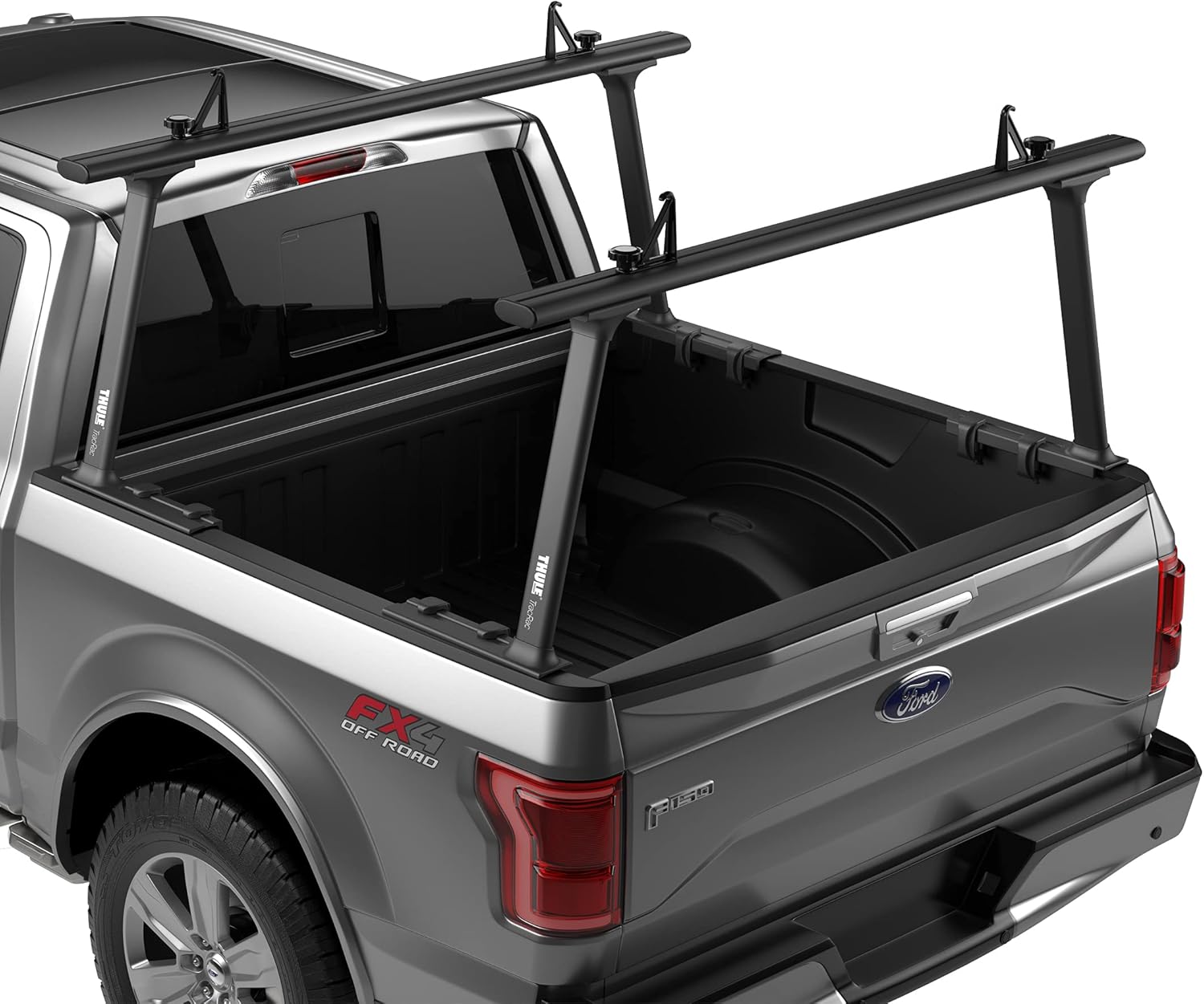
The Thule TracRac TracOne is a traditional heavy-duty truck rack designed around long cargo and everyday hauling. It uses aluminum construction and a drill-free mounting system on applicable trucks.
Thule lists an 800-pound maximum load when properly installed and the load is evenly distributed. Adjustable aluminum load stops help position cargo across the rack, while the T-track system supports compatible accessories.
The TracOne is a practical choice when your main job is carrying ladders, lumber, kayaks, or other long materials above the bed.
Its straightforward design can be an advantage for a work truck that does not need a highly configurable overland system. Adjustable load stops help keep longer items positioned where they belong, and the aluminum construction avoids some of the extra weight associated with heavier steel racks. As with any bed-mounted rack, however, the truck-specific mounting instructions and load limits should be checked before installation.
It is less about changing height for different uses and more about providing a straightforward overhead cargo platform.
Who should consider it?
- Owners who frequently haul ladders or lumber
- Drivers who want a traditional heavy-duty rack
- Buyers who prefer aluminum construction
- Users who want adjustable load stops
Who may want something else?
If your priority is adjustable height or a lower-profile adventure setup, another rack style may be a better fit.
Pros
- 800-pound maximum distributed load listed by Thule
- Aluminum construction
- Drill-free mounting on applicable applications
- Adjustable aluminum load stops
- T-track accessory support
Cons
- Traditional work-rack design
- Fitment varies by truck
- Overall rack height should be considered
- Higher cost than basic racks
4. VEVOR 800-lb Aluminum Truck Rack — High-Capacity Value Option
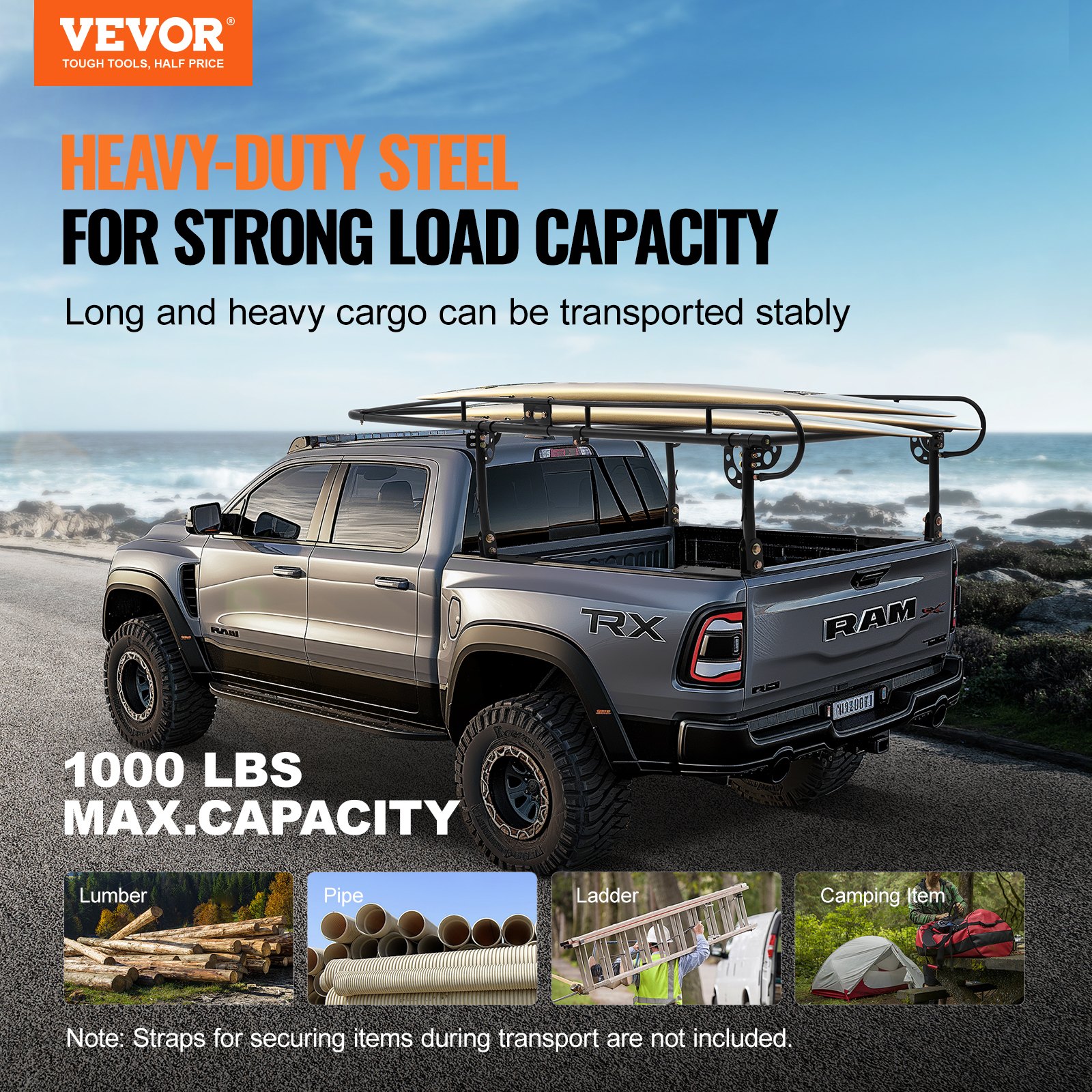
The VEVOR 800-lb aluminum truck rack is aimed at buyers who want a high-capacity two-bar setup without moving into premium rack-system pricing. The version covered here uses aluminum rack construction with heavy-duty steel base brackets and eight non-drilling C-clamps.
The crossbar width is 71 inches and the manufacturer advertises an 800-pound load capacity. It is intended for bulky cargo such as kayaks, surfboards, ladders, lumber, and other long items that would otherwise consume the entire truck bed.
The no-drill C-clamp installation is practical for owners who do not want to permanently modify their truck. The rack can be removed when it is not needed, although the exact installation depends on the shape and construction of the truck’s bed rails.
VEVOR also uses adjustable tie-down positions to accommodate different cargo widths. The powder-coated construction and enclosed tube ends are intended to improve resistance to corrosion and weather exposure.
The main reason to consider this style of rack is straightforward hauling capacity.
It is also worth thinking about how often the rack will be installed and removed. A clamp-mounted system can be attractive for owners who need extra carrying space only for occasional projects, but repeated installation still requires careful positioning and tightening. Before using the rack, check that both bars are securely mounted and that the load is balanced across the support points.
If the truck regularly carries ladders, lumber, kayaks, or other large cargo, a two-bar rack can free the bed floor for additional equipment.
However, the 800-pound figure should not be interpreted as permission to load 800 pounds onto every truck. The truck’s own payload rating, bed structure, mounting points, and load distribution remain relevant. Dynamic loads during driving can also be very different from a stationary load.
Pros
- Advertised 800-pound capacity
- 71-inch crossbar width
- Aluminum rack construction
- No-drill C-clamp mounting
- Useful for ladders, lumber, kayaks, and other long cargo
Cons
- Universal fit still requires careful bed-rail measurement
- Capacity does not override the truck's payload limit
- Less modular than premium accessory-focused systems
- Exact fit can vary with bed accessories and rail design
5. OUTPRIZE Non-Drilling Steel Truck Rack — Adjustable-Width Work Rack
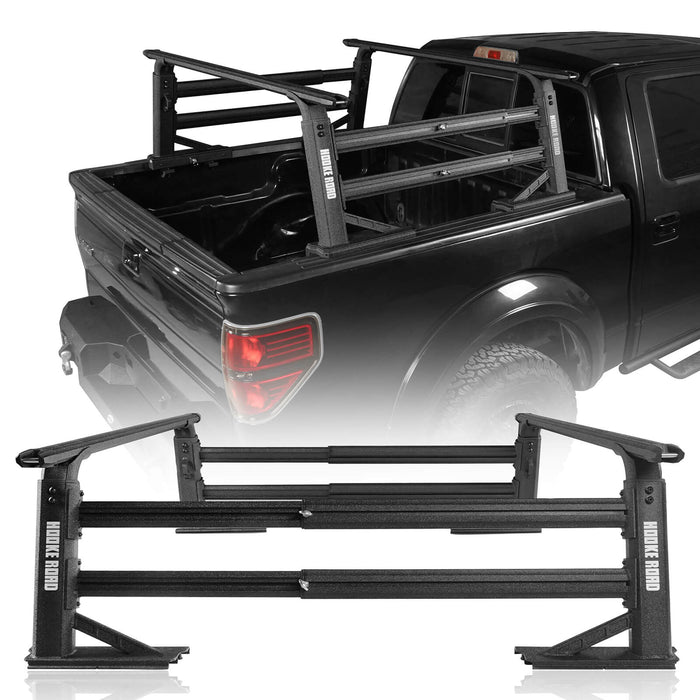
The OUTPRIZE non-drilling steel truck rack is a work-oriented option with an adjustable width range of roughly 52 to 71 inches. It uses steel tubing and is advertised with an 800-pound load capacity.
One feature that separates it from many basic universal racks is the choice of mounting methods. It can be installed with no-drill J-bolts or with drill-through mounting, depending on the truck and the owner’s preference.
The adjustable width makes it suitable for a range of pickup beds, but universal fit does not mean every truck is automatically compatible. Utility-track systems, toolboxes, side boxes, bed covers, and unusual bed-rail designs can interfere with installation.
For work use, the steel construction and advertised capacity can be attractive.
The adjustable width is especially relevant when the truck is used for different kinds of long cargo. Even so, a wide rack is not automatically a better rack. The mounting points need to sit on suitable sections of the bed, and accessories such as a toolbox or tonneau cover can reduce the usable installation area. Taking measurements before ordering can prevent a universal rack from becoming a poor fit.
The rack is designed to carry long materials such as ladders and lumber above the bed, leaving floor space available for other cargo.
The no-drill option also makes the rack appealing for owners who do not want to permanently modify the bed. If a permanent installation is preferred and the truck allows it, the drilling option provides another route.
As with any high-capacity rack, the 800-pound rating is a product specification rather than the truck’s usable payload. The truck, bed, mounting hardware, cargo, and driving conditions all need to be considered together.
Pros
- Advertised 800-pound load capacity
- Adjustable 52-to-71-inch width range
- Steel construction for work-oriented hauling
- Offers both no-drill and drill-through mounting options
- Leaves the truck bed floor available for other cargo
Cons
- Steel construction adds weight compared with aluminum
- Universal fit does not guarantee compatibility with every bed
- Toolboxes and tonneau covers can affect installation
- High capacity still depends on proper mounting and load distribution
Best Truck Bed Rack for Overlanding
Overlanding puts different demands on a rack than ordinary work hauling. The rack may need to support a rooftop tent, recovery boards, awnings, lighting, fuel or water accessories, bikes, camping equipment, and other gear while the truck travels over uneven surfaces.
A useful overland truck bed rack should have a clearly documented dynamic load rating rather than only a large static capacity. It should also provide reliable mounting points for accessories and allow the load to be positioned in a way that works with the truck’s center of gravity.
The Yakima OverHaul HD and AA-Racks APX2502 are built specifically around modular use. Both use HD Bars and are rated up to 300 pounds off-road when configured correctly. The OverHaul adds height adjustment, while the AA-Racks APX2502 keeps a fixed mid-height profile.
Another important consideration is how much equipment you actually plan to carry. A rooftop tent, bedding, recovery gear, water, and camping supplies can add up quickly. The rack’s rating is only one part of the calculation; the truck’s payload rating still applies to everything carried by the vehicle.
Best Low Profile Truck Bed Rack With Tonneau Cover
A low profile truck bed rack with tonneau cover is one of the trickier combinations to configure because both accessories need usable space around the bed rails. The exact tonneau design matters just as much as the rack.
Some racks can work with select roll-up or retractable covers, while others need a dedicated adapter kit. The Yakima OverHaul HD is an example where Yakima specifically lists a Tonneau Kit 1 for select tonneau-cover installations.
Before buying, check whether the tonneau mounts inside or on top of the bed rails. An inside-the-bed rail cover may leave more room for rack clamps, while a cover that occupies the top of the rail can interfere with mounting hardware.
Also consider where the crossbars sit when the cover is opened. Even if the rack towers clear the cover rails, the crossbar or mounting hardware can still restrict the cover’s travel.
If keeping the tonneau fully functional is more important than having maximum rack height, a lower or modular system can make more sense. Always verify the exact rack, truck year, bed length, and tonneau combination before ordering.
What to Consider Before Buying
Check the truck bed width
Universal truck racks normally cover a range of bed widths, but that does not guarantee a clean fit. Measure the actual mounting area and compare it with the manufacturer’s stated range.
Decide how high the rack should sit
A taller rack is useful when long cargo needs to clear the cab. A lower rack can make loading easier and keep the overall setup more compact. Adjustable systems provide more flexibility if your use changes frequently.
Check the real load rating you need
Do not choose a rack solely because it has the largest advertised number. Consider whether the rating is static, on-road, or off-road, and make sure it is appropriate for the cargo you intend to carry.
Consider your truck’s payload rating
The rack does not increase the truck’s payload capacity. The rack, crossbars, rooftop tent, cargo, passengers, and other accessories all contribute to the vehicle’s total load.
Measure the bed rails
Clamp-on racks depend on the shape and construction of the bed rails. Bed liners, utility tracks, stake pockets, factory rails, and other accessories can change the available mounting space.
Check whether crossbars are included
Some premium systems sell towers separately from the crossbars. The Yakima OverHaul HD and AA-Racks APX2502 are examples. Make sure you understand what is included before comparing prices with complete two-bar racks.
Think about tonneau-cover compatibility
If you use a tonneau cover, verify compatibility with the exact rack and cover combination. Some systems need a separate adapter, while others cannot be used together.
Consider the cargo you carry most often
Kayaks, ladders, lumber, rooftop tents, bikes, and camping gear do not all require the same rack design. Think about your most common load before selecting a general-purpose system.
Look at mounting and removal
If you only need the rack occasionally, a quick-removal or no-drill system can be convenient. A permanent drill-mounted rack may make more sense for a work truck that carries long materials every day.
Think about accessory compatibility
For an overland build, T-slots and accessory channels can be valuable. They let you add mounts and gear without rebuilding the entire rack.
Check the truck-specific fitment
Universal racks still have limits. Check the truck’s year, make, model, bed length, rail configuration, and any factory cargo-management system before ordering.
Consider wind and overall height
A tall rack can add wind resistance and increase the overall height of the truck. If you regularly use parking garages or drive long highway distances, the rack’s height may be an important part of the decision.
FAQs
What is a truck bed rack used for?
A truck bed rack creates an elevated cargo-support system above the pickup bed. It can carry ladders, lumber, kayaks, bikes, rooftop tents, camping gear, and other bulky items while leaving the bed floor available for additional cargo.
What is the difference between a truck bed rack and a ladder rack?
The terms overlap, but ladder racks are generally focused on long work materials such as ladders and lumber. Truck bed rack systems can be broader in purpose and may include accessory channels, rooftop-tent support, adjustable height, and overland mounting options.
Can a truck bed rack work with a tonneau cover?
Some can, but compatibility is not universal. Certain rack systems have dedicated tonneau adapters, while others require a particular cover design or cannot be used with a cover at all. Check both manufacturers’ fitment information.
Are truck bed racks universal?
Some are designed to fit a broad range of truck beds, while others are vehicle-specific. Even universal racks have limits related to bed width, rail shape, utility tracks, toolboxes, and other accessories.
How much weight can a truck bed rack hold?
It depends on the product and how the rating is defined. Yakima publishes separate on-road and off-road ratings for its OverHaul HD and AA-Racks APX2502 systems, while some work-oriented racks advertise an 800-pound capacity. The truck’s own payload and mounting limitations still apply.
Is an aluminum truck bed rack better than steel?
Neither material is automatically better for every application. Aluminum can reduce rack weight and resist corrosion, while steel can provide a robust work-oriented structure. The better choice depends on the load, mounting system, required capacity, and how often the rack is removed.
What is the best truck bed rack for rooftop tents?
A suitable rack needs a published rating that covers the tent and its occupants under the conditions in which the rack will be used. Overland-focused systems such as the Yakima OverHaul HD and AA-Racks APX2502 are designed around applications that include rooftop tents, but the exact vehicle and configuration still need to be checked.
Do truck bed racks affect fuel economy?
They can. A rack adds weight and can increase aerodynamic drag, particularly when the crossbars and cargo sit high above the cab. The effect varies with rack height, vehicle shape, speed, and the cargo being carried.
Do truck bed racks require drilling?
Not always. Many clamp-on and J-bolt systems are designed for no-drill installation. Some racks also offer drilling as an alternative for a more permanent installation. Always follow the specific manufacturer’s instructions.
Can I leave a truck bed rack installed all the time?
That depends on the rack and how you use the truck. A permanent rack can be convenient for frequent hauling, while a removable or adjustable rack may be better if the truck is also used as a daily driver.
What should I carry on a pickup truck bed rack?
Common loads include ladders, lumber, kayaks, canoes, bikes, surfboards, rooftop tents, recovery equipment, camping gear, and other long or bulky cargo. The load must remain within the rack and vehicle’s applicable ratings and be properly secured.
How do I choose a heavy duty truck bed rack?
Start with the actual cargo and the truck’s limitations. Compare the rack’s material, dynamic and static ratings, width range, mounting method, height, accessory support, and compatibility with the truck’s bed and any tonneau cover or toolbox.
Final Thoughts
The best truck bed rack depends heavily on how you use your pickup. A contractor carrying ladders and lumber may need a different system from an overlander carrying a rooftop tent, while a daily driver may prioritize a removable or low-profile design.
The Yakima OverHaul HD offers a highly adjustable approach with a broad accessory ecosystem and documented on-road and off-road ratings. The AA-Racks APX2502 keeps a lower fixed profile for owners who prefer a mid-height setup. Budget-oriented work racks such as the VEVOR and OUTPRIZE models focus more directly on capacity and straightforward hauling.
Before ordering, verify the rack’s fitment, actual load rating, mounting method, crossbar requirements, and compatibility with your tonneau cover. A properly matched rack can add useful carrying space without sacrificing the truck bed’s everyday practicality.