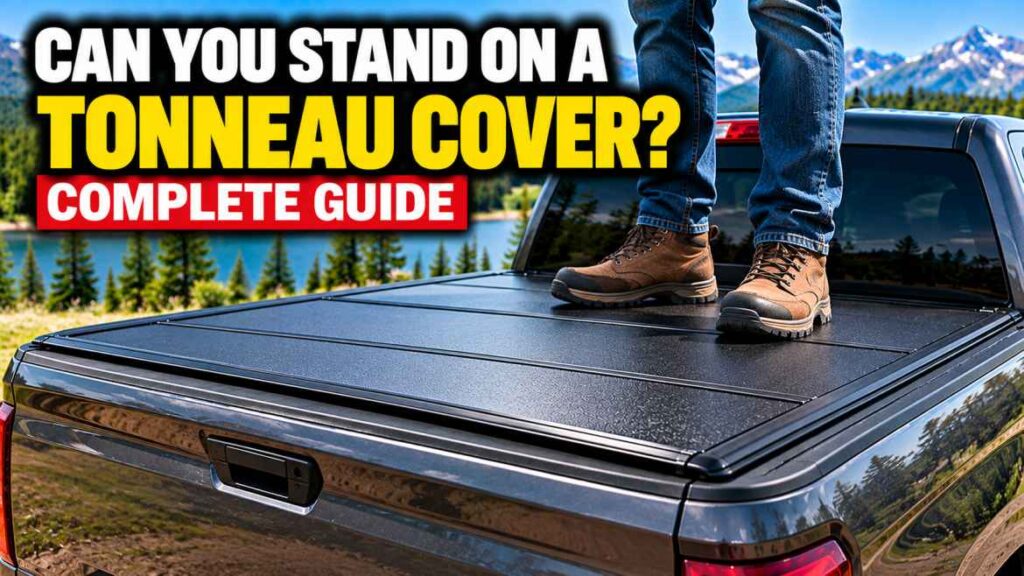
A closed tonneau cover can look strong enough to support a person, especially when it has rigid aluminum or composite panels. But whether you can stand or walk on it depends entirely on the specific cover’s design and manufacturer rating.
Do not assume you can stand on a tonneau cover. Some rigid covers are specifically rated for a substantial evenly distributed load, and a manufacturer may permit walking on the closed cover for a particular model. Other covers explicitly say not to place objects on the cover or framework. Soft vinyl and fabric covers generally should not be treated as standing platforms. The only safe answer for a specific cover is the manufacturer’s published load rating and instructions.
Short Answer
Sometimes—but only when the manufacturer specifically permits it and the load is within the published rating.
“Hard” does not automatically mean “walkable.” A rigid panel can support a load in one configuration and still be damaged by a concentrated load in another. Hinges, latches, support rails, panel cores, and mounting hardware all contribute to the actual capacity.
For example, BAK’s current MX4 product information states a 400-pound evenly distributed capacity when the cover is closed. That is a product-specific rating, not a rule that applies to all tonneau covers.
Our hard folding tonneau cover guide can help if you are specifically comparing rigid folding designs, but the individual manufacturer’s instructions still control safe loading.
Why Weight Ratings Matter
A load rating tells you something about the conditions under which the manufacturer says the cover can support weight. The wording matters.
“400 pounds evenly distributed” is not the same as saying one person can place all of their weight on one small point. The rating may assume the load is spread over the supported panels rather than concentrated on a heel, knee, ladder foot, or other small contact area.
Always read the complete statement. Some manufacturers rate the cover only when closed and correctly installed. Others may prohibit standing even if the panels appear rigid.
Evenly Distributed vs. Point Load
| Load situation | Why it matters |
|---|---|
| Evenly distributed cargo | Spreads force across a larger area and may match the manufacturer’s test condition. |
| One person standing | Weight is concentrated through feet, which can create higher local stress. |
| Kneeling on one point | Creates an even smaller contact area. |
| Heavy box or equipment | Weight may be concentrated on a small base or edge. |
| Dynamic load | Movement can create forces higher than simple body weight. |
This is why you should not convert a static load rating into a general permission to use the cover as a work platform.
Can You Stand on a Soft Tonneau Cover?
Generally, no. A soft roll-up or soft folding cover is not designed to act as a person’s platform unless its manufacturer specifically says otherwise.
Soft covers rely on fabric or coated material, bows, rails, straps, hook-and-loop sections, and other components that are designed to span and cover the bed—not to support a person’s body weight.
Manufacturer safety instructions can be explicit. TruXedo manuals, for example, warn users not to place objects on or against the cover or framework on certain soft-cover systems.
If the manual does not provide a standing or load rating, treat the cover as non-walkable.
What About Hard Tonneau Covers?
Some hard covers are engineered to support loads on top when closed. The important word is some.
Hard folding covers often use reinforced panels, hinges, and perimeter rails. Their construction can be much stronger than flexible vinyl, but the exact capacity depends on the model.
BAK’s current MX4 information lists a 400-pound evenly distributed capacity when closed. Other products may have lower ratings or no standing/load rating at all. Never transfer the MX4 specification to another cover.
If your cover is a hard folding design, read the model-specific owner’s manual or manufacturer’s product page before putting your weight on it.
Examples of Manufacturer Ratings
Manufacturer information illustrates why model-specific checking matters. BAK’s MX4 documentation lists up to 400 pounds of evenly distributed load when the cover is fully closed. By contrast, TruXedo’s soft-cover safety instructions for products such as the TruXport say not to place objects on or against the cover or framework.
These are not contradictory. They are different designs with different engineering limits.
If your cover has a published capacity, follow the exact conditions attached to that rating. If it does not, do not invent a capacity from the appearance of the cover.
Risks of Standing on a Tonneau Cover
- Panel damage: concentrated weight can bend or crack a panel.
- Hinge damage: the load can be transferred into hinges or attachment points.
- Latch damage: excessive force can affect alignment or latch hardware.
- Seal damage: movement can deform perimeter seals and create leaks.
- Loss of balance: a smooth or wet cover can be slippery.
- Vehicle damage: if the cover fails, a fall can result in injury or damage to the truck.
If Your Cover Is Rated for Walking
If the manufacturer explicitly permits walking or standing, follow the conditions exactly.
- Close and latch the cover completely.
- Confirm the truck is parked securely on level ground.
- Stay below the stated weight limit.
- Keep the load distributed as the manufacturer specifies.
- Avoid jumping, dropping equipment, or creating impact loads.
- Do not exceed the rating because “it feels strong.”
- Inspect the cover afterward for movement, cracks, damaged seals, or latch problems.
If you need a work platform frequently, a cover specifically engineered and marketed for that use is a better choice than treating an ordinary tonneau as one.
If Your Cover Is Not Rated
Keep your weight off it. This is especially important for soft covers and for rigid covers with no published load rating.
Do not rely on anecdotes from another truck owner. A different cover can have different panel construction, hinge spacing, rail support, and mounting hardware even if the two covers look similar.
For ordinary cargo, place the load inside the bed unless the cover’s manufacturer explicitly provides instructions for carrying cargo on top.
Frequently Asked Questions
Can you walk on a hard tonneau cover?
Only if the manufacturer specifically allows it and the load remains within the published conditions. Hard construction alone is not enough.
Can you stand on a soft tonneau cover?
Generally no. Unless the manufacturer explicitly rates the cover for standing or walking, treat it as a non-walkable surface.
How much weight can a tonneau cover hold?
It varies by model. Some rigid covers publish load ratings; others do not. Use the manufacturer’s rating rather than a generic number.
Does a 400-pound rating mean one person can stand anywhere?
No. If the rating says evenly distributed, do not interpret it as permission to concentrate the entire load at one small point.
Can I put a ladder on a tonneau cover?
Only if the cover manufacturer explicitly permits that load and provides the required conditions. A ladder can create concentrated contact points and dynamic forces.
Why Dynamic Loads Matter
Body weight is not the only force a cover may experience. Stepping onto a surface, shifting your feet, jumping, dropping equipment, or moving a heavy object can create short-duration forces that are higher than the simple static weight.
That is another reason a manufacturer may publish an evenly distributed load rating instead of saying “a person can stand anywhere.” If you need to work from the top of the bed regularly, use equipment designed for that purpose rather than improvising.
Installation Condition Matters
A load rating assumes the cover is installed as designed. Loose clamps, damaged rails, missing hardware, an incorrect truck application, or an open/partially folded configuration can change how forces are transferred.
Never use a published rating as permission to load a cover that is damaged or incorrectly installed. If the cover has been bent, cracked, or involved in an impact, inspect it and follow the manufacturer’s repair guidance before loading it again.
Standing, Sitting, and Carrying Cargo Are Not the Same
| Use | What to check |
|---|---|
| Standing/walking | Explicit manufacturer permission and load conditions |
| Sitting | Same load-rating requirement; do not assume sitting is safe |
| Light cargo | Published cargo rating and distribution requirements |
| Long equipment | Contact points, concentration of load, and manufacturer approval |
| Work platform | Use a cover specifically engineered for this purpose |
The Safest Rule
If the owner’s manual does not clearly state that the cover supports people or a particular load, keep people off the cover. This is especially important when the surface is wet, when the truck is on uneven ground, or when the cover has been exposed to damage or extreme conditions.
A tonneau cover’s primary purpose is to cover and protect the truck bed. A load-bearing platform is a separate function that requires explicit engineering and instructions.
Bottom Line
Whether you can stand on a tonneau cover is a model-specific safety question, not a question of whether the cover looks strong. Soft covers generally should not be stood on, while some rigid covers are rated for specific evenly distributed loads. Check the manufacturer’s exact instructions and never exceed or reinterpret the published rating.