Truck bed drawers and a traditional toolbox both keep equipment out of the loose cargo pile, but they organize a pickup in different ways. A drawer system stores gear beneath a raised platform and lets you pull items out from the tailgate. A conventional toolbox usually sits near the cab or along a bed side, leaving more of the bed floor open. The better choice comes down to what you carry, how often you need it, and how much usable bed space you want to preserve.
Choose a truck bed drawer system if you carry lots of small or medium tools and supplies, want separate compartments, and need to reach gear without climbing into the bed. The deck above the drawers can still carry cargo, but the system adds weight, costs more in many cases, and reduces vertical bed depth.
Choose a conventional toolbox if you mainly need one lockable compartment for tools, want to keep most of the bed floor open, or prefer a simpler and often less expensive setup. The trade-off is that items can pile up inside a single compartment, and a crossover box occupies space across the front of the bed.
- Drawers vs. Toolbox at a Glance
- What Is a Truck Bed Drawer System?
- What Is a Conventional Truck Toolbox?
- Security and Weather Protection
- Organization and Everyday Access
- Usable Bed Space and Cargo Flexibility
- Fitment, Installation, and Removal
- Cost and Long-Term Value
- DECKED Drawer System vs. a Traditional Toolbox
- Which Storage Is Better for You?
- Frequently Asked Questions
- Final Verdict
Truck Bed Drawers vs. Toolbox at a Glance
| Factor | Drawer system | Conventional toolbox |
|---|---|---|
| Storage layout | Separate pull-out compartments beneath a deck | Usually one main compartment, with dividers on some models |
| Access | Pull drawers toward the tailgate; less reaching into the bed | Open the lid or door; access depends on box location and lid clearance |
| Bed floor | Covered by the system’s platform | Most of the floor usually remains open, except where the box is mounted |
| Vertical cargo room | Reduced by the raised platform | Generally preserved across most of the bed |
| Organization | Strong for separating tools, recovery gear, and small supplies | Works well for a larger shared tool compartment; add organizers if needed |
| Security | Depends on drawer locks, latches, tailgate access, and installation | Depends on lock, lid design, mounting, and the truck’s cover or cap |
| Weather protection | Varies by system, seals, and installation | Varies by box construction, lid seal, and installation |
| Installation | Usually a larger, heavier, vehicle-specific installation | Often a simpler mounting job, but mounting style and box size matter |
| Best fit | Frequent access and organized storage for many items | One secure tool compartment while retaining more open bed space |
These are category-level differences, not guarantees for every product. Drawer heights, extension length, locks, seals, toolbox placement, and mounting hardware vary. Check the exact model’s specifications and fitment notes before buying.
What Is a Truck Bed Drawer System?
A truck bed drawer system installs a platform over a set of storage drawers. The drawers typically slide toward the tailgate, while the flat deck above them can carry other cargo. This arrangement creates two storage levels: smaller gear stays inside the drawers, and larger items can ride on top if the system’s rated capacity and dimensions allow it.
Drawers are useful when a truck doubles as a mobile workshop or carries many different items on a regular basis. You can keep hand tools in one compartment, recovery gear in another, and camping or maintenance supplies in a separate area. Rather than moving several items to reach something at the bottom of a pile, you pull out the relevant drawer.
The main compromises are cost, weight, and height. A full-length system is a substantial piece of equipment that remains in the bed, even when you do not need the drawers. Its deck also raises the cargo floor, limiting the height available for tall objects. Some systems are designed around specific truck makes, model years, and bed lengths, so fitment must be checked carefully.
For a product-focused overview, see our Best Truck Bed Drawer Systems guide. That article covers individual systems; this comparison focuses on whether drawers or a toolbox makes more sense for your use.
What Is a Conventional Truck Toolbox?
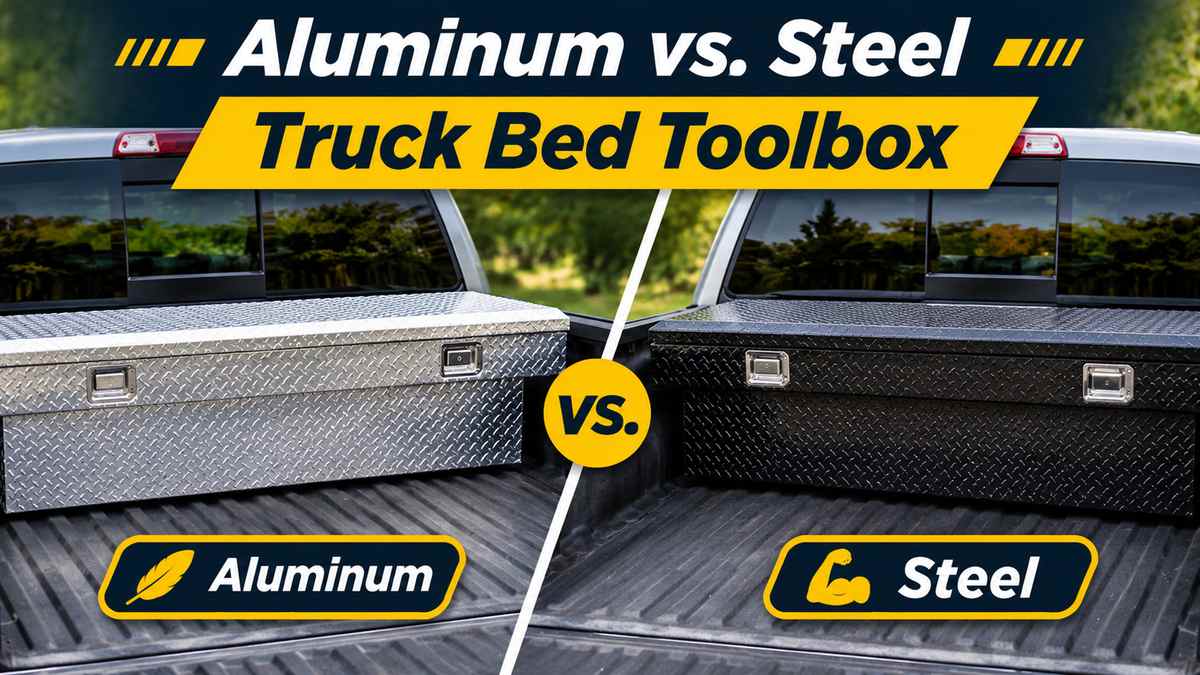
A conventional truck toolbox is an enclosed container mounted in or along the bed. A crossover or saddle box usually spans the bed near the cab and rests along the bed rails. Other styles include side-mount boxes, chest boxes, and compact boxes designed for particular mounting positions. Materials and features vary, with metal and molded-polymer options available.
The big advantage is a simpler division between storage and cargo. A crossover box takes up space at the front of the bed, but the area behind it and the bed floor generally remain available for lumber, furniture, landscaping supplies, luggage, or other bulky loads. A low-profile model may also be compatible with some tonneau covers, but clearance must be confirmed for the exact combination.
A basic toolbox often has one large compartment. That is convenient for larger tools and supplies, but smaller items can become mixed together unless you use trays, dividers, or cases. Access also depends on the box’s location and lid design: a lid may need room to open, and reaching into a deep box can still require bending or stretching.
Our Best Truck Bed Tool Boxes guide covers common toolbox styles, construction, security features, and fitment considerations. If you need a portable or differently shaped enclosure rather than a mounted tool box, compare options in our Best Truck Bed Storage Boxes guide.
Security and Weather Protection
Neither storage type is automatically theft-proof. A lock can deter casual access, but security also depends on the strength of the enclosure, the latch, how the unit is attached to the truck, and whether a thief can access the storage area through an unlocked tailgate or cover. Consider what you plan to leave in the vehicle and where you usually park it.
Some drawer systems use lockable drawers or rely partly on a locked tailgate to block access. Others have different locking arrangements. A toolbox may have a keyed lock, a locking handle, or other hardware, but the quality and resistance to prying differ by model. Inspect the actual locking mechanism instead of assuming that all drawers or boxes provide the same level of protection.
Weather resistance is equally model-specific. Seals, lid overlap, drawer-face design, drainage, dust barriers, and installation all influence how well a system keeps out rain and debris. Manufacturers sometimes use terms such as weather-resistant, weatherproof, or waterproof differently, so read the product documentation and warranty carefully. Do not assume that a product can be submerged or will keep every item dry in every condition unless its manufacturer explicitly supports that claim.
For valuable tools, also consider the rest of the setup. A locking tonneau cover or truck cap may add another barrier, but compatibility and access can change when combined with drawers or a toolbox. Confirm that the full configuration works together before ordering.
Organization and Everyday Access
Drawers are usually the more convenient option when you carry many small or medium items and need to find them repeatedly throughout the day. Sliding a drawer out toward the tailgate gives you a view of its contents and reduces the need to climb into the bed. Dividers and cases can make that layout even more useful, provided the drawer dimensions suit the gear.
A toolbox is often sufficient when you carry a smaller collection of tools or a few larger items that do not need their own compartments. It can be especially practical for a driver who wants to keep a socket set, straps, gloves, and emergency supplies in one place. Add a removable organizer tray for frequently used items, and keep heavy gear secured so it does not shift around.
Think about how often you open the storage. A contractor who reaches for tools dozens of times a day may value drawer access more than someone who only needs to retrieve a jack, jumper cables, and a few hand tools occasionally. On the other hand, a large toolbox can be easier to use for unusually shaped equipment that does not fit well into a drawer’s height or width.
Usable Bed Space and Cargo Flexibility
This is one of the most important trade-offs. A drawer system uses much of the bed’s footprint and raises the platform, but the surface above it can remain useful for cargo. It is not the same as losing the entire bed: long or bulky items may still fit on top. However, tall objects and loads that need the original bed depth can become difficult or impossible to carry.
A conventional crossover toolbox generally preserves more of the bed’s original depth and leaves a broad open area behind the cab. That can be a better layout for people who regularly haul tall equipment, soil, yard waste, furniture, or large building materials. The box itself still occupies part of the bed, and a side-mount or chest box will affect space differently from a crossover model.
Make a realistic list of your most common loads before choosing. Measure the available bed length, width between wheel wells, and vertical clearance after installation. If you frequently switch between tools and oversized cargo, removable storage boxes or organizers may be more flexible than a permanent drawer platform.
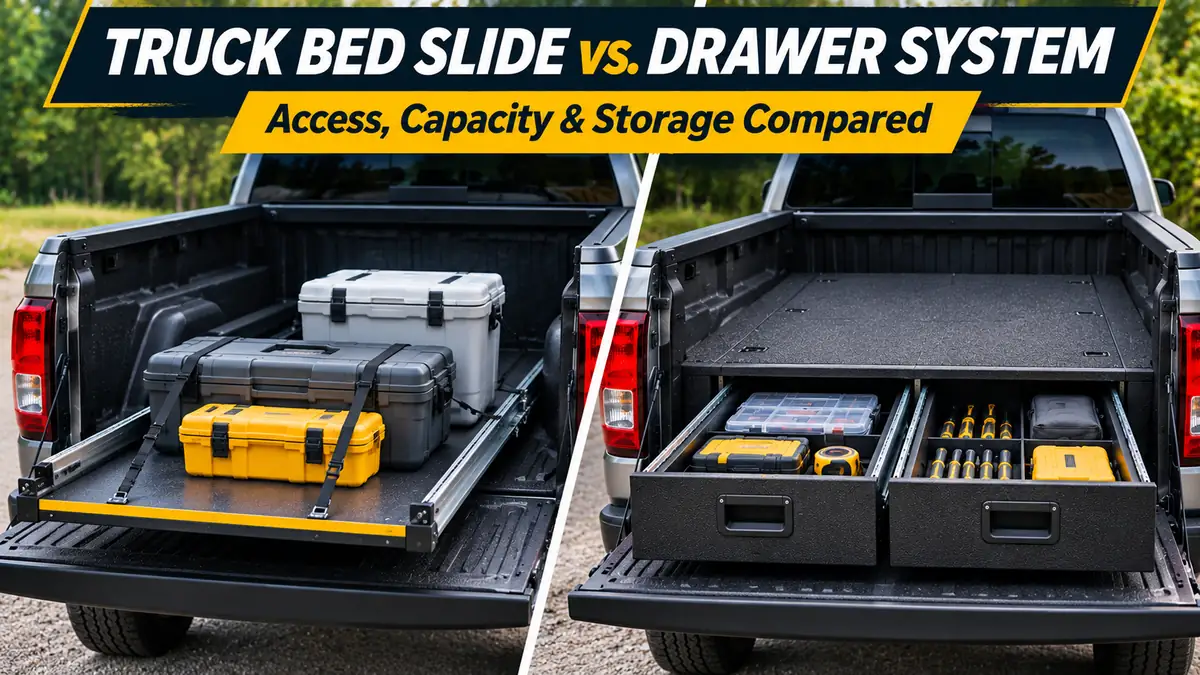
If your main goal is to pull heavy cargo closer to the tailgate rather than store tools in enclosed compartments, that is a different use case. See the separate Best Truck Bed Slides guide; a cargo slide is not the same as a drawer system or a toolbox.
Fitment, Installation, and Removal
Drawer systems are typically heavier and involve more parts than a simple toolbox. Some bolt to factory tie-down points, while other truck and bed configurations may require additional hardware or drilling. The exact process varies by product and vehicle. Check the manufacturer’s current installation guide, required tools, number of installers, and any restrictions before starting.
Toolboxes can be simpler to install, but they still need secure mounting. A crossover box may use bed-rail clamps or brackets, while other designs use different attachment points. Poor fit or loose hardware can cause movement, noise, damage, or unsafe loads. Do not drill or clamp blindly; follow the manufacturer’s instructions and confirm that mounting will not interfere with wiring, covers, bed accessories, or the truck’s structure.
Vehicle-specific fitment matters for both options. Verify the exact model year, cab and bed configuration, bed length, liner type, and any existing cover or cap. A drawer system may require a drop-in liner or bed rug to be removed, while a spray-in liner may be compatible, depending on the product. Never assume that a product listed for a truck name fits every generation or bed length.
Removal is possible for many systems, but it is not equally convenient. A toolbox may be easier to lift out, depending on its size and weight. A full drawer platform is bulky and may require help or partial disassembly. If you frequently need a completely empty bed, include removal effort in your decision.
Cost and Long-Term Value
A conventional toolbox is often the lower-cost starting point, especially if you need only one enclosed compartment. Drawer systems typically cost more because they combine a platform, sliding mechanisms, and multiple storage spaces in a vehicle-specific assembly. Actual prices change by truck fitment, materials, capacity, lock options, accessories, and retailer, so compare current listings rather than relying on a single category-wide price.
Do not compare purchase price alone. Consider how much time the storage saves, whether it protects expensive equipment, how frequently you use the truck, and whether the system will limit future hauling. A more expensive drawer system may make sense for daily work when organization and access matter; a toolbox may be better value when you only need a secure place for a modest set of tools.
Check warranty coverage, replacement parts, seals, latches, and service instructions. Ask what is covered and whether the warranty depends on correct installation or registration. Also account for any extra items needed to make the setup work, such as a compatible tonneau cover, tie-downs, liners, mounting hardware, or organizers.
DECKED Drawer System vs. a Traditional Truck Toolbox
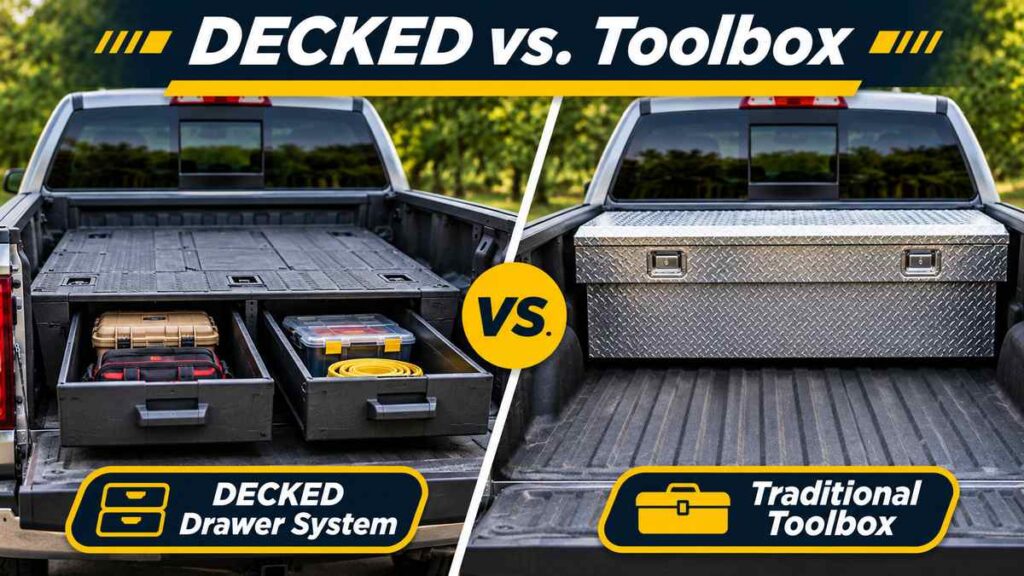
DECKED is a useful real-world example of the under-deck drawer approach, but it should not be confused with a conventional crossover toolbox. The DECKED Drawer System sits over the truck bed floor and creates lockable storage drawers beneath a load-bearing deck. A traditional toolbox is usually a separate box mounted near the cab or along the bed side. The right comparison is therefore about two different storage layouts, not simply two brands of toolbox.
Where the DECKED system has an advantage
The DECKED layout is designed for owners who want a flat upper deck and separate compartments below it. You can keep tools, recovery equipment, and smaller supplies out of sight while still carrying suitable cargo on top. That two-level arrangement is convenient for a work truck or overland setup where organization and access matter more than keeping the bed completely open.
DECKED publishes different specifications for full-size and midsize applications. Its current technical information lists a 2,000-pound evenly distributed load capacity for the full-size deck and 1,000 pounds for the midsize deck. The drawer payload figures also vary by system size, so check the specification for the exact truck and product rather than applying one capacity figure to every DECKED installation. These ratings do not increase the pickup’s own payload limit.
Where a traditional toolbox can be the better choice
A conventional crossover toolbox is generally simpler and leaves more of the original bed floor and vertical cargo depth available. It is often the more practical option if you carry a modest set of tools, occasionally need to haul tall items, want a lower initial cost, or prefer a storage unit that can be removed without dealing with a large platform assembly. A toolbox does not provide the same two-level organization, but it can be a better fit for mixed everyday hauling.
Fitment, liners, locks, and compatibility checks
DECKED fitment is specific to the truck’s make, model, year, and bed length. The manufacturer’s FAQ says drop-in bed liners and BedRug mats must be removed for installation of the Drawer System. The Drawer System’s locks are sold separately, while the separate DECKED Tool Box includes its lock; do not confuse that Tool Box product with the Drawer System discussed here. DECKED also lists restrictions for some truck-bed configurations, including fifth-wheel and gooseneck setups, and compatibility between its Drawer System and Tool Box is limited to certain 8-foot beds.
A traditional toolbox also needs exact measurements and secure mounting, but it may be easier to match with an existing liner or to remove later. Before buying either option, confirm the product’s current fitment guide, bedliner requirements, tonneau-cover clearance, rack or hitch equipment, and the truck’s remaining payload.
Which one should you choose?
- Choose DECKED if you regularly carry many tools or smaller items, want them separated into drawers, and will make use of the flat deck above them.
- Choose a traditional toolbox if you want a simpler lockable compartment, need to preserve more bed depth, carry tall cargo, or want to spend less.
- Reconsider both options if you frequently need a completely empty bed, have a drop-in liner you do not want to remove, or have hitch or cover equipment that conflicts with the installation.
For exact dimensions, current load ratings, and vehicle-specific restrictions, consult DECKED’s official FAQ and technical specifications before ordering. Specifications and compatibility can change between model years.
Which Storage Is Better for You?
Choose a drawer system if:
- You carry many tools or supplies and want them separated into dedicated compartments.
- You open storage repeatedly and want gear to slide toward the tailgate.
- You want a platform above the storage for suitable cargo and can accept reduced bed depth.
- You are comfortable with a higher initial cost and a heavier, more involved installation.
Choose a conventional toolbox if:
- You mainly need one secure compartment for tools and emergency gear.
- You want to preserve more of the bed’s original floor area and vertical cargo room.
- You often haul bulky or tall loads behind the box.
- You prefer a simpler storage setup or may want to remove it later.
Consider another storage format if neither is a perfect fit
If you only need occasional organization, a portable storage box or modular organizer may offer enough structure without permanently changing the bed layout. Our Best Truck Bed Organizers guide compares options for keeping loose cargo sorted. If access to heavy items is the main problem, consider a cargo slide instead of buying drawers for a job it was not designed to do.
Frequently Asked Questions
Are truck bed drawers more secure than a toolbox?
Not automatically. Both can be lockable, and the actual level of security depends on the enclosure, lock, mounting, tailgate, and cover. Compare the specific models and consider whether someone could access the storage through another unlocked part of the truck.
Do drawer systems take up the whole truck bed?
They occupy much of the bed footprint and raise the cargo surface, but many systems provide a usable platform on top. The platform can still carry cargo within its stated capacity. The main limitation is reduced vertical space below the top of the bed rails.
Can I use a tonneau cover with truck bed drawers or a toolbox?
Often, but compatibility depends on the specific products, mounting rails, and available clearance. Check both manufacturers’ fitment information, including whether the cover can open fully and whether the toolbox or drawer deck interferes with its operation.
Are truck bed drawer systems waterproof?
Do not assume every system is waterproof. Weather protection varies by model and installation, and manufacturers may use different definitions. Read the current product documentation and treat claims about immersion or complete water exclusion cautiously unless they are explicitly specified.
Can I remove a truck bed drawer system?
Many systems can be removed, but their size and weight can make the process more involved than lifting out a small toolbox. Review the installation manual and plan for help if the manufacturer recommends it.
Is a toolbox enough for work tools?
For many users, yes. If you mainly need a secure place for a basic set of tools, a toolbox can be a practical solution. A drawer system becomes more compelling when you carry a wider range of equipment and benefit from separating it into compartments.
Final Verdict: Drawers vs. Toolbox
Truck bed drawers are the better choice for organized, frequent access to lots of tools and supplies, especially when a flat cargo deck above the drawers is useful. A conventional toolbox is usually the more straightforward option for a secure tool compartment while keeping more of the bed open for bulky loads.
Before buying, list the gear you carry most often, measure the truck’s exact bed configuration, and check the storage unit’s dimensions, capacity, lock design, weather-protection claims, installation requirements, and compatibility with existing accessories. Choose the layout that fits the work you actually do—not simply the one with the most compartments.
Research references: DECKED’s official product and FAQ information and CRAFTSMAN’s official truck toolbox specifications. Product details and fitment vary by model; confirm current documentation before purchase.