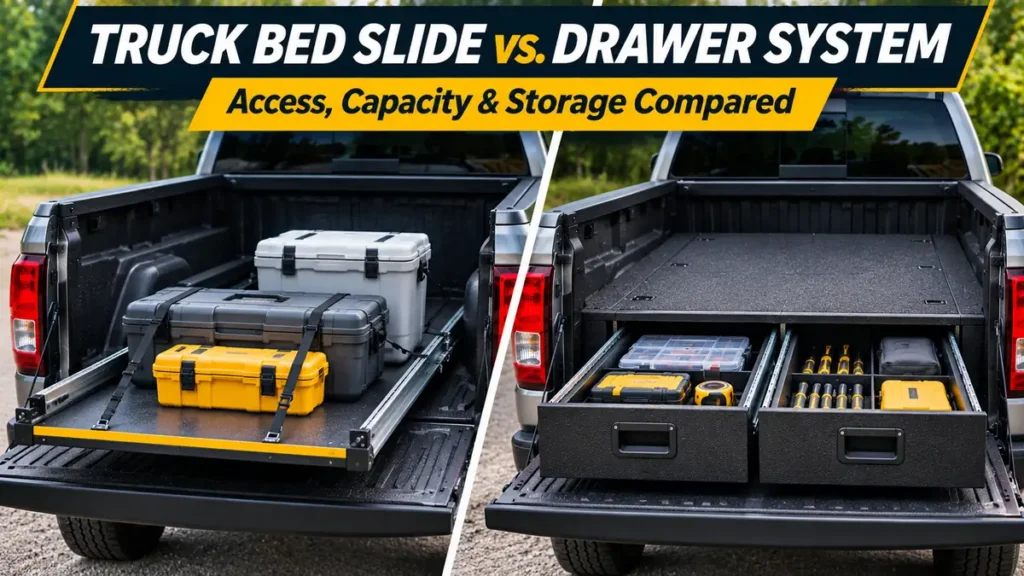
A truck bed slide and a truck bed drawer system solve a similar problem: they make gear easier to reach. But they do it differently. A slide pulls a loaded platform toward the tailgate, while a drawer system stores smaller items in enclosed compartments beneath a deck. If you regularly move bulky cargo, a slide may be the more flexible choice. If keeping tools and supplies organized matters most, drawers can be worth the extra structure.
Choose a truck bed cargo slide if you want to pull a large load surface toward the tailgate, often carry bulky equipment, or need to load and unload without reaching deep into the bed. Check the slide’s rated payload, extension percentage, deck size, and tie-down provisions.
Choose a drawer system if you want enclosed, separated storage for tools, recovery gear, and smaller supplies, with a flat deck above for additional cargo. Drawers can improve organization, but the system adds weight and height, and the drawers have their own capacity and dimensions.
Neither category has one universal load rating or fitment standard. Compare the exact model’s specifications and remember that the truck’s payload and bed limits still apply.
- Slide vs. Drawer System at a Glance
- What Is a Truck Bed Slide?
- What Is a Truck Bed Drawer System?
- Loading Access and Everyday Use
- Load Ratings, Weight, and Cargo Type
- Storage Layout and Usable Bed Space
- Fitment, Installation, and Compatibility
- Cost and Long-Term Value
- Which One Should You Choose?
- Frequently Asked Questions
- Final Verdict
Truck Bed Slide vs. Drawer System at a Glance
| Factor | Truck bed slide | Drawer system |
|---|---|---|
| Main purpose | Moves cargo toward the tailgate on a sliding platform | Stores gear in enclosed drawers beneath a deck |
| Best for | Bulky cases, equipment, coolers, and loads that are awkward to reach | Tools, smaller supplies, and equipment that benefits from separation |
| Access | Pull the loaded deck out; the whole load moves together | Pull out the relevant drawer; items in other drawers stay in place |
| Storage layout | Open platform; cargo needs to be restrained and organized | Separate compartments, usually with a usable deck above |
| Load rating | Varies by model and extension design | Separate ratings may apply to the deck and each drawer |
| Bed height | Low-profile models sit close to the bed floor; heavy-duty platforms may sit higher | Raised deck reduces the vertical room available above it |
| Security | Usually relies on cargo restraints and any separate storage boxes or cover | Can conceal gear in drawers; locking and tailgate arrangements vary |
| Flexibility | Strong for loading and unloading a large load surface | Strong for keeping different gear types sorted and out of sight |
| Installation | Mounting, bed length, clearance, and extension need checking | Vehicle-specific fitment, height, weight, and liner compatibility matter |
This is a category-level comparison, not a promise that every model shares these features. Capacity, extension, deck height, drawer depth, locking, weather protection, and installation requirements vary by product.
What Is a Truck Bed Slide?
A truck bed slide is a platform or tray mounted in the pickup bed that rolls or slides toward the tailgate. Instead of climbing into the bed to reach cargo near the cab, you release the mechanism and bring the platform closer to you. Heavy-duty versions commonly use a framed deck and bearing mechanism; lower-profile designs may use plastic trays or simpler sliding surfaces.
The biggest benefit is that the load surface moves as a unit. If you carry a cooler, tool cases, parts bins, or other bulky items, a slide can bring them to the tailgate without requiring you to unload the items in front. Many models include tie-down points, but the user still needs to secure cargo according to the manufacturer’s instructions.
Pay attention to two specifications: payload capacity and extension. Payload tells you how much weight the slide is rated to support under its stated conditions. Extension describes how far the tray travels out of the bed. A higher capacity does not automatically mean the tray extends farther, and a longer extension may have different fitment or load restrictions.
For a product-by-product look at available styles, see our Best Truck Bed Slides guide. This comparison is about choosing the slide category versus enclosed drawers, not ranking individual products.
What Is a Truck Bed Drawer System?
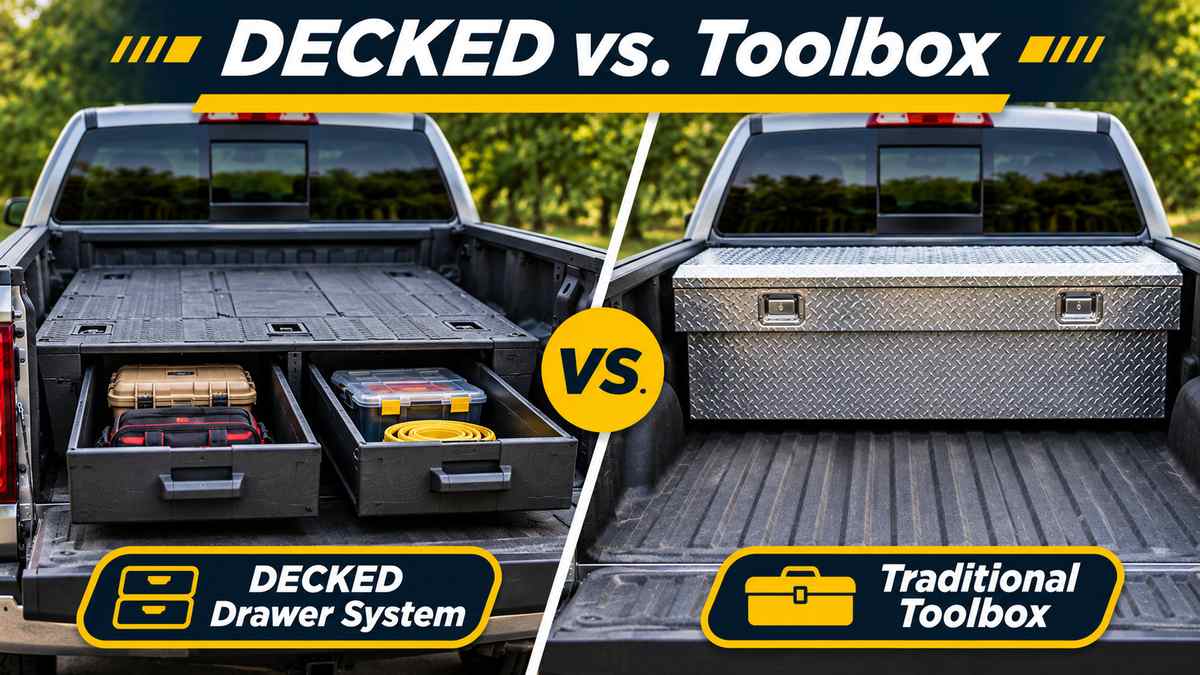
A drawer system usually places one or more enclosed drawers under a raised platform. The deck remains available for cargo, while the drawers separate tools and supplies below. Depending on the design, the drawers may span much of the bed width or be arranged in a different modular layout.
This setup is useful when you carry many smaller items and want a consistent place for each one. A mechanic might separate hand tools, diagnostic equipment, and consumables; a camper might keep recovery gear, cooking supplies, and repair kits apart. Drawers can also keep contents less exposed to view than items sitting on an open slide, although actual security depends on the locking design, tailgate, and the rest of the truck.
The trade-off is that the system takes up space and adds weight even when the drawers are empty. The deck raises the cargo floor, which can make tall objects harder to carry. Drawer systems also have their own limits: the deck’s payload rating is not necessarily the same as the rating for each drawer.
Our Best Truck Bed Drawer Systems guide covers product options and the differences between enclosed drawers and slide-out trays. Use it if you have decided on drawers and want to compare individual systems.
Loading Access and Everyday Use
A slide is convenient when the whole load needs to come to you
If you regularly load and unload bulky gear, a sliding platform can save repeated reaching and climbing. Pulling the deck toward the tailgate brings items from the front of the bed into easier reach. It can be particularly helpful when a bed cover or cap makes the front of the bed difficult to access.
However, the platform does not automatically organize the cargo. Cases can still shift or become stacked on top of one another, and you may need to move or strap down items before sliding the tray. Check the manufacturer’s instructions for loading, locking positions, and whether the tray must be retracted before driving.
Drawers are convenient when you need one specific item
With drawers, you can open the compartment containing the item you need without moving everything else on the deck. This is a strong advantage for work trucks carrying small tools, fasteners, straps, and parts. Dividers or removable organizers can improve the layout further, as long as they fit the drawer dimensions.
Drawer access still depends on extension length, drawer width, and how the system is mounted. Large objects may not fit inside the drawers, and gear stored on top of the deck may need to be moved if it blocks access to a drawer or its handle.
Load Ratings, Weight, and Cargo Type
Do not choose by comparing only the biggest advertised number. Sliding platforms are often rated for the load carried on the tray, while drawer systems can publish separate limits for the deck and individual drawers. These ratings describe different parts of the system and should not be treated as directly interchangeable.
For example, DECKED advertises some CargoGlide configurations with payload ratings up to 2,200 pounds, while its drawer system documentation lists a 2,000-pound evenly distributed deck payload for certain full-size systems. These are examples from one manufacturer’s product range, not universal category limits; available ratings depend on the specific configuration. Review the exact model page and installation manual before relying on any number.
Weight distribution matters as much as the headline rating. A concentrated load, heavy item with small feet, or cargo that shifts during travel can put stress on a smaller area. Follow the manufacturer’s directions for load distribution, restraints, and use, and never exceed the truck’s own payload rating, axle limits, or bed limitations. Adding a storage system also consumes some of the truck’s available payload.
Think about the shape of your typical cargo. A large compressor case or cooler may be better suited to an open slide, while many small tool cases may be easier to organize in drawers. Measure the cargo you carry most often rather than assuming that a high capacity guarantees a good fit.
Storage Layout and Usable Bed Space
A slide preserves an open platform, so it is flexible for changing loads. It can be easier to carry a mix of boxes, equipment, and irregularly shaped items, provided they fit the deck and can be secured safely. The slide mechanism itself occupies some vertical space, so compare total installed height—not just the tray thickness—if you use a tonneau cover or need to carry tall cargo.
A drawer system gives you two levels: enclosed storage below and a deck above. This is efficient if you want tools separated from cargo and prefer a flat surface for larger items. But the raised deck reduces the original bed depth, and items too tall to sit on the platform may no longer fit. The system is also a more permanent presence in the bed than a collection of portable boxes.
Neither design necessarily leaves the truck bed completely unchanged. Before buying, measure bed length, width between wheel wells, rail height, and clearance under any cover. Consider whether you need to haul sheet goods, tall equipment, or loads that require the original bed floor height.
Fitment, Installation, and Compatibility
Fitment is model-specific. Confirm the truck’s make, model year, bed length, bed shape, and existing accessories. A product advertised for a full-size pickup may not fit every generation or bed configuration. Check for conflicts with bed-mounted spare tires, fifth-wheel or gooseneck equipment, factory tie-downs, lighting, tailgate features, and tonneau-cover rails.
Slides may need mounting holes or specific brackets, and their extension can be limited by the tailgate or the space behind the truck. Drawer systems can be heavy and may require two people to install safely. Some systems are incompatible with drop-in liners or bed rugs because these change the bed’s shape; others may work with them. Check the manufacturer’s fitment guide rather than assuming all liners are compatible.
Some slide products are designed to mount on top of compatible drawer systems, but this is not universal. DECKED, for example, documents specific CargoGlide configurations and bracket requirements for drawer-system installations, and notes that certain extensions or payload versions cannot be mounted on drawers. Treat combined setups as a separate compatibility check, not a guaranteed feature of either category.
Cost and Long-Term Value
Price varies substantially by size, payload rating, extension, materials, and vehicle fitment. Heavy-duty sliding platforms and full drawer systems are both substantial accessories, so neither category is always the cheaper option. Compare current prices for products that actually fit your truck and have similar capacity and usable dimensions.
Include the cost of mounting hardware, installation, organizers, tie-downs, or a compatible cover. Also consider whether you can remove the system easily if you need the bed for a different job. A slide may be better value if the main problem is reaching bulky cargo. Drawers may justify their cost if you repeatedly spend time searching for tools and want a permanent organization system.
For long-term ownership, check warranty terms, replacement parts, cleaning instructions, and service requirements for moving components. A sliding mechanism needs to stay clear of debris and be maintained as directed; drawers and latches also need periodic inspection. Follow the manufacturer’s maintenance schedule for the specific product.
Which One Should You Choose?
Choose a truck bed slide if:
- You frequently load and unload bulky or heavy equipment.
- You want to bring a large section of cargo toward the tailgate instead of opening individual compartments.
- Your cargo changes often and needs an open, adaptable platform.
- You have checked the payload rating, extension, deck dimensions, and mounting requirements for your truck.
Choose a drawer system if:
- You carry many small or medium tools and supplies that benefit from dedicated compartments.
- You want to keep gear separated and less visible beneath a deck.
- You can accept added weight and a raised cargo floor.
- You have verified the drawer and deck capacities separately and confirmed bed-cover and liner compatibility.
Can you use both?
Some systems can be combined, with a compatible sliding platform mounted above drawers. This can provide enclosed storage below and a pull-out cargo surface above, but it adds cost and weight and is only suitable for approved configurations. Verify the exact slide, drawer system, brackets, payload rating, and fitment with the manufacturers before combining products.
Frequently Asked Questions
Is a truck bed slide the same as a drawer system?
No. A slide moves a platform carrying cargo toward the tailgate. A drawer system stores items inside enclosed compartments under a deck. Some products blur the terminology, so inspect the actual design and specifications instead of relying on the product title.
Which has a higher weight capacity?
There is no universal winner. Some heavy-duty slides support very large loads, while some drawer-system decks also have high evenly distributed payload ratings. Compare the exact product’s deck or tray rating, drawer rating if applicable, and the truck’s limits.
Can I install a cargo slide on top of a drawer system?
Some manufacturers support specific combinations, but compatibility depends on the slide model, extension, payload rating, brackets, and drawer system. Do not assume that every slide can be mounted on every drawer platform.
Do drawer systems keep tools dry?
Weather protection varies by product and installation. Some systems offer weather-resistant decks or seals, but no category-wide guarantee applies. Review the manufacturer’s documentation and do not assume complete waterproofing unless it is explicitly specified for the model.
Will either system work with a tonneau cover?
Possibly, depending on installed height, mounting rails, cover type, and the exact truck. Measure available clearance and check both manufacturers’ compatibility information before buying.
Final Verdict
A truck bed slide is the better fit when easy access to a large, flexible load surface is the priority. A drawer system is better when the goal is to keep tools and supplies sorted in enclosed compartments while retaining a deck above them. For daily work use, the deciding question is simple: do you most often need to bring the cargo closer, or find one specific item among many?
Before choosing, compare exact dimensions, ratings, fitment, installation, and total cost. Use our truck bed slide guide and drawer system guide to explore individual options after you decide which layout suits your truck and cargo.
Specifications and compatibility can change. Confirm current details with the manufacturer before purchasing or installing any truck-bed storage system.