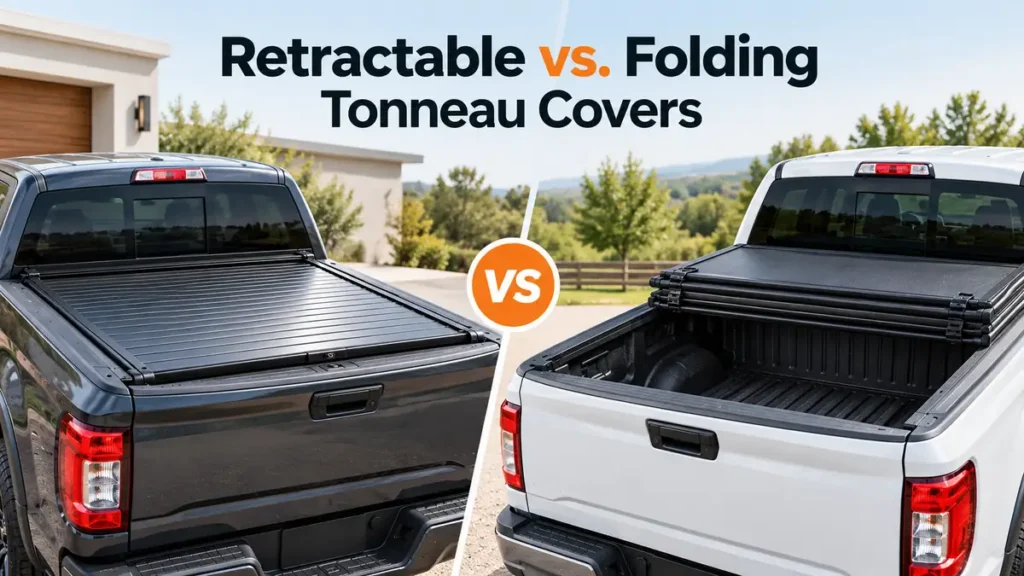
Retractable and folding tonneau covers both protect a pickup bed, but they open in different ways. A retractable cover slides along rails into a canister near the cab; a folding cover hinges into sections that stack toward the cab. That difference affects bed space, partial access, installation, maintenance, and price.
The best choice depends on the cargo you carry and how often you need to open the bed. Retractable systems can offer convenient intermediate opening positions, while folding covers avoid a front canister and are available in soft and rigid designs. Features vary by model, so compare the exact product and truck fitment before ordering.
Choose a retractable tonneau cover if you regularly open the bed and want to uncover different amounts of cargo space without folding panels. First confirm that the canister will not interfere with the items you haul.
Choose a hard folding tonneau cover if you want rigid panels, straightforward section-by-section access, and no canister at the front of the bed. Folded panels still occupy space near the cab and may affect rear visibility.
Neither style is automatically more secure or waterproof. Locking hardware, seals, drainage, installation, and fitment vary by model.
Retractable vs. Folding Tonneau Covers at a Glance
| Factor | Retractable | Folding |
|---|---|---|
| Opening method | Slides along rails into a front canister | Panels fold toward the cab |
| Partial access | Many models stop at multiple positions | Access depends on panel layout and latch design |
| Space when open | Canister remains in the bed | Folded panels occupy space near the cab |
| Construction | Often interlocking slats; materials vary | Soft fabric or rigid panels |
| Operation | Manual or powered | Usually manual |
| Maintenance | Rails, slats, canister and drainage paths | Hinges, latches, clamps, seals and panel alignment |
| Typical price position | Often premium, especially powered models | Broad range; soft and hard versions differ greatly |
| Best for | Frequent access and adjustable opening | Simple panel-based access and avoiding a canister |
This is a category-level comparison. A basic polymer retractable cover can differ significantly from a powered aluminum model, just as soft-folding and hard-folding covers have different trade-offs.
What Is a Retractable Tonneau Cover?
A retractable cover moves along side rails and stores in a canister mounted at the front of the bed. The cover is commonly made from connected slats, with materials and operating systems varying by model. Some are manually operated; others use an electric motor.
The main advantage is flexible access. Some models can be secured at different points along the bed, allowing you to uncover only the space you need. When opened, the cover moves out of the cargo area rather than leaving a stack of panels behind the cab.
The trade-off is the canister. It remains in the bed even when the cover is fully open, and its dimensions vary by product. On a short-bed truck, that can matter if you haul long boards, sheet goods, furniture, or other cargo that needs the full bed length. Rails may also affect compatibility with racks, cargo-management systems, or other accessories.
Retractable systems have moving parts that need to work together: rails, slats, seals, latches and sometimes drainage tubes or electrical components. Follow the manufacturer’s instructions for cleaning and maintenance; do not assume every model is maintenance-free.
What Is a Folding Tonneau Cover?
A folding cover uses connected panels that hinge toward the cab. The category includes soft covers made from flexible material over a frame and hard covers made with rigid panels. A tri-fold is one common arrangement, but folding covers can have other panel counts.
Folding designs can be convenient if you usually drive with the bed covered and occasionally need access. Depending on the model, you may fold one or more sections, secure the panels in an open position, or remove the cover for a large load. The approved open positions for driving vary, so check the exact instructions.
Hard folding covers provide a more substantial physical barrier than soft fabric covers, but rigid panels do not make a truck bed theft-proof. Security depends on the latch system, tailgate lock, installation, and construction. Weather resistance depends on seals, panel joints, drainage, and fitment.
When open, the folded stack uses space near the cab and may obstruct part of the rear view. Some covers can be removed to free the bed, but consider panel weight and storage before relying on that option.
The Differences That Matter Most
1. Everyday access
Retractable covers suit owners who regularly need different amounts of open bed space. If the model supports intermediate positions, you can uncover part of the bed without folding and securing a panel stack. Confirm the exact locking positions and operation in the product documentation.
Folding covers suit people who mostly keep the bed covered and open it in sections when needed. The mechanism is easy to understand, but the folded panels remain near the cab. If you regularly carry tall cargo, either style may need to be fully opened, secured or removed according to its manual.
2. Usable bed space
A retractable canister takes up a fixed amount of space at the cab end. A folding cover avoids that canister, but its panels occupy space when open. Which arrangement is less intrusive depends on your cargo and the specific design.
Before buying, compare the manufacturer’s canister or folded-stack dimensions with the items you carry. Measure your usable bed length and think about long, flat loads, toolboxes and racks.
3. Security
Hard retractable and hard folding covers can both provide rigid barriers, but the actual level of protection depends on panel construction, locks, latches, rail attachment and whether the tailgate can be locked. Soft folding covers generally offer less resistance to cutting than rigid designs.
Do not assume every retractable cover is more secure than every folding cover, or vice versa. For valuable tools, treat a tonneau cover as one layer of protection rather than a secure vault.
4. Weather protection
Both styles help shield cargo from rain, snow, road spray and dust, but neither should automatically be considered completely waterproof. Seals, joints, rails, drainage, the tailgate interface and correct installation all affect performance.
Retractable systems may route water through channels and drain tubes that need to be installed and kept clear. Folding covers rely on perimeter and panel-joint seals that can require adjustment or replacement. If cargo is moisture-sensitive, use suitable containers rather than relying on the cover alone.
5. Installation and compatibility
Neither type is universally easier to install. A folding cover may use rails, clamps, hinges and latches. A retractable system adds a canister and sliding mechanism, and some versions include drainage tubes or electrical connections. Installation difficulty depends on the truck and product.
Check compatibility using the exact model year, make, model, bed length and bed features. Factory cargo systems, liners, rail caps, sports bars and racks can affect fit. Read the manual before buying and confirm whether drilling, extra tools or a second person are recommended.
6. Maintenance and long-term value
Keep retractable rails and drainage paths clear and follow the manufacturer’s instructions for the canister and mechanism. Powered versions also have electrical components. Folding covers need periodic checks of hinges, latches, clamps, seals and panel alignment.
Retractable covers often sit toward the premium end of the market, particularly powered versions. Folding covers range from relatively affordable soft designs to premium hard-panel models. Compare the full installed cost, compatibility with accessories, warranty terms and likely maintenance—not just the advertised price.
Retractable vs. Roll-Up Tonneau Covers
Retractable and roll-up covers both move toward the cab, but the mechanisms are different. A retractable cover slides along rails into a canister. A roll-up cover typically rolls the cover material or connected slats toward the front of the bed, with the storage arrangement depending on the design.
Soft roll-up covers are often lighter and simpler; hard roll-up designs may use interlocking slats. Retractable covers can offer convenient intermediate positions, but the canister consumes bed space. Compare the specific product’s construction, security, operation, and fitment rather than choosing by the label alone.
See our best roll-up tonneau covers guide for a product-focused look at roll-up options.
Which Cover Should You Choose?
Choose a retractable cover if:
- You open and close the bed frequently.
- You want adjustable partial access without folding panels.
- You prefer a low-profile look and a cover that retracts out of the main cargo area.
- You have confirmed that the canister will not interfere with your usual loads.
- Your budget accommodates the model and installation.
Choose a folding cover if:
- You want rigid coverage without a front canister.
- You usually keep the bed covered and open it in sections.
- You prefer a panel-based mechanism.
- You want to compare hard-folding models at several price points.
- You may need to remove the cover for oversized cargo and can handle and store it safely.
If you are leaning toward a folding design, compare products in our best hard-folding tonneau covers guide. For general background, see our best truck bed covers guide.
Fitment and Buying Checks
- Exact truck configuration: Confirm model year, generation, bed length, tailgate and factory equipment.
- Canister or folded-stack dimensions: Compare them with your typical cargo and available bed space.
- Accessory compatibility: Check racks, utility tracks, bedliners and cargo-management systems.
- Driving positions: Read the manual to confirm whether and how the cover can be driven while open.
- Weather management: Review seals, drains and installation requirements.
- Warranty and support: Read the terms and exclusions for the exact application.
Frequently Asked Questions
Is a retractable tonneau cover better than a folding cover?
Not for every owner. Retractable covers suit frequent access and adjustable opening positions, while folding covers avoid a front canister and provide section-by-section access. Cargo habits, fitment and budget should decide.
Do retractable covers take up bed space?
Yes. The canister remains near the cab when the cover is open. Check its dimensions before buying, particularly if you haul long cargo.
Are folding tonneau covers more secure?
Hard folding covers provide a rigid barrier, but security depends on the specific panels, latches, tailgate lock and installation. The category name alone does not establish security.
Which style keeps water out better?
There is no universal winner. Seals, drainage, panel joints, installation and maintenance all matter. Follow the manufacturer’s guidance and do not assume either type is completely waterproof.
Can I drive with a folding cover open?
Only if the manufacturer permits that open position and the cover is secured exactly as instructed. Approved configurations vary by model.
Is a retractable cover the same as a roll-up cover?
No. Retractable covers slide along rails into a canister. Roll-up covers roll toward the cab, with storage details depending on the design.
Final Verdict
Choose a retractable tonneau cover if frequent access, flexible opening positions and a clean appearance matter most—and the canister does not interfere with your cargo. Choose a folding cover if you want rigid, practical coverage without a front canister and prefer section-by-section access.
Before buying either style, verify truck fitment, measure the space occupied when open, compare locking and drainage systems, and read installation and warranty instructions. The best cover is the one that fits your truck and cargo routine, not simply the one with the more complex mechanism.
Related WheelsWire guides: Best hard-folding tonneau covers · Best roll-up tonneau covers