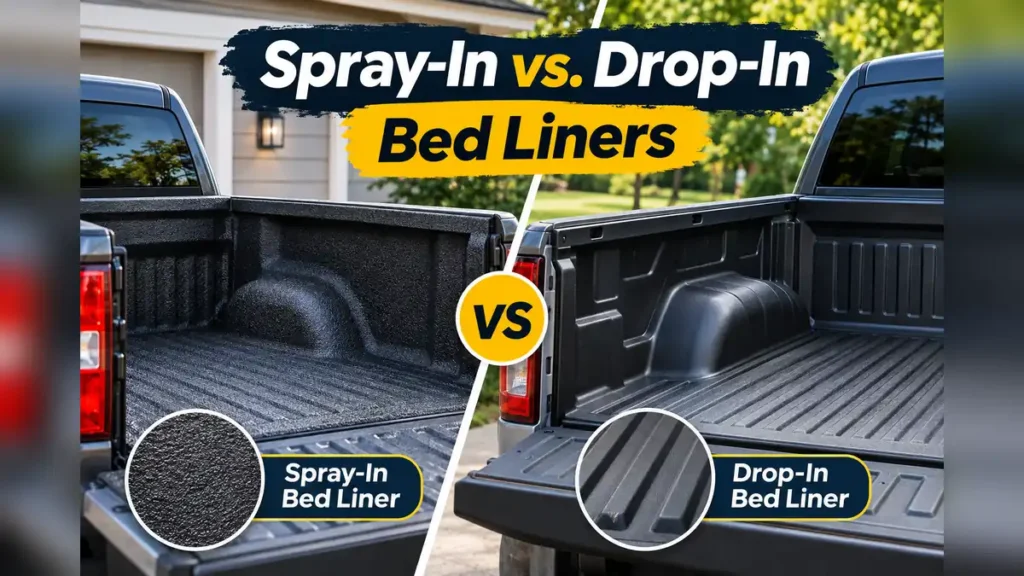
Choosing between a spray-in and a drop-in bed liner comes down to how you use your pickup, how much you want to spend up front, and whether you want a permanent coating or a removable insert. Both can help protect the factory bed from everyday cargo wear, but they work differently—and neither is automatically better for every truck.
Choose a spray-in bed liner if you want a bonded, low-profile coating that follows the bed’s contours and you plan to keep the truck for years. It usually costs more to have professionally applied, and proper surface preparation is critical.
Choose a drop-in bed liner if you value a removable system, a lower initial purchase cost, or the ability to inspect the metal underneath. Fitment, secure installation, and periodic cleaning beneath the liner matter because dirt and moisture can collect between the insert and the bed.
- Spray-In vs. Drop-In at a Glance
- What Is a Spray-In Bed Liner?
- What Is a Drop-In Bed Liner?
- Protection and Everyday Use
- Surface Preparation and Installation
- Reversibility, Repairs, and Maintenance
- Cost and Long-Term Value
- Warranty Considerations
- Which Type Should You Choose?
- Frequently Asked Questions
- Final Verdict
Spray-In vs. Drop-In Bed Liners at a Glance
| Factor | Spray-in liner | Drop-in liner |
|---|---|---|
| Design | Coating bonded to a prepared bed surface | Molded insert fitted inside the bed |
| Initial cost | Usually higher for professional installation | Often lower, depending on fit and material |
| Installation | Requires careful preparation, application, and curing | Requires correct fitment and secure installation |
| Reversibility | Difficult to remove completely | Generally removable |
| Fit around contours | Follows the prepared surface closely | Depends on the mold and vehicle-specific fit |
| Moisture management | No separate shell-to-bed gap, but chips and damaged areas still need attention | Moisture and debris may collect underneath if fit, drainage, or maintenance is poor |
| Repair approach | Damaged coating may need surface preparation and a compatible patch or reapplication | Some damage can be addressed by removing or replacing the insert |
| Best fit | Long-term ownership and a permanent, low-profile finish | Owners who want removability and easier access to the underlying bed |
These are category-level differences, not guarantees for every product. Spray-in formulas vary, and drop-in liners differ in material, coverage, fasteners, drainage design, and how closely they fit a specific truck bed.
What Is a Spray-In Bed Liner?
A spray-in bed liner is a protective coating applied directly to the truck bed after the surface has been prepared. Depending on the system, the material may be polyurethane, polyurea, or a related coating formulation. Once applied and cured, it creates a textured layer that follows the floor, sidewalls, corners, and other surfaces the installer coats.
Advantages of spray-in liners
- Low-profile coverage: Because the coating follows the bed’s shape, it does not add a separate molded shell or take up the same space as a thick insert.
- Continuous surface: A correctly applied coating can cover complex contours without the large seams of a multi-piece insert.
- Long-term convenience: There is no full liner shell to lift out for routine cleaning, although the coating still needs inspection and care.
- Choice of installation: Owners can use a professional installer or, where appropriate, a DIY kit designed for the task.
Limitations of spray-in liners
The main trade-off is commitment. The bed must be prepared correctly, and removing a bonded coating later can be labor-intensive. If the coating is chipped, peeling, or damaged, repairs depend on the specific material and the condition of the surface beneath it.
Professional application also raises the upfront cost. A DIY kit may reduce labor expense, but it still requires time, suitable working conditions, protective equipment, and careful compliance with the manufacturer’s instructions. Spraying is not simply a matter of pointing a gun at the bed: contamination, inadequate scuffing, poor masking, or incorrect curing conditions can affect adhesion and finish.
What Is a Drop-In Bed Liner?
A drop-in bed liner is a pre-formed insert that fits inside the truck bed. Most traditional versions are molded plastic, with designs shaped around a particular make, model, bed length, and sometimes model-year range. Depending on the kit, it may cover the floor, sidewalls, and tailgate.
Advantages of drop-in liners
- Removability: The insert can generally be removed for cleaning, inspection, or replacement, following its installation instructions.
- Lower initial expense in many cases: A molded liner can be less expensive than a professionally applied coating, though vehicle-specific pricing varies.
- No coating cure time: Installation does not involve spraying and curing a bed coating, although the manufacturer may provide specific fitting instructions.
- Replaceable protection: If an insert is badly damaged, replacement may be more straightforward than stripping a bonded coating.
Limitations of drop-in liners
Fitment is especially important. A liner made for the wrong bed length or generation may not sit correctly, cover the intended areas, or work with the truck’s tie-downs and other features. Even a correct insert must be secured as directed so it does not shift during use.
The space between the insert and the metal bed is the key maintenance concern. Dirt and moisture can get underneath, particularly if the liner is damaged, loose, or poorly fitted. That does not mean every drop-in liner causes rust; it means owners should follow the maker’s cleaning and inspection guidance rather than assuming the metal beneath is permanently protected.
Some manufacturers design channels or ribs to promote airflow and drainage. For example, Ford’s official accessory listing for certain Super Duty drop-in liners describes a ribbed floor intended to improve drainage and airflow between the liner and bed. Check the listing for your exact vehicle rather than assuming all inserts share the same design.
Protection and Everyday Use
Scratches, abrasion, and impacts
Both liner types provide a sacrificial layer between cargo and the original bed finish. A spray-in coating protects the surfaces to which it is properly bonded; a drop-in liner creates a separate barrier over the areas it covers. Neither makes the bed indestructible. Heavy or sharp cargo can still dent the metal, damage a coating, or crack an insert.
For frequent loading of tools, building materials, landscaping supplies, or equipment, consider the actual work you do. A textured coating can be useful across irregular surfaces, while a well-fitted insert can be replaced if its shell is damaged. Load-securing practices still matter whichever type you choose.
Traction and cargo movement
Texture varies widely between spray-in formulas and drop-in designs. Some textured coatings offer useful grip, while some hard plastic inserts can be relatively slick with certain loads. Other inserts use textured or ribbed surfaces. Do not assume the label alone tells you how much cargo will slide: check the actual surface and use tie-downs for loads that can move.
Weather and corrosion concerns
A sound spray-in coating can help separate the metal from water and contaminants, but scratches, chips, failed adhesion, and exposed areas should be inspected and repaired according to the coating maker’s instructions. A drop-in liner can also protect the bed, but the hidden interface between the shell and metal needs attention. Remove the liner only as the manufacturer allows, then clean and inspect the bed before reinstalling it securely.
Surface Preparation and Installation
This is one of the biggest differences between the two systems.
Installing a spray-in liner
Surface preparation is essential because the coating must bond to the intended substrate. Depending on the product and bed condition, the process may include washing, degreasing, removing loose rust or failing paint, scuffing the surface, removing dust, masking areas that must remain uncoated, and allowing the bed to dry fully. Professional installers use product-specific procedures and equipment; DIY users must follow the kit instructions precisely.
Do not coat over active corrosion or damaged metal without addressing it first. Also protect wiring, connectors, drains, latches, sensors, and other components that should not be covered. Ford has documented cases where aftermarket spray-in installation was associated with bed or tailgate electrical concerns when connectors were disconnected, damaged, or coated. That is a reason to use a qualified installer and to confirm that sensitive components are protected—not a claim that spray-in liners inherently cause electrical faults.
Installing a drop-in liner
Drop-in installation is usually more about fit, alignment, and fastening than surface coating. Confirm the exact truck application, inspect the bed before fitting, follow the specified sequence, and use all required fasteners or retainers. Make sure the liner does not interfere with tailgate operation, factory tie-down points, bed accessories, or drainage paths.
Never force an insert into place or improvise a mounting method that the manufacturer does not approve. If the liner has to be modified for fit, confirm with the manufacturer that the modification is acceptable before proceeding.
Reversibility, Repairs, and Maintenance
Can you remove it later?
A drop-in liner is the clear winner for reversibility. It is designed to be removed, although the exact process and fasteners depend on the product. A spray-in coating is intended to stay bonded to the bed; removing it can require substantial labor and may expose underlying paint or require refinishing.
What happens if it gets damaged?
With a spray-in liner, small damaged areas may be repairable, but the correct method depends on the coating chemistry, damage depth, and substrate. A patch should not be applied blindly over loose or contaminated material. Follow the original manufacturer’s repair instructions or ask the installer to assess the damage.
With a drop-in liner, minor scuffs may be cosmetic, while cracks, broken mounting points, or distorted areas may affect fit and protection. Some inserts can be replaced as a unit. After damage, check whether the shell still fits securely and whether debris or water can reach the bed beneath it.
Which is easier to maintain?
A spray-in liner is often simpler for routine sweeping and washing because there is no separate shell to lift out. It still needs inspection for damage. A drop-in liner can be easy to wash too, but thorough maintenance may require removing it periodically when permitted so the underlying bed can be checked and cleaned.
Cost and Long-Term Value
Drop-in liners commonly have a lower upfront price than professionally applied spray-in coatings. Spray-in pricing varies with truck size, bed condition, coating system, location, installer, and whether extra preparation or old-liner removal is needed. DIY spray kits can cost less than professional installation, but tools, protective equipment, preparation supplies, and the risk of a poor application should be included in the calculation.
There is no reliable single price that applies to every pickup. Get a quote for the exact vehicle and compare what is included: bed-floor and sidewall coverage, tailgate coverage, surface preparation, treatment of existing coatings or rust, cure time, and warranty terms.
For long-term ownership, a spray-in coating may be worth the additional expense if you prefer a bonded finish and do not expect to remove it. A drop-in liner may offer better value if removability is important, you want a lower initial cost, or you expect to replace the liner rather than restore a permanent coating. Resale value is not guaranteed to improve with either option, so choose based on protection, condition, and your intended use—not an assumed resale premium.
Warranty Considerations
Do not assume either style automatically preserves every part of the truck’s factory warranty or that an aftermarket liner automatically voids it. Warranty coverage depends on the vehicle manufacturer’s terms, the product’s own warranty, the installation, and what caused the failure.
Ford’s warranty guidance distinguishes factory-option bedliners from aftermarket products, and Ford service communications note that damage caused by an aftermarket product or its installation may not be covered by the vehicle warranty. The practical takeaway is to read the warranty documents for your exact truck, ask the dealer about relevant requirements before installation, and keep the liner invoice and installation records. Separately, review the liner manufacturer’s warranty for exclusions involving preparation, misuse, damage, and unauthorized repairs.
Which Type Should You Choose?
Choose a spray-in liner if…
- You plan to keep the truck for a long time.
- You want a low-profile coating that follows the bed’s contours.
- You prefer not to remove a full liner shell for routine cleaning.
- You are comfortable paying for professional application or doing the preparation and application work correctly yourself.
Choose a drop-in liner if…
- You want a removable system and easy access to the original bed.
- You prefer a lower upfront cost where the fitment and product quality make sense.
- You want the option to replace the liner if it becomes cracked or badly worn.
- You are willing to inspect beneath the liner and keep it correctly secured.
Before you buy either type
- Confirm the truck’s model year, bed length, cab configuration, and factory bed features.
- Inspect existing paint, rust, dents, holes, or an old liner before covering the bed.
- Check whether the liner covers the tailgate and sidewalls or only the floor.
- Ask how the product handles tie-down points, drains, sensors, wiring, and bed accessories.
- Read installation, maintenance, repair, and warranty instructions before purchase.
If you are still deciding which bed-protection approach fits your truck, our Best Truck Bed Liners guide covers broader options. For spray-applied DIY products, see Best Spray-In Bed Liners; for a different DIY coating method, see Best Roll-On Truck Bed Liners. For the basic definitions and differences between liner types, read What Is a Truck Bed Liner? If you are preparing to fit a liner yourself, our truck bed liner installation guide covers the general process.
Frequently Asked Questions
Is a spray-in bed liner better than a drop-in liner?
Not for every owner. Spray-in liners are a strong fit for permanent, low-profile coverage, while drop-in liners are better for removability and often have a lower initial cost. The right choice depends on how you use and maintain the truck.
Can a drop-in bed liner cause rust?
Rust is not inevitable, but moisture and debris trapped between the liner and metal can contribute to corrosion if the bed is not maintained. Correct fitment, intact fasteners, drainage, and periodic inspection help reduce the risk.
Can you remove a spray-in bed liner?
Yes, but removal is generally much more difficult than lifting out a drop-in insert. It may require specialized labor and can affect the underlying finish. Ask the original installer about repair or removal before attempting it.
Does a spray-in liner protect against dents?
It can help protect the surface from scratches and abrasion, but it cannot prevent every dent or structural impact. Heavy cargo can still deform the metal beneath a liner.
Can I install a spray-in liner myself?
Some products are sold as DIY kits, but they require careful preparation, the right equipment, suitable ventilation and protective equipment, and adherence to mixing, application, and curing instructions. If you are unsure about surface preparation or protecting vehicle components, use a qualified installer.
Does a drop-in liner need to be removed for cleaning?
Follow the liner maker’s maintenance instructions. Periodic removal or lifting may be appropriate for cleaning and inspecting the bed, but the process should not damage fasteners, wiring, or the insert itself.
Final Verdict
For a truck you plan to keep and use regularly, a properly prepared and applied spray-in liner is a good choice when you want a permanent, contour-following protective surface. A drop-in liner makes more sense when you want removable protection, easier access to the underlying bed, and the option to replace the insert later.
Whichever route you choose, fit and installation quality matter as much as the liner category. Inspect the bed first, verify vehicle-specific compatibility, protect drains and electrical components, and follow the manufacturer’s maintenance guidance. That is the best way to get useful protection without creating avoidable problems.