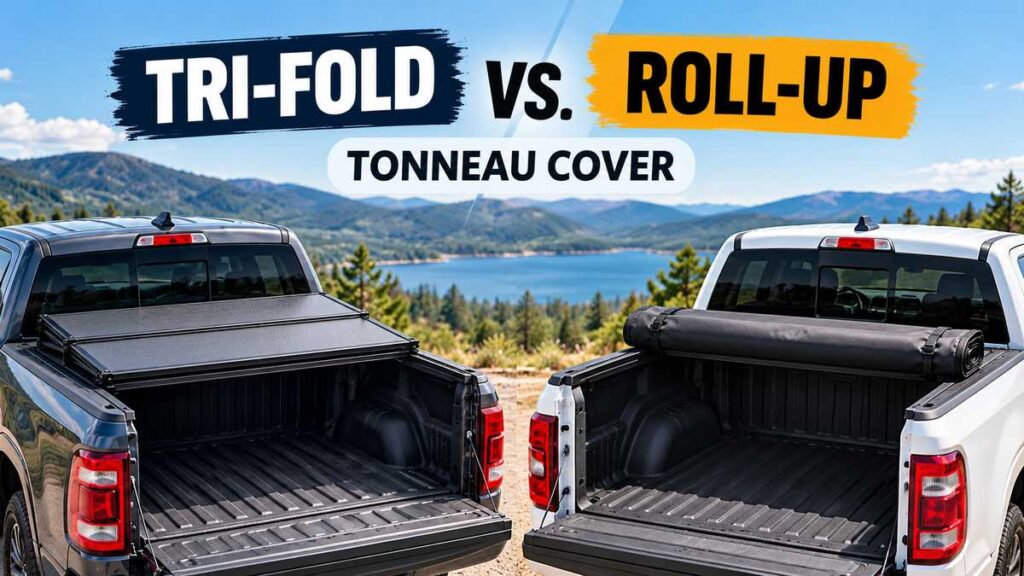
Choosing between a folding and a roll-up tonneau cover mostly comes down to how you use your truck bed. Folding covers open in hinged panels—tri-fold designs are especially common—while roll-up covers gather toward the cab. Folding designs can make quick partial access convenient; roll-up designs often provide a clearer opening for bulky cargo. The best option depends on your preferred access, the space the open cover occupies, and the exact cover construction.
One important detail: both styles are available in soft and hard versions. A soft tri-fold and a hard tri-fold can differ substantially in security, weight, and price; the same is true of soft and hard roll-up covers. Compare construction as well as opening style instead of assuming all covers in one category perform the same way.
Quick Answer: Folding or Roll-Up?
Choose a folding tonneau cover if you often need quick partial access, prefer opening the cover in sections, and are comfortable with the folded panels taking up space near the cab. Choose a roll-up tonneau cover if you frequently carry taller or longer cargo and want the cover rolled out of the way along the front of the bed.
For security, compare hard and soft construction—not just folding versus rolling. Rigid-panel designs generally resist cutting better than flexible vinyl, while weather protection depends on seals, drainage, fitment, installation, and the exact model. Neither style should be treated as completely waterproof or theft-proof.
Folding vs. Roll-Up Tonneau Covers at a Glance
| Factor | Folding cover | Roll-up cover |
|---|---|---|
| How it opens | Panels fold forward toward the cab | Cover rolls toward the cab |
| Partial bed access | Usually quick: fold back one or more panels | Unlatch and roll back the amount needed, then secure it as instructed |
| Full bed access | Depends on the model; some folded stacks still restrict access or visibility | Often provides a more open bed once rolled and secured |
| Space used when open | Folded panels form a stack near the cab | Rolled cover forms a bundle near the cab |
| Security | Depends heavily on soft versus hard construction and latch design | Depends heavily on soft versus hard construction and locking design |
| Weather sealing | Panel joints add sealing points on folding models | Long side seals and end seals matter; design varies |
| Installation | Often clamp-mounted, but model instructions vary | Often clamp-mounted, but model instructions vary |
| Cost | Soft versions are often budget-friendly; hard versions cost more | Soft versions are often budget-friendly; hard slatted versions can be premium-priced |
What Is a Folding Tonneau Cover?
Folding tonneau covers use hinged panels that fold toward the cab. Some use two panels, while tri-fold designs use three. The number of panels and the way they secure when open affect how much of the bed is accessible. For a tri-fold example, you release the latches and fold the rear section toward the cab, usually followed by the middle section. To open it, you release the latches and fold the rear section toward the cab, usually followed by the middle section. Depending on the design, the cover may remain folded in a partially open position or be secured farther forward. Some hard tri-fold models are designed to tilt or fold fully upright, but that is not a feature to assume without checking the manufacturer’s instructions.
Advantages of folding covers
- Fast partial access: Folding back one section can be convenient when you need to reach a bag, tool case, or smaller item without opening the entire bed.
- Simple operation: The hinged panels make the opening sequence straightforward once you learn the latches and support straps.
- Many material choices: Soft tri-folds can be relatively lightweight and affordable, while hard tri-folds use rigid panels for added resistance to cutting and a more solid surface.
- Neat folded position: The cover stacks near the front of the bed rather than forming a long roll.
Trade-offs to consider
- The folded stack occupies space: Panels remain at the cab end and may limit how far forward cargo can be loaded.
- Access depends on the design: Some covers expose only part of the bed when folded. A fully open position may require extra steps or removal.
- Visibility can be affected: When folded upright against the cab, some models may obstruct part of the rear window. Follow the product’s driving-position instructions.
- Hard models can be heavy: Panel construction and size affect handling, and removal may be easier with a second person.
If you are leaning toward a rigid folding design, see our guide to the best hard-folding tonneau covers. For an overview of other styles, start with our best truck bed covers guide.
What Is a Roll-Up Tonneau Cover?
A roll-up tonneau cover uses a flexible sheet or a linked set of slats that rolls toward the cab. Soft versions typically use vinyl or another flexible material stretched over a frame. Hard roll-up designs use rigid interlocking slats or similar reinforcement beneath an outer layer. These constructions differ in weight, cost, security, and how compactly the cover rolls.
Advantages of a roll-up cover
- Broad bed access: When rolled fully and secured, many models leave most or all of the bed opening clear, which is useful for taller cargo or larger items.
- No stack of folding panels: The cover gathers into a roll near the cab rather than stacking several rigid sections.
- Useful for frequent hauling: Owners who regularly load and unload bulky items may appreciate having the cover out of the way without removing it.
- Range of constructions: Soft roll-ups are often lightweight and lower-cost; hard roll-ups offer a more reinforced design at a higher price.
Trade-offs to consider
- Full opening takes a few steps: You generally need to release the latches, roll the cover, and secure it in the open position according to the instructions.
- Partial access may be less convenient: A tri-fold lets you open a specific section. With a roll-up, you may need to roll more of the cover away to reach an item near the front.
- Soft material needs care: Flexible covers can wear, stretch, or be cut more easily than rigid panels. Correct tension and cleaning matter.
- Hard roll-ups can cost more: Slatted designs add components and complexity, so compare current prices and warranty terms for the exact fitment.
See our dedicated guide to the best roll-up tonneau covers for product-specific options.
Bed Access and Storage Position
Bed access is often the biggest practical difference between the two styles. A tri-fold cover is handy when you only need to uncover a portion of the bed. Fold one section back and you may be able to retrieve an item without moving the entire cover. This is useful for daily cargo such as groceries, tool bags, or smaller equipment stored near the tailgate.
A roll-up cover is often more convenient when the goal is to open up the bed for a bulky load. Once rolled toward the cab and strapped securely, it can leave fewer obstructions across the bed opening. The roll still occupies some space near the front, and the amount of usable access depends on the cover’s design and how it is secured.
Think about what you haul most often. If your loads are short and you regularly need quick access to one section, a tri-fold may be more convenient. If you often carry tall items, large boxes, or equipment that needs a broad opening, a roll-up may be a better fit. Always check whether the open cover blocks the rear window and whether the manufacturer permits driving in that position.
Weather Sealing: Which Keeps Water Out Better?
Neither design is automatically more waterproof. Tri-fold covers have seams or hinges between panels, so the quality and placement of seals around those joints matter. Roll-up covers rely on perimeter seals and, on soft designs, material tension and the way the edges attach to the rails. Both styles also need suitable sealing near the cab and tailgate, and some systems use drainage channels or tubes.
Real-world results depend on the specific model, truck bed shape, installation, and weather. Water can enter through gaps at the tailgate or bed rails even when the cover itself is in good condition. Treat most tonneau covers as weather-resistant rather than guaranteed waterproof. If keeping sensitive equipment dry is important, review the manufacturer’s sealing instructions and use waterproof containers for items that cannot get wet.
If your existing cover leaks, our guide to common tonneau cover leaks and fixes can help you investigate the likely causes.
Security: Does Folding or Rolling Make a Difference?
Construction matters more than the opening method alone. A soft tri-fold and a soft roll-up both use flexible material that can be cut, so they primarily conceal cargo and discourage casual access rather than provide a strong security barrier. Rigid-panel tri-folds and hard slatted roll-ups generally offer more resistance to cutting, although the exact latches, locks, rails, and tailgate arrangement vary.
Do not assume a cover has an independent lock simply because it is described as hard. Some rely on latches that secure when the tailgate is closed; others have specific locking features. Check how the exact cover secures to the bed and pair it with a locked tailgate when appropriate. No tonneau cover makes valuables completely theft-proof.
Installation, Removal, and Everyday Use
Both tri-fold and roll-up covers commonly use rails and clamps, but installation details vary by truck and model. Confirm the correct model year, bed length, and bed configuration before ordering. Bed liners, rail caps, utility tracks, and other accessories can affect fitment or installation steps. Never assume a cover is a no-drill installation without checking the instructions.
Soft versions are often easier to lift and remove because they weigh less. Hard versions may be heavier, although some have quick-release hardware. If you expect to remove the cover frequently, compare its removal procedure and storage requirements—not only the time needed for initial installation.
For step-by-step preparation, see how to measure your truck bed for a cover and how to install a tonneau cover.
Cost and Long-Term Value
Price varies widely with construction, brand, fitment, materials, and features. Soft tri-fold and soft roll-up covers are commonly positioned toward the more affordable end of the market. Hard tri-fold covers typically cost more because of their rigid panels and hardware, while hard roll-up models with interlocking slats can also reach premium price points. Current prices should be compared for covers made for the same truck and bed length.
Think about value in terms of use rather than purchase price alone. A lower-cost soft cover may be sensible if your main goals are concealing cargo, reducing direct exposure to rain, and opening the bed occasionally. Paying more for a hard design may make sense if you need better resistance to cutting or a more rigid cover. Choose a style you will use comfortably every day, and compare warranty coverage, replacement parts, and maintenance instructions before deciding.
Which One Should You Choose?
Choose a folding tonneau cover if:
- You often need quick access to only part of the bed.
- You prefer folding panels over rolling a cover back and securing it.
- You want to compare a wide range of soft and hard folding options.
- The folded stack near the cab will not interfere with the cargo you usually carry.
Choose a roll-up tonneau cover if:
- You frequently need a broad, unobstructed bed opening.
- You carry tall or bulky items and want the cover to roll out of the way.
- You prefer a roll at the cab instead of a stack of panels.
- You have checked the open-position restraints, fitment, and sealing design for the exact model.
Frequently Asked Questions
Is a tri-fold cover more secure than a roll-up cover?
Not necessarily. A hard tri-fold may be more resistant to cutting than a soft roll-up, but a hard roll-up can also use reinforced slats. Compare the actual construction and locking system rather than the cover’s opening style alone.
Which gives better access to the full truck bed?
A roll-up cover often leaves a clearer opening when rolled fully toward the cab. Some tri-fold models can also provide extensive access, but folded panels may occupy space or affect rear-window visibility. Check the specific model’s open position.
Are folding tonneau covers easier to open?
They can be more convenient for quick partial access because you fold back one panel at a time. A roll-up can be more convenient when you want to open most or all of the bed. The latches and assistance features on the exact model also affect ease of use.
Which type is more waterproof?
Neither type is guaranteed waterproof. Seal design, panel joints, side rails, drainage, installation, and the truck’s tailgate gap all affect water intrusion. Review the manufacturer’s weather-sealing details for the model you are considering.
Can I carry cargo on top of either cover?
Only if the manufacturer explicitly provides a load rating and instructions for that exact cover. Do not assume a rigid-looking panel can support weight, and never exceed the stated limit or use the cover as a step.
Do these covers fit every pickup?
No. Covers are made for specific truck years, models, bed lengths, and configurations. Check compatibility before ordering, especially if your truck has a bed liner, rail caps, or factory utility tracks.
Final Verdict
A folding tonneau cover is a strong choice for drivers who value quick partial access and a panel-based opening action; tri-fold models are one common option. A roll-up tonneau cover is often better for drivers who regularly need a broad opening for bulky cargo and want the cover gathered near the cab. Neither is universally better: compare soft and hard constructions separately, check how the open cover is secured, and inspect the sealing system and fitment requirements.
For product-specific recommendations, visit our guides to hard-folding tonneau covers and roll-up tonneau covers. You can also compare other styles in our best truck bed covers guide.
Research references: RealTruck’s roll-up vs. tri-fold comparison and TruckPowerUp’s comparison guide. Features vary by product, so check the manufacturer’s current instructions and specifications.