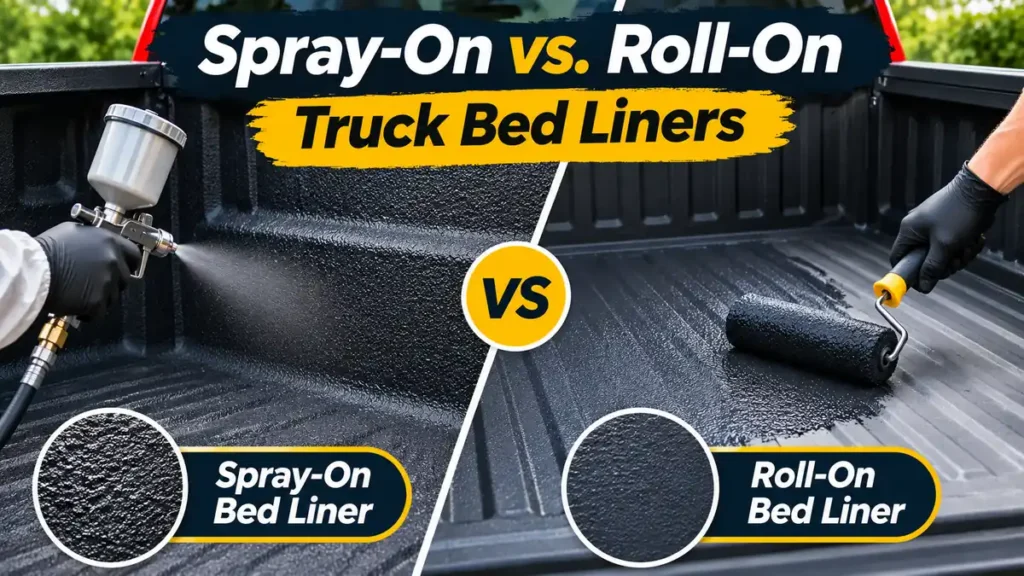
When comparing a spray-on vs. roll-on bed liner, the biggest difference is how the coating is applied—not a guarantee that one formula is automatically tougher. Spraying can create an even finish across complex contours, especially in a professional shop, while rolling gives DIY owners more control with simpler equipment. Surface preparation, coating chemistry, application thickness, and cure conditions often matter as much as the tool.
Choose a professionally applied spray-on liner if you want a consistent, low-profile finish and prefer to leave surface preparation and application to an experienced installer. Ask about the coating system, warranty, preparation process, and cure time.
Choose a roll-on liner if you want a DIY project with less specialized equipment and are comfortable cleaning, sanding, masking, applying multiple coats, and waiting for a full cure. A careful roll-on application can be useful, but results vary by product and technique.
- Spray-On vs. Roll-On at a Glance
- What Does Spray-On Bed Liner Mean?
- What Is a Roll-On Bed Liner?
- Surface Preparation and Application
- Finish, Coverage, and Durability
- Cost: DIY vs. Professional Bed Liner
- Safety, Drying, and Cure Time
- Which Method Should You Choose?
- Frequently Asked Questions
- Final Verdict
Spray-On vs. Roll-On Bed Liners at a Glance
| Factor | Spray-on | Roll-on |
|---|---|---|
| Application | Spray gun, aerosol, or other product-specific spray system | Roller, often with a brush for corners and edges |
| Typical user | Often a professional installer; some products are DIY | Commonly a DIY owner |
| Equipment | May require specialized spray equipment and masking | Usually basic roller and brush tools, depending on the kit |
| Finish | Can be uniform across contours when applied correctly | Can show roller texture or overlap if application is uneven |
| Surface preparation | Critical; the exact steps depend on the coating and substrate | Also critical; cleaning, deglossing/scuffing, and masking are commonly required |
| Cost | Professional installation usually includes labor and equipment | Often lower initial outlay for a DIY kit, but tools and preparation supplies add cost |
| Skill and effort | Professional work reduces DIY labor; DIY spraying still needs skill and control | Less specialized equipment, but careful prep and even coverage take time |
| Durability | Depends on chemistry, thickness, adhesion, preparation, and use | Depends on chemistry, thickness, adhesion, preparation, and use |
This is a comparison of application methods, not a claim that every spray-on product outperforms every roll-on product. Read the technical instructions for the exact coating you plan to use.
What Does Spray-On Bed Liner Mean?
“Spray-on” can refer to several different products and services. A professional shop may apply a two-component polyurethane or polyurea-style coating with dedicated equipment. Consumer products may use an aerosol can, a sprayable coating, or a kit designed for a particular applicator. These products are not interchangeable, and their preparation, film thickness, texture, cure time, and warranty can differ substantially.
A properly applied spray coating can follow the bed floor, sidewalls, wheel wells, and other contours without the roller having to reach into every recess. A trained installer can also control the spray pattern and build coverage in layers. However, the final quality still depends on the product system, operator skill, correct mixing where required, and a properly prepared surface.
Potential advantages
- Coverage around contours: Spraying can reach shaped areas and corners that are awkward to roll, provided they are masked and prepared correctly.
- Consistent texture: A skilled applicator can produce a more uniform appearance across large areas.
- Professional installation option: Owners who do not want to perform the prep and coating work can pay an installer to handle the process.
Potential drawbacks
- Equipment and setup: Some systems need specialized equipment, careful mixing, masking, ventilation, and controlled application conditions.
- Overspray risk: Nearby paint, glass, wiring, plugs, latches, and accessories must be protected.
- Installer dependence: A poor application or inadequate preparation can undermine the result even when the coating itself is capable.
What Is a Roll-On Bed Liner?
A roll-on bed liner is a liquid protective coating spread with a roller, often using a brush for corners and tight areas. Many kits are intended for DIY use and include at least some of the application tools. Formulations vary: some are rubberized, while others use different resin or polymer systems. Do not assume all roll-on coatings share the same texture, chemical resistance, flexibility, or cure schedule.
Rolling gives the user direct control over how much product is loaded onto the roller and how each section is covered. It can be practical for someone who has the time to prepare the bed and follow the kit instructions closely. The trade-off is that uneven loading, rushing between coats, or missing recesses can lead to a patchy appearance or inconsistent coverage.
Potential advantages
- DIY accessibility: Many kits use common hand tools rather than a professional spray rig.
- Manageable setup: There is no spray pattern to control, although masking and ventilation remain important.
- Hands-on control: The applicator can work carefully around edges and correct missed spots while the coating is still within its working time.
Potential drawbacks
- Labor-intensive preparation: The bed still needs thorough cleaning, drying, scuffing or deglossing as specified, and masking.
- Visible application texture: Roller marks or overlap may show, especially if the product is applied inconsistently.
- Time and cure requirements: Multiple coats may be required, with specified intervals between coats and a longer wait before heavy use.
Surface Preparation and Application
Preparation is one of the most important parts of either method. A coating cannot reliably compensate for grease, wax, loose paint, active rust, moisture, or a surface that the product was not designed to bond to. Manufacturer instructions differ, so use the exact product’s label and technical documentation rather than combining steps from unrelated kits.
Typical spray-on workflow
- Inspect the bed and address rust, damage, loose coatings, or contamination as directed.
- Wash and degrease the surface, then allow it to dry fully.
- Scuff, sand, or otherwise prepare the substrate as required by the coating system.
- Mask paint, trim, drains, electrical components, fastener holes, and any area that must remain uncoated.
- Apply the product using the specified equipment, mixing ratio, passes, and film build.
- Allow the coating to cure under the stated temperature and humidity conditions before loading the bed.
Professional installation may include additional steps specific to the coating and truck. Ask the shop what it will do about existing rust, previous coatings, bed accessories, and protected components. If the bed has corrosion or damage, confirm how that will be treated before the coating is applied.
Typical roll-on workflow
- Remove loose debris and clean the bed thoroughly; remove oil, grease, wax, and residues as directed.
- Allow the bed to dry, then scuff or sand the intended coating area as specified by the manufacturer.
- Mask the edges and protect drains, bolt holes, lights, trim, and adjacent paint.
- Mix or activate the coating exactly as instructed, if the product requires it.
- Brush corners and hard-to-reach areas, then roll the larger surfaces with even coverage.
- Apply the required number of coats and respect the recoat window and full cure time.
For example, Herculiner’s roll-on instructions call for cleaning, scuffing glossy paint, solvent wiping, and applying two coats. Rust-Oleum’s professional-grade kit also specifies surface preparation, protective equipment, and a defined coating and curing process. These examples illustrate why you should follow the instructions for your specific product; they are not universal directions for every bed liner.
Finish, Coverage, and Durability
Which gives a better finish?
Spraying often has an advantage when the goal is an even texture across complex contours, especially with professional equipment and an experienced applicator. Rolling can still create a useful, textured finish, but the appearance may reveal the roller’s stipple or overlap between sections. Product chemistry and applicator technique make a difference, so compare examples of the exact coating system rather than relying only on the words “spray-on” or “roll-on.”
Which lasts longer?
There is no universal winner. Durability depends on the coating formulation, adhesion, surface preparation, applied thickness, cure conditions, sun exposure, cargo abrasion, chemicals, and maintenance. A well-prepared roll-on coating can outperform a poorly prepared spray application; likewise, a professionally applied system may deliver a more consistent finish than a rushed DIY job. Do not treat a product’s advertised performance claim as a direct comparison unless the products were evaluated using comparable methods.
Can either method prevent rust?
A suitable coating can help shield a properly prepared metal bed from moisture and abrasion, but it is not a substitute for treating existing corrosion or repairing damaged metal. If the coating chips, peels, or is breached, follow the maker’s inspection and repair guidance. Do not simply cover active rust unless the product instructions explicitly support that use.
Cost: DIY vs. Professional Bed Liner
A DIY roll-on kit commonly has a lower upfront cost than hiring a professional to spray a bed, because you are doing the labor and using simpler application tools. But the kit price is not the full project cost. You may need abrasives, cleaners, masking materials, gloves, eye protection, suitable ventilation, and extra coating for a larger bed. Mistakes can also mean buying more material or repeating part of the work.
Professional spray-on pricing varies with truck size, coating system, bed condition, old coating removal, repair needs, location, and installer. Ask for a written quote that states what areas are covered, how the surface will be prepared, how rust or old coatings will be handled, how long the truck must stay at the shop, and what the warranty covers.
For a fair comparison, get a professional quote and add up all the supplies and time required for the DIY alternative. Avoid comparing the cheapest aerosol product with a premium professional coating as though they were equivalent systems. They may be intended for different use cases and have different application requirements.
Safety, Drying, and Cure Time
Both methods require attention to product safety. Follow the label and safety data sheet, use the specified gloves and eye protection, and provide the ventilation the product requires. Some products involve solvents or reactive components; vapors can be hazardous and flammable. Do not spray or roll a product in an enclosed space unless its instructions expressly describe suitable controls. Keep ignition sources away wherever the product requires it, and do not improvise respiratory protection.
Dry-to-touch time is not necessarily full cure. A coating may feel dry before it is ready for heavy cargo, dragging sharp equipment, exposure to water, or chemical contact. Temperature and humidity can change the schedule. Follow the exact recoat interval and return-to-service time on the product instructions instead of assuming all bed liners cure overnight.
Which Method Should You Choose?
Choose professional spray-on if…
- You want a consistent finish across the bed’s contours.
- You prefer to pay for installation rather than do the preparation and coating yourself.
- You have access to a reputable installer who explains the coating system, surface prep, cure time, and warranty.
- You are comparing a professional system with a DIY option and the additional cost fits your priorities.
Choose roll-on if…
- You want to complete the job yourself with a kit designed for roller application.
- You can set aside enough time for thorough prep, multiple coats if required, and full curing.
- You are comfortable following chemical-handling and ventilation instructions.
- You accept that the finish depends on your technique and the particular product.
Before buying
- Check that the product is suitable for your truck bed material and existing finish.
- Read the full instructions and safety information before opening the kit.
- Confirm coverage per kit for your bed length and the required number of coats.
- Check the warranty, exclusions, repair method, and conditions for professional installation if relevant.
- Plan around temperature, humidity, ventilation, rain, and the time the truck must remain out of service.
If you want to compare specific options, see our Best Spray-In Bed Liners and Best Roll-On Truck Bed Liners guides. For a broader overview of liner types, read What Is a Truck Bed Liner? If you plan to handle installation yourself, our truck bed liner installation guide covers the broader process.
Frequently Asked Questions
Is spray-on bed liner better than roll-on?
Not in every case. Spray-on application can create an even finish across complex shapes, particularly when handled by a skilled professional. Roll-on products can be practical for DIY owners. The formula, prep, application quality, and cure matter more than the method name alone.
Is roll-on bed liner as durable as professional spray-on?
It depends on the products being compared and how each is applied. Without comparable testing of the exact formulas and application conditions, it is not accurate to say all roll-on coatings are as durable—or less durable—than all professional spray-on systems.
Can I spray a roll-on bed liner product?
Only if the manufacturer explicitly allows that application method and specifies compatible equipment and safety procedures. Do not thin or spray a product just because it appears liquid enough to use in a sprayer.
Does a DIY bed liner void the truck warranty?
Do not assume it automatically voids the entire vehicle warranty. Coverage depends on the warranty terms and whether a product or its installation caused a problem. Review your truck manufacturer’s warranty and the liner maker’s terms before installation.
How long should I wait before using the truck bed?
Use the product’s instructions for the exact recoat, drying, and full-cure times. These can differ by formula and environmental conditions, and heavy use may require a longer wait than light handling.
Final Verdict
Spray-on and roll-on bed liners are application approaches, not a simple ranking of quality. A professional spray application is a strong choice when consistent coverage and less hands-on work matter most. A roll-on kit makes sense when you want a DIY project and can commit to careful preparation, safe application, and the full cure period. Compare the actual coating systems, instructions, warranty, and total cost before deciding.